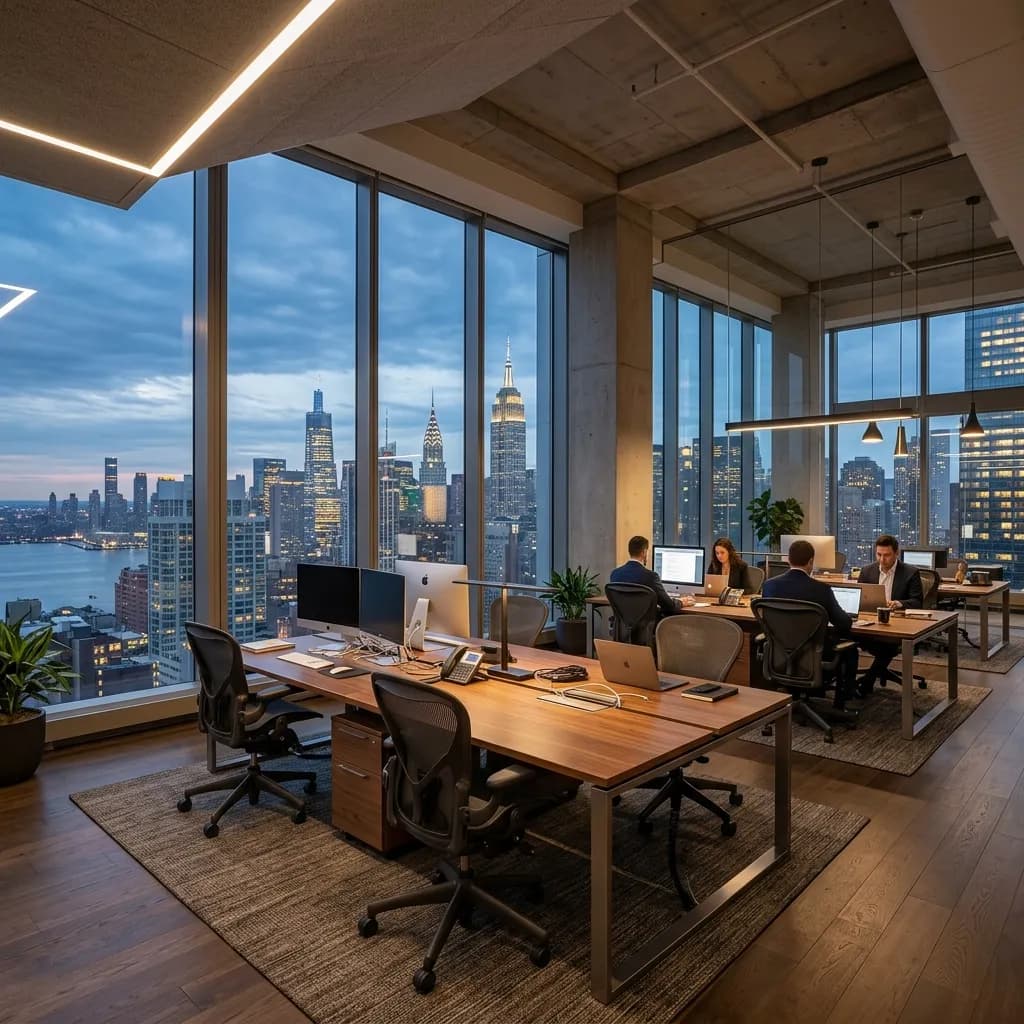
Letting commercial space: why the virtual tour takes over the pre-selection
With office and commercial space every viewing costs several hours – on both sides. Pre-selection therefore belongs up front.
With residential property a viewing is half an hour. With commercial space it is half a day – travel, several participants, coordinating diaries between management, facility staff and external advisers.
That is precisely why pre-selection is the real bottleneck in commercial lettings. Moving it forward saves considerably on both sides.
What commercial tenants actually want to know
The questions differ fundamentally from residential letting:
- How many workstations actually fit?
- What grid dimensions and column spacing apply?
- Where are the load-bearing walls, where can the space be divided?
- How is access organised – lifts, stairwells, escape routes?
- What clear height is available, what sits in the suspended ceiling?
- How are deliveries and manoeuvring organised?
None of these can be answered with photos. A floor plan helps but demands spatial imagination not every decision-maker has.
What the tour achieves
A walkable 3D tour answers these questions without anyone travelling. The prospect moves freely through the space, sees layout and access in context and – the decisive point with commercial space – can measure directly in the model.
Grid dimensions, clear heights, window band widths and distances can be taken and transferred into their own planning. An interior designer preparing a space plan no longer needs a site visit for it.
The effect on the process
In practice the sequence shifts markedly. Instead of five viewings with three hopeless candidates, two appointments take place with serious prospects who already know what they are getting into.
That works in both directions: you save time, and so does the prospect. With enquiries from other regions the tour is frequently the precondition for a candidate considering the journey at all.
Vacancy is the real problem
An empty office floor looks inhospitable in photos and in the tour alike – bare walls, raw flooring, no furnishing. Prospects see space, not our future office.
Virtual office staging solves this by digitally populating the floor with workstations, meeting areas and circulation. The benefit is less aesthetic than informational: the prospect sees that 42 workstations plus two meeting rooms genuinely fit. That is the figure the decision turns on.
Information points instead of an appendix
The practical advantage of a tour over photo galleries lies in the embedded information. The data sheet sits on the electrical distribution, the U-value on the window, the maintenance log on the ventilation plant, the area survey on the space itself.
The tour thus becomes a data room prospects search on their own – instead of sending you the same questions one after another by email.
Reuse beyond the letting
The effort arises once, the benefit remains. The same capture later serves:
- facility management as dimensionally accurate documentation
- fit-out planning, because record drawings often no longer match
- handover, as a three-dimensional protocol of condition
- the next letting, provided nothing structural has changed
The second point in particular is underestimated. In existing buildings, drawings and reality regularly diverge – the scan delivers the as-is state as a reliable basis. Where higher precision matters, 3D laser scanning is the fitting complement.
For large properties: wayfinding
Beyond a certain size the tour alone is not enough – in sprawling complexes, clinics or exhibition grounds visitors simply cannot find their way. Here indoor navigation extends the twin with concrete routing to the destination.
What the tour does not replace
Honestly: the final decision still falls on site. Noise, light through the day, smell and the atmosphere of the surroundings cannot be conveyed digitally.
The goal is not to abolish the viewing but to limit it to the candidates where it is worthwhile. That is exactly what the tour does reliably.
What prospects derive from the model
The questions with commercial space are more concrete than with residential and can almost all be answered on the dimensionally accurate model. How many workstations fit at an assumed area per desk? Where can meeting rooms be partitioned without violating escape routes? What clear height remains below the suspended ceiling? How wide are the axes between columns? Anyone able to take these values in the tour needs no follow-up question – and enters the conversation with a reliable idea rather than a wish.
The tour as a data room
With commercial property it pays to use the tour beyond the walkthrough. Documents can be attached at the relevant spots: the area survey on the space, the data sheet on the ventilation plant, the energy certificate at the entrance, the parking allocation on the deck. The tour becomes a spatially sorted data room in which prospects research independently. That reduces the number of identical enquiries considerably and speeds up review on the tenant side, because documents sit where the question arises.
Letting during ongoing operations
The hardest situation is re-letting while the current tenant still works there. Viewings are delicate because they unsettle staff, and appointments only fit into off-peak hours. A tour defuses this: it is created in a single appointment outside working hours and afterwards replaces most preliminary viewings. Data protection matters – screens, documents, name plates and personal items belong out of sight before capture, and people must not be recognisable. Agree this with the current tenant, in writing.
What changes in enquiry quality
Landlords regularly report an initially puzzling effect: the absolute number of enquiries falls while the number of closings rises. The reason is obvious – anyone who has seen the space virtually and finds the layout or height unsuitable never gets in touch. This self-selection is the real economic benefit, because every commercial viewing ties up several hours on both sides. Count the effect not in enquiries but in appointments saved and vacancy shortened.
Reuse in portfolio management
The effort arises once, the use stretches over years. The same capture serves after letting as a three-dimensional handover protocol, as a basis for fit-out planning, as documentation for facility management and, at move-out, as the reference state for the return. The last point has tangible value: disputes over condition at return can be settled factually against a dated model instead of contradictory memories. Anyone booking the capture as mere marketing cost underestimates it considerably.
Related articles
Explore VR viewings
See what the service includes, which source material is useful and how a typical project starts.