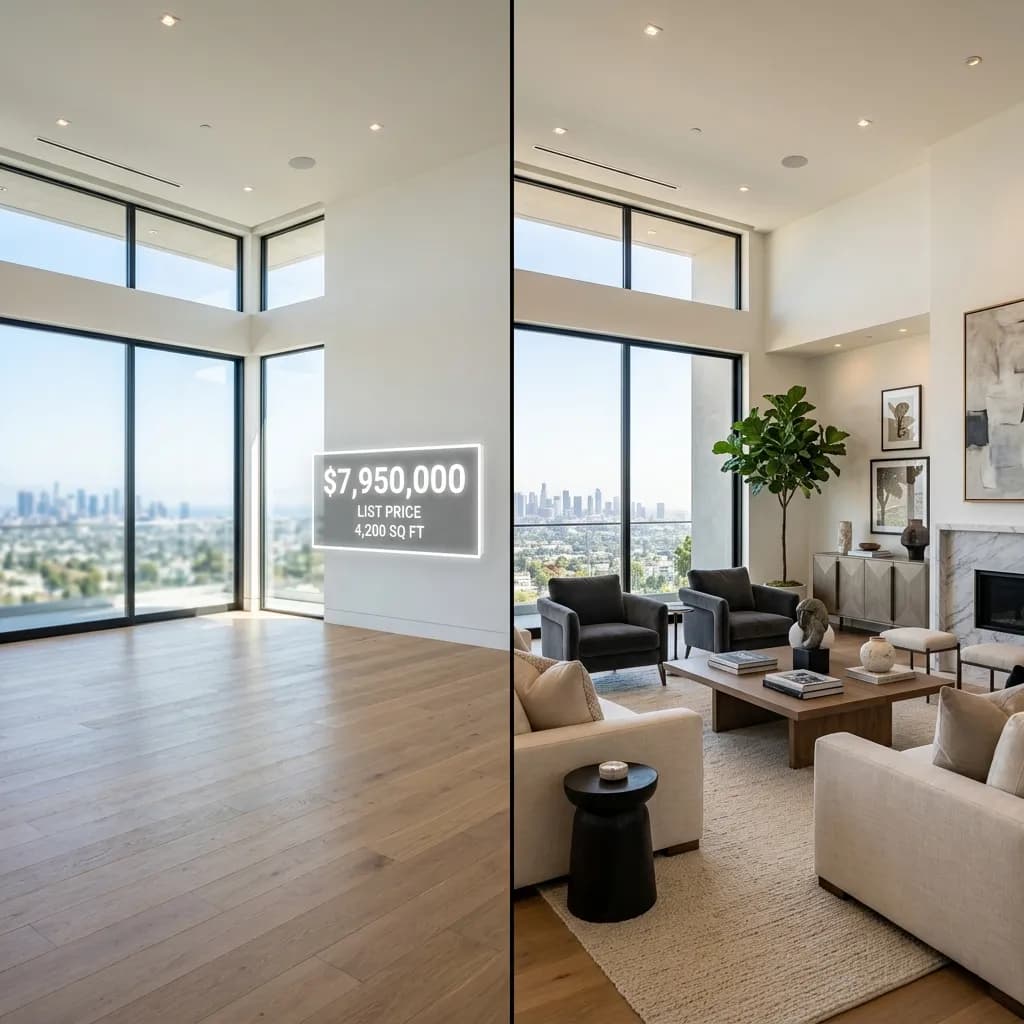
Physical or virtual home staging? An honest comparison
Both methods solve the same problem – but not the same part of it. The difference lies in whether the buyer enters the room.
Vacant rooms sell worse. That is undisputed and has a simple reason: few people can derive from an empty room whether their sofa fits and how the room feels lived-in.
Two routes exist – real furnishing and digital visualisation. They are often played off against each other but solve different parts of the problem.
What physical staging achieves
Classic staging brings real furniture, textiles and decoration into the property. The decisive advantage: the effect also works at the viewing. The prospect enters a furnished room, not an empty shell with nice photos.
It additionally works on levels photos cannot reach: a furnished room sounds different – carpets and curtains absorb the echo that makes empty rooms feel inhospitable. Smell and temperature are perceived differently too.
Costs typically sit in the four-figure range per property, depending on size and rental duration. Add set-up, removal, and the question of what happens to the furniture during marketing.
What virtual staging achieves
With virtual home staging the rooms are furnished digitally in the photo. The property itself stays empty.
Its strength lies in cost and speed: instead of four-figure sums, costs arise per image, and delivery takes days rather than weeks. Several furnishing styles of the same room are possible – classic for one audience, modern for another. Physically that would be unaffordable.
A further practical advantage: it works where real staging is ruled out – in tenanted properties, in shell construction, in properties under compulsory administration, or where nobody can arrange access.
The limit: the viewing
Here lies the honest disadvantage of the digital variant. The prospect arrives at the viewing with the brochure image in mind – and stands in an empty room. That discrepancy can disappoint if unprepared.
It can be cushioned well in practice: label the images clearly as visualisations, and bring a printout to the viewing. Standing in the empty room with the image beside it, people understand the furnishing immediately – often better than from the photo alone.
The legal line
Both methods are permissible, virtual staging only with labelling. Images that appear furnished without being marked as visualisations can constitute deception.
Two hard rules have proven themselves:
Structural facts stay unchanged. Furniture, pictures and plants may be added. Cracks, damp damage, pipes or an awkward window position may not disappear.
Proportions must be right. A bed that in truth does not fit the room is not a stylistic device but a false statement.
Anyone observing these two rules is on the safe side.
What actually works
Marketing practice shows a clear pattern: the click rate on the portal is decided by the title image, and there virtual staging works as well as real. The decision for or against a property, however, frequently falls at the viewing – and there real staging has the edge.
A pragmatic rule follows: the higher the property value and the more decisive the on-site impression, the more real staging pays. The more it is about generating attention and viewing appointments in the first place, the better the digital variant is invested.
When to use which
Virtual staging is the right choice for:
- existing flats in the mid price segment
- tenanted properties
- inherited and estate properties
- new-build projects that do not yet exist
- tight budgets or time pressure
Physical staging is the right choice for:
- high-priced properties where the viewing decides
- show apartments in larger new-build projects
- properties already long on the market without success
Both combined makes sense in larger projects: one real show apartment on site, all other units visualised digitally.
The same principle applies to commercial space
Empty office floors have the same problem – except real staging practically never happens there. Virtual office staging shows floor layouts and workstation counts not readable from the empty floor. For letting it is often the difference between space and our future office.
The preliminary stage is underestimated
Whatever method you choose: staging does not repair bad photos. Skewed lines, colour casts and underexposure remain visible after furnishing. Image editing comes before staging, not after.
What good staging costs and returns
The cost question cannot be answered flatly, but the orders of magnitude differ clearly. Physical staging moves in the mid to upper four-figure range depending on size and rental period; virtual staging is billed per image and regularly comes to a low three-figure sum for a whole property. More important than the absolute amount is the relation to property value: on a property in the lower price segment, physical staging can consume a noticeable share of the margin, while on a high-priced property it hardly registers.
The furnishing style must match the audience
A common mistake in both methods is stylistic miscasting. A styled loft look in a terraced house in a family neighbourhood feels alien; classic upholstery in a new-build penthouse likewise. The furnishing should address the most likely buyer group and reflect their life – including a child's room where families buy and a workspace where professionals buy. With virtual staging this is especially easy, because several variants of the same room cost no extra.
Furnish less than you think
In both methods, overfilled rooms look smaller. The purpose of staging is not to fill the room but to show its usability. A sofa, a table, a lamp and a plant suffice to make a living area readable. What is regularly too much: decoration on every surface, several rugs, overloaded shelves. With virtual staging the effect intensifies, because digital furniture costs nothing and is therefore readily overused. Restraint is a deliberate decision.
The special case of tenanted properties
In occupied flats physical staging is practically ruled out, and photography is delicate too: personal belongings, family photos and individual furnishing hinder buyers' imagination and touch the tenants' privacy. Digital removal of items followed by neutral furnishing is often the only viable route. Coordination with the tenant matters, as does clear labelling – a room that appears empty and neutral in the brochure but is occupied must be recognisable as a visualisation.
How to measure the effect
To judge whether staging paid off, two metrics suffice that can be collected without effort: the portal click rate in the first seven days and the number of viewing enquiries in the first two weeks. Both respond directly to improved imagery. Anyone who has marketed a comparable property without staging already has a baseline. Marketing duration is the most meaningful figure but needs several properties to distinguish from chance.
Related articles
Explore Virtual home staging
See what the service includes, which source material is useful and how a typical project starts.