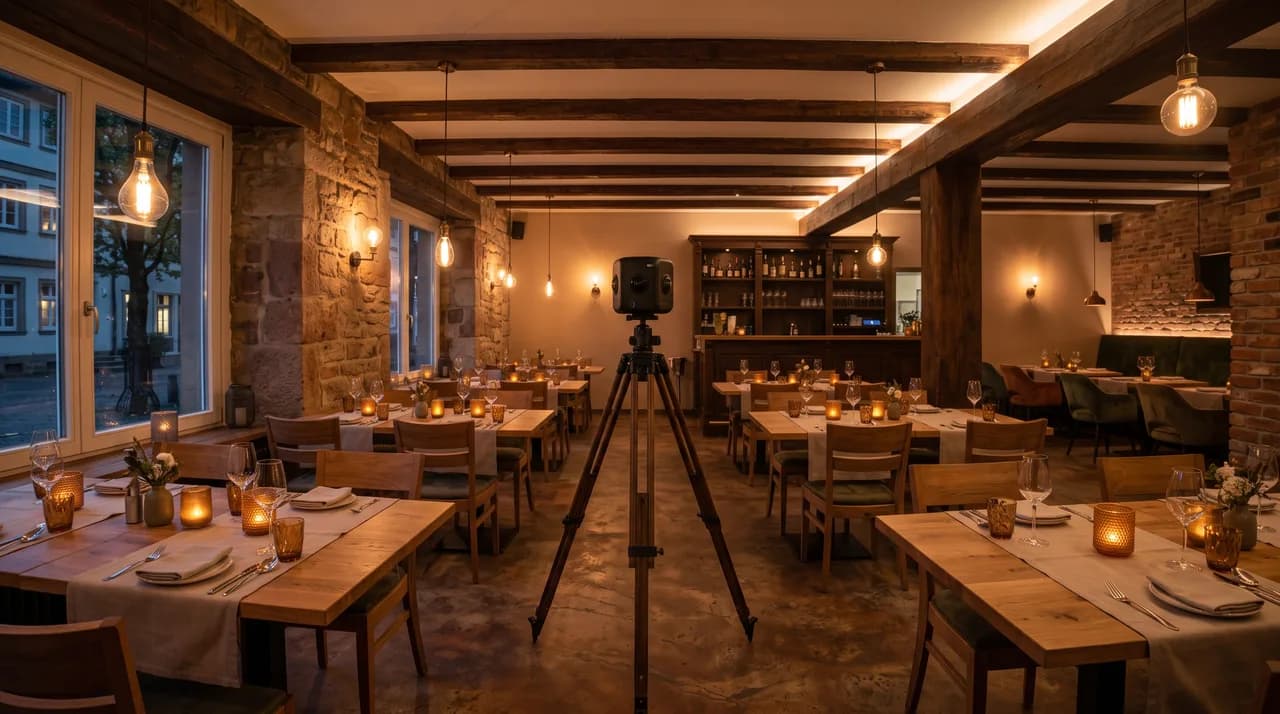
Ask any restaurant owner what makes their venue special, and they will rarely mention the floor plan. They talk about the atmosphere: the warm glow over the bar at dusk, the buzz of a full dining room, the way the beer garden opens up on a summer evening. That atmosphere is exactly what a printed menu and a handful of phone snapshots fail to convey. A virtual tour, built through professional 3D capture, lets a prospective guest walk through your restaurant before they ever book a table, feel the room, and choose the corner they want to sit in. This article explains, step by step, how a working restaurant is digitized without disrupting service, and how the finished tour becomes a genuine tool for reservations, private events, and multi-location consistency.
Why a Restaurant Is Harder to Capture Than It Looks
A restaurant might seem like a simple interior to photograph, but it is one of the more demanding hospitality spaces to digitize well. Unlike an empty apartment or an office, a restaurant is deliberately designed to be seen in a particular light, at a particular time of day, and often in half-darkness. The lighting that makes a dinner service feel intimate is the same lighting that makes a camera or a 3D scanner struggle. The room is also full of reflective and difficult surfaces: polished bar tops, glassware, mirrors, dark upholstery, and windows that behave completely differently at nine in the morning than at nine at night.
On top of the technical challenges sits the operational one. A restaurant is rarely truly empty. There are deliveries in the morning, prep work in the kitchen, staff setting tables, and a service window that leaves only a narrow slice of the day genuinely quiet. Capturing the space means working around all of this without getting in the way of the business, and without appearing in the tour itself. A half-set table, a cleaning trolley in the background, or a stack of chairs on tables tells the wrong story to a prospective guest.
Finally, a restaurant is an emotional purchase in a way that many spaces are not. Guests are not just checking whether the venue is big enough; they are deciding whether it feels right for a first date, a family celebration, or a business lunch. That means the digitization has to preserve mood, not merely geometry. Getting this right requires planning the shoot around the restaurant's rhythm, its light, and the specific experiences it wants to sell, rather than simply switching on every light and scanning room by room.
Scheduling Around Service: Why Early Mornings Win
The single most important planning decision for a restaurant capture is timing. Because the venue needs to be spotless, fully set, and completely free of both guests and staff in the frame, the natural window is the early morning before the doors open. Many restaurants find that arriving as the first deliveries are being put away and finishing before the lunch prep reaches full pace gives a clean, uninterrupted run at the space. The room is already reset from the night before, tables can be dressed to look their best, and there is no service to interrupt.
The alternative windows are the mid-afternoon lull between lunch and dinner, or a scheduled closing day. Each has trade-offs. The afternoon gap is short and can be squeezed by an over-running lunch, while a closing day offers the most relaxed schedule but may mean the kitchen and staff are not present to help stage the space. For most independent restaurants, an early-morning slot of two to four hours is the sweet spot: enough time to capture the main dining room, bar, and key secondary spaces, but tight enough that it does not eat into a trading day.
Coordinating this window is a shared task between the restaurant and the capture team. The venue needs to know exactly which areas will be shot and in what order, so that staff can dress each space just ahead of the camera rather than setting everything at once and watching it gather a morning's worth of small disturbances. A short walk-through the week before, agreeing the running order and the look of each area, turns a potentially chaotic morning into a calm, predictable one. The better the pre-planning, the shorter the on-site time and the smaller the impact on the business.
The Lighting Problem: Evening Mood Versus Scanning Needs
Restaurant lighting is designed to flatter faces and food at dinner, not to help a scanner build an accurate model. Dimmed pendants, candlelit tables, warm spotlights on a feature wall, and deep pools of shadow all create the mood guests love and the exact conditions that make 3D capture difficult. Scanners and cameras need enough consistent light to resolve detail and measure depth reliably; too little light produces noisy, incomplete data, while wildly mixed colour temperatures make the whole room look muddy or unnaturally orange.
There are two honest ways to handle this, and the right choice depends on what the tour needs to communicate. The first is to capture the room in a brighter, more neutral state than a guest would ever see at dinner, giving a clean, accurate, well-lit walkthrough that shows the space clearly, and then to convey the evening atmosphere through separately produced feature photography. The second is to work carefully with the venue's own dimmers and any permitted supplementary lighting to strike a balance: bright enough for reliable capture, warm enough to keep the character of the room. Neither approach pretends that a dim dinner setting can be scanned as-is without compromise.
The practical lesson is that lighting must be discussed before the shoot, not improvised on the day. Knowing which fixtures are on dimmers, whether candles or table lamps can be lit safely for stills, and how the daylight behaves through the windows at the chosen hour all shape the plan. A restaurant that can show its space both clearly and atmospherically gives prospective guests the best of both: an honest sense of the layout and a genuine feel for the mood. Managing the gap between how a room is lit for evening service and how it must be lit for capture is the single biggest craft challenge in digitizing a restaurant.
Capturing the Full Guest Experience, Zone by Zone
A restaurant is not one space but several, and each plays a different role in a guest's decision. The dining room is the heart of the tour, but it is rarely enough on its own. The bar tells guests whether this is a place to arrive early for a drink; the beer garden or terrace signals summer trade and relaxed daytime dining; private rooms speak to celebrations and corporate bookings. A tour that captures only the main room misses much of what actually drives a booking. Planning the capture zone by zone ensures each part of the experience is represented and can be linked in a logical journey.
The bar deserves particular care because it is often the most visually complex area, with backlit bottles, mirrored shelving, and glossy surfaces that reflect the whole room. It is also where much of a venue's personality lives. The dining room, meanwhile, benefits from being shown in more than one configuration where possible: a couple's table by the window, a larger group setting, and any distinctive features such as banquettes, an open kitchen, or a feature wall. The goal is for a guest to find and picture the exact table they would want to book.
Outdoor and semi-outdoor spaces bring their own timing considerations. A beer garden or terrace looks entirely different in flat morning light than under a summer sun, so it may be worth capturing these areas at the hour they look most inviting, even if that means a second short visit. Private event rooms should be shown dressed for a realistic occasion rather than as empty, characterless boxes, because event enquirers are trying to imagine their own function in the space. Capturing each zone deliberately, and in its best-looking state, is what turns a technical scan into a persuasive guest experience.
From Tour to Bookings: Reservations and Event-Space Marketing
A virtual tour earns its keep when it does more than look attractive; it should drive concrete actions. For everyday dining, the tour helps a hesitant guest commit. Someone deciding between three restaurants for an anniversary can walk through yours, see the intimate corner table, sense the mood, and book with confidence rather than gambling on a stranger's photos. Embedding the tour on the reservations page, in your Google Business Profile, and across social channels means it works at exactly the moment a guest is choosing where to eat, reducing the uncertainty that causes people to hesitate or pick somewhere they already know.
Where a virtual tour often delivers the clearest return, however, is in private events and functions. Event enquiries are high-value and frequently made by someone who cannot easily visit in person during the day, or who is comparing several venues on behalf of a group. A dedicated tour of your function room, complete with a realistic setup, lets that organizer explore the space on their own schedule, share it instantly with colleagues or family, and shortlist your venue without a site visit. For weddings, corporate dinners, and large celebrations, this can be the difference between an enquiry and a booking.
Event marketing also benefits from being able to show a room in more than one guise. A private room set for a seated dinner tells a different story than the same room laid out for a standing reception, and being able to present both helps an organizer picture their specific occasion. Combined with clear capacity information and a direct enquiry link placed within the tour itself, the walkthrough becomes an active sales tool for the most profitable part of many restaurants' trade, rather than a passive gallery that visitors admire and then leave.
Consistency Across a Franchise or Multi-Location Group
For restaurant groups, chains, and franchises, digitization raises a challenge that single venues never face: consistency. When a brand promises the same experience in every city, its virtual presence has to reflect that promise. If one location presents a polished, well-lit, professionally captured tour while another offers dim, uneven, amateur imagery, the inconsistency undermines the brand and confuses guests. A coordinated capture programme across locations ensures that every venue is presented to the same standard, with the same style of lighting, framing, and navigation.
Achieving this consistency is largely a matter of defining a specification once and applying it everywhere. That specification covers the order in which spaces are captured, how tables are dressed, the lighting balance to aim for, which zones every location must include, and how the finished tours are structured and labelled. With a clear standard in place, each new location, whether a company-owned site or a franchisee, can be brought online in a way that feels unmistakably part of the same family. For franchise operators in particular, this gives head office a reliable way to protect brand presentation across sites they do not directly control.
Consistency also pays off operationally. When every location's tour follows the same structure, a group can manage them centrally, update them on a predictable schedule, and roll out new locations quickly using an established template. Guests moving between cities encounter a familiar, trustworthy experience, and the brand gains a coherent digital footprint rather than a patchwork of mismatched pages. For growing groups, treating digitization as a repeatable, standardized process rather than a one-off project per venue is what keeps quality even as the number of locations climbs.
Making the Tour Useful: Menu Links and Booking Tags
A restaurant tour becomes far more powerful when it is interactive rather than purely visual. Within the walkthrough, small clickable markers, often called info tags or hotspots, can be placed directly in the space to connect what a guest is looking at with an action they can take. Standing virtually at the bar, a guest might click a tag that opens the drinks list; looking at the dining room, another tag might open the current food menu; a marker near the entrance might launch the reservation system. This turns passive browsing into a path toward booking without ever leaving the tour.
The most valuable of these connections are usually the menu link and the booking tag. Linking directly to a live, up-to-date menu means guests can weigh the food and the room together, in one place, at the moment their interest is highest. A booking tag placed prominently within the tour captures that interest immediately, letting a guest move from imagining their evening to securing a table in a single step. For private rooms, an enquiry tag that opens a function request form does the same job for events, routing high-value leads straight to the team that handles them.
Because menus and offers change, it is worth planning these links so they point to content the restaurant can update itself, rather than baking fixed information into the tour. A tag that opens your always-current online menu stays accurate through every seasonal change, whereas a menu embedded as a static image is out of date the moment a dish changes. Thinking about these connections during planning, rather than bolting them on afterwards, ensures the tour is built as a working part of the restaurant's digital presence rather than a standalone showpiece that quietly drifts out of date.
Typical Timeline and What to Expect
For a single restaurant, the whole process is more contained than owners often expect. It begins with a short planning conversation and ideally a brief walk-through, during which the areas to be captured, the running order, the lighting approach, and the desired mood are agreed. This preparation usually takes place in the days or week before the shoot and is what keeps the on-site time short. The clearer the plan, the smoother the capture, so this stage is worth taking seriously even though it feels less tangible than the shoot itself.
The on-site capture for a typical independent restaurant, covering the dining room, bar, and one or two secondary spaces such as a private room or terrace, generally fits within a single early-morning session of a few hours. Larger venues, multiple event rooms, or outdoor areas that look best at a different time of day can extend this or add a short second visit. Because the work happens before opening, most restaurants lose no trading time at all, which is one of the reasons the early-morning window is so widely preferred.
After the shoot, the individual captures are processed and stitched into a connected, navigable tour, and the interactive elements, menu links, booking tags, and any capacity or event information, are added and checked. A short review with the restaurant confirms that labels, links, and the overall feel are right before the tour goes live. For a single venue, the entire journey from first conversation to a published tour commonly runs from around one to three weeks, with the exact timing depending on the size of the venue and how quickly content and approvals come together. For multi-location groups, the first site takes the longest as the standard is established, after which each additional location follows the template far more quickly.
Conclusion
Digitizing a restaurant is not simply a matter of pointing a scanner at each room. It is the craft of capturing atmosphere under lighting designed to resist capture, working within the narrow quiet windows that a busy venue allows, and representing every part of the guest experience, from the bar to the beer garden to the private function room. Done well, it produces something a menu and a few photographs never can: a space a prospective guest can walk through, feel, and choose to book, all before they arrive.
The restaurants that gain the most treat the tour as a working tool rather than decoration. By scheduling around service in the early morning, handling the tension between evening mood and scanning needs deliberately, capturing each zone in its best light, and wiring the finished walkthrough to live menus and booking systems, they turn a visual asset into a genuine driver of reservations and lucrative private events. For groups and franchises, applying a single standard across every location protects the brand and makes each new venue quick to bring online. Approached with a clear plan, digitizing a restaurant is a fast, low-disruption project that pays back in confident guests, stronger event enquiries, and a digital presence that finally does the room justice.