In just a few years, virtual tours have evolved from a technical gimmick into an established element of modern real-estate and marketing communication. Anyone marketing an apartment, promoting a hotel, or presenting a production facility today can hardly avoid interactive 360° experiences. The reasons are obvious: a tour conveys space, proportion, and atmosphere in a way that conventional photos and floor plans simply cannot. Viewers move through the rooms on their own terms, examine details from their own perspective, and gain a realistic sense of the property before ever setting foot in it.
At the same time, the subject is more complex than it first appears. There are different technical approaches, various quality levels, a wide range of features, and numerous fields of application. Add to that the legal questions surrounding data protection and data sovereignty, as well as the fundamental challenge of finding the right provider. This guide brings the topic together from the ground up. It is aimed at decision-makers in real estate, retail, hospitality, culture, and industry who want to understand what virtual tours can do, how they are created, and what really matters in their execution.
What Is a Virtual Tour?
A virtual tour is a digital, interactive walkthrough of a real space or object. Unlike a video, which follows a fixed sequence, users decide for themselves where to look and which area to move into next. The basis is usually 360° captures of individual vantage points that are linked together. Through clicks, swipe gestures, or the movement of a smartphone, viewers navigate from point to point and thereby experience a coherent sense of space.
The decisive difference from a classic image gallery lies in immersion and control. A photo shows a detail that the photographer has chosen. A tour gives viewers the freedom to look around, grasp the relationships between rooms, and develop a feel for routes and distances. It is precisely this self-directed exploration that creates trust: what you have discovered yourself feels more credible than what has been presented to you.
Modern tours are platform-independent. They run directly in a web browser on desktop, tablet, and smartphone, can be embedded in listings, websites, and portals, and can even be fully immersive with a VR headset. This low barrier to entry is a key reason for the technology's broad adoption across the most diverse industries.
The Main Types of Virtual Tours
Broadly speaking, two major categories can be distinguished. The first is the classic 360° panorama tour. Here, spherical panoramas are captured at selected vantage points, depicting the entire room in all directions. These panoramas are then connected via so-called hotspots, allowing users to jump from position to position. The advantage of this method lies in its high photographic image quality and the creative control over each individual shot. It is ideally suited when particularly attractive, high-quality single images matter most.
The second category is 3D scans, such as those produced with Matterport cameras or comparable systems. Here, the camera captures not only image data but also spatial depth information. The result is a three-dimensional model of the entire object through which viewers can move freely, much like in a video game. From this depth data, additional features can be derived, such as a dollhouse view of the entire building, automatically generated floor plans, or measurement tools. The 3D scan thus delivers a particularly complete and measurable representation.
Both approaches have their merits, and the choice depends on the goal. A high-end residential property in a premium location often benefits from the visual perfection of the panorama tour, while a complex office building or a property where dimensions and spatial understanding take center stage thrives on the analytical features of a 3D scan. In practice, experienced service providers such as FotoEstate frequently combine both methods to leverage their respective strengths for the specific project.
How a Virtual Tour Is Produced
Every production begins with planning. It is determined which rooms and vantage points will be captured, in what order the tour should be experienced, and which additional features, such as floor plans or info tags, are needed. Equally important is preparing the property itself: tidy, well-staged, and adequately lit rooms are half the battle. Personal items are removed, windows cleaned, light sources switched on, because whatever the camera captures directly shapes the final impression.
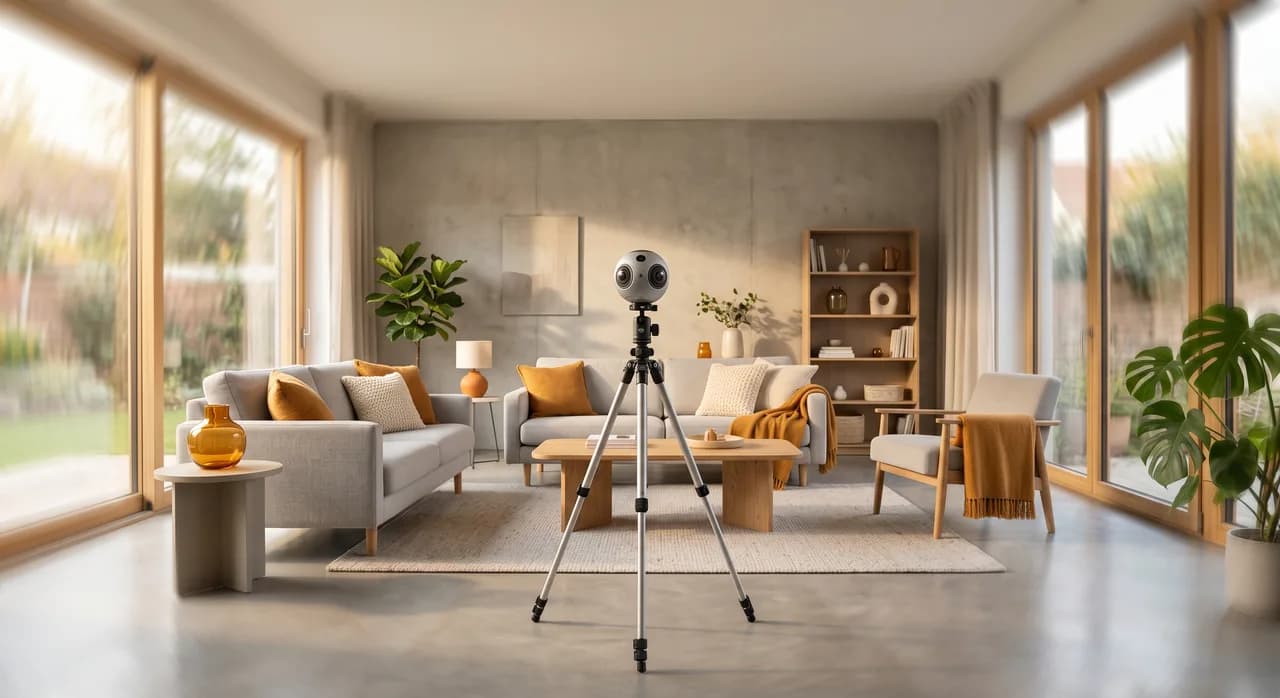
The actual capture is carried out with specialized cameras on a tripod. To correctly depict rooms with strong differences in brightness, for instance where bright windows and dark corners meet, HDR technology is usually employed. Here, several exposures of the same vantage point are captured and later merged into a balanced image. This preserves both the structure of bright window views and the detail in shadow areas. With 3D scans, the system additionally captures the room geometry at each vantage point.
Capture is followed by post-processing. The individual shots are stitched into seamless spherical panoramas, colors and contrasts are matched, and distracting elements such as the tripod or reflections are retouched. The vantage points are then linked into the finished tour, hotspots are placed, and additional features are integrated. It is this post-production that determines whether a tour looks professional and cohesive or amateurish. It is the step in which quality shows most clearly and which laypeople most often underestimate.
Key Features and Their Benefits
Modern virtual tours offer far more than mere looking around. The dollhouse view, often called just that in professional jargon, is one of the most impressive features. It shows the entire object as a three-dimensional model from the outside that can be freely rotated. Viewers thus grasp at a glance how the rooms are arranged relative to one another, how many floors there are, and what the basic structure looks like. This bird's-eye perspective provides orientation before one steps into the individual rooms.
Closely related is the automatically generated floor plan. From the spatial data of a 3D scan, a scaled plan is created that can additionally be used for navigation. Prospects see immediately which room they are in and can jump to specific locations. The measurement tool, in turn, allows distances to be determined directly within the tour, such as the width of a wall or the height of a room. Especially for furniture planning or initial calculations, this feature is extraordinarily practical and saves specific on-site appointments.
Info tags, finally, transform the tour from a purely visual experience into an information medium. Clickable markers can be placed at any location to display texts, images, videos, or links. This makes it possible, for example, to highlight special fittings, explain a technical detail, or link directly to a contact form. This interweaving of experience and information turns the tour into a standalone sales and communication tool that works for you around the clock.
Fields of Application in Practice
The most obvious area of application is real-estate marketing. Whether an apartment, house, commercial space, or new-build project, a virtual tour enables prospects to view properties anytime and from anywhere. This significantly reduces the number of unnecessary on-site appointments, because it becomes clear in advance whether a property is fundamentally a good fit. Agents and developers save time, present themselves as modern, and also reach prospects who live farther away or are searching internationally.
But the potential extends considerably further. In retail, tours are used to make stores, showrooms, and exhibition spaces digitally experienceable. Hotels and hospitality businesses show rooms, suites, conference spaces, and outdoor areas, giving guests a reliable basis for their decisions before booking. Museums and cultural institutions use the technology to make exhibitions digitally accessible, archive collections, and reach a worldwide audience that would never make it to the physical location.
An often underestimated field is industry. Production halls, plants, and technical facilities can be documented via 3D scan, which offers considerable added value for planning, maintenance, training, and remote collaboration. A precise digital replica of a facility allows experts to take measurements remotely, plan modifications, or onboard new employees without everyone having to be physically present. The breadth of applications shows that wherever space plays a role, a virtual tour can add value.
What Makes a Tour Successful
A virtual tour is not an end in itself; it is meant to have an effect, be it an inquiry, a booking, or a sale. The most important factor for this is quality. Sharp, well-exposed, and color-accurate images convey value and credibility. Blurry, dark, or distorted images achieve the opposite and harm the impression of the property more than having no tour at all would. The investment in professional capture and post-processing pays off immediately in how the property is perceived.
Equally decisive is technical performance, especially on mobile devices. A substantial share of users view tours on their smartphone. If the tour loads too slowly, the navigation stutters, or it uses up unnecessary amounts of data, prospects drop off before they have even experienced the property. Optimized load times, smooth operation, and intuitive controls are therefore not a side issue but directly relevant to success. A good tour works on any device without hurdles.
Added to this is well-thought-out user guidance. A tour should not leave viewers disoriented but should guide them intuitively through the property. A logical order of vantage points, clearly recognizable navigation points, a helpful floor plan, and deliberately placed information ensure that users find their way and linger longer. And the longer someone explores a property, the stronger the emotional connection that ultimately decides whether they get in touch. Success arises from the interplay of image quality, technology, and dramaturgy.
Data Protection and Legal Foundations
Creating virtual tours means depicting real environments, which brings data protection into focus. As soon as identifiable people appear in the footage, the General Data Protection Regulation applies. In practice, this means that tours should generally be captured without any people present. Where this cannot be avoided, people must be made unrecognizable, or valid consent must be obtained. The same applies to neighbors, passers-by, or employees who happen to end up in the frame.
Object details can also be relevant to data protection. Private photos, documents, name plates, license plates, or screen contents must not leave any personal information recognizable. Careful preparation of the property and targeted retouching in post-processing are therefore not only a matter of aesthetics but also of legal certainty. For commercial properties, trade secrets and security-relevant areas should additionally be deliberately excluded from the tour.
Another important dimension is the processing and storage of the data. Where are the tours hosted, which service providers are involved, and is data processed outside the EU? These questions should be clarified before the project begins and cleanly regulated by contract, in particular through a data processing agreement with the service provider. Those who consider data protection from the outset avoid later conflicts and build trust with owners and users alike.
Data Sovereignty: Who Owns the Tour?
Closely connected to data protection, yet to be considered on its own, is the question of data sovereignty. Many clients simply assume that the finished tour belongs to them without restriction. In reality, this depends heavily on the provider and the platform used. Some service providers and systems tie tours to their own infrastructure, so that access is linked to an ongoing subscription. If that subscription ends, the tour may no longer be accessible, even though it was paid for long ago.
For this reason, before commissioning the work, it should be clarified which usage rights are transferred and whether the raw data as well as the exported tours can be handed over. Ideally, the client receives a result they can use permanently and independently of the original provider, for instance as self-hostable files. That way, the investment retains its value even if the business relationship changes or a provider discontinues its services.
Equally relevant is the question of whether and how a tour can later be updated or expanded. Those who retain control over their data are more flexible and more independent in the long run. Transparent providers regulate these points openly and in writing. At FotoEstate, the customer's data sovereignty is central: clients should know what happens to their footage and be able to use the results on their own terms, without becoming dependent.
Choosing the Right Provider
The choice of the right service provider significantly determines the outcome. A first point of reference is their reference work. Anyone who has already completed comparable projects can use concrete examples to show what their tours look like in practice. In doing so, don't just pay attention to the visual appeal of individual stills, but test the tours yourself: How smooth is the navigation, how quickly does everything load on the smartphone, how intuitive are the controls? A good tour proves itself in actual use.
Second, the provider should have command of the method suited to your project. Not every property needs the same approach, and a competent service provider advises with an open mind on whether a panorama tour, a 3D scan, or a combination makes more sense. Ask about the specific process, the preparation, the timeframe, and the features included. Transparency in communication is a reliable indicator of professionalism. Those who readily explain how they work usually have nothing to hide.
Finally, the soft factors belong on the list: a clear pricing structure, understandable contract terms, well-regulated usage rights, a clean approach to data protection and data sovereignty, as well as reliable availability for questions and later adjustments. The cheapest provider is rarely the best, and the most expensive is not automatically so. What matters is the overall package of quality, advice, fairness, and reliability. A service provider who understands your project and takes your interests seriously is worth every extra cent.
Conclusion
Virtual tours are no longer a topic for the future but an established and effective tool for marketing and documenting spaces of all kinds. They build trust, save time, extend reach, and lift the presentation of a property to a professional level. Whether classic 360° panorama or detail-rich 3D scan, whether real estate, hotel, museum, or production hall, the technology offers concrete added value for almost every industry, provided it is executed with proper craftsmanship.
Decisive for success are quality, technical performance, and well-thought-out user guidance, complemented by features such as dollhouse view, floor plan, measurement tool, and info tags. Equally important are the often-overlooked framework conditions: a clean approach to data protection and securing one's own data sovereignty. Those who consider these aspects from the outset and choose a transparent, competent provider receive a result that creates value in the long term.
If you are considering using virtual tours for your properties, it is worth looking at the subject holistically, from concept through production to legally compliant use. FotoEstate guides clients through this entire process, placing particular emphasis on high-quality results and the customer's self-determination over their own data. This turns a one-time investment into a permanently usable tool that makes your spaces compellingly experienceable.