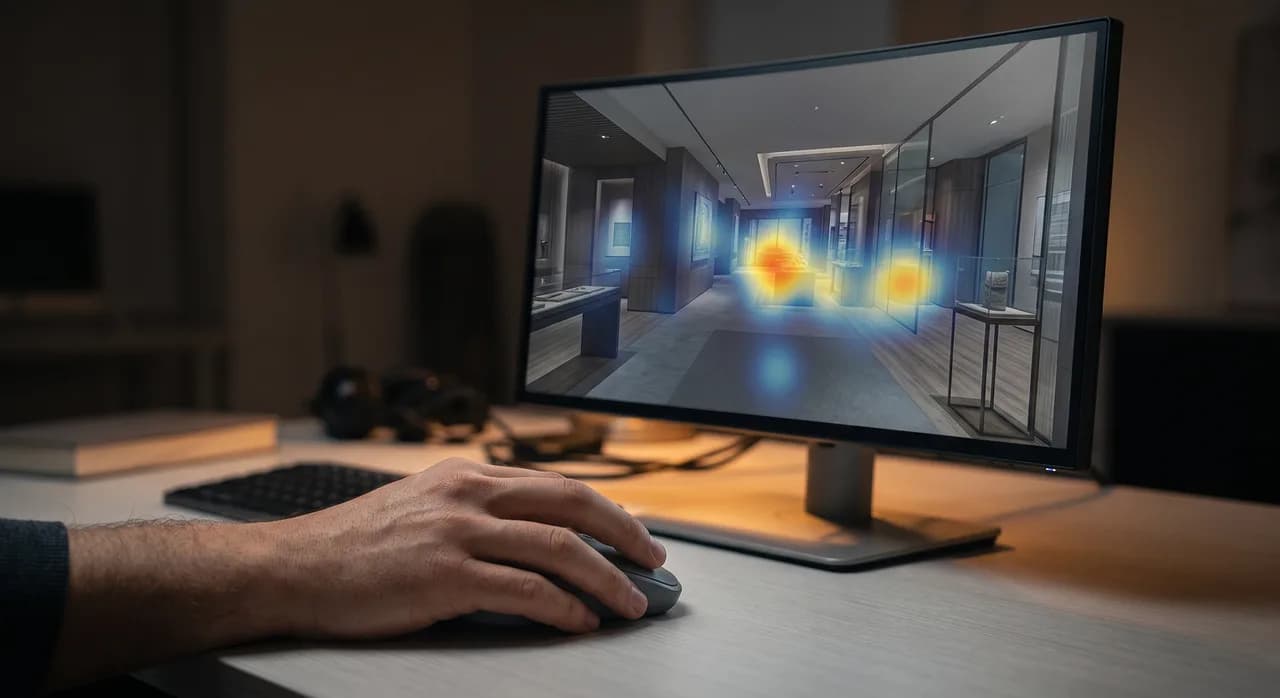
Every virtual tour platform now ships with some form of analytics: dwell time per room, click heatmaps, drop-off points, device breakdowns. Most agencies glance at the aggregate numbers — total views, average session length — and stop there. That is a missed opportunity, because the room-by-room data tells a much more useful story: viewer attention in a 3D tour is never distributed evenly across a floor plan. Some rooms get studied for a minute or more. Others are entered and left within two seconds. A few are barely visited at all.
This is not random. Across hundreds of tours we have produced and monitored for residential and commercial clients, the same behavioral pattern reappears with striking consistency, regardless of property size, price point, or region. Understanding that pattern changes how a shoot should be planned, which spaces deserve extra editing attention, and where a listing's real weaknesses are likely to surface first. For anyone commissioning virtual tours as a serious marketing tool rather than a novelty, this data is worth taking seriously.
What follows is a room-by-room breakdown of where attention concentrates, where it evaporates, and what the underlying causes are — technical and psychological — along with the practical implications for how shoots get planned and prioritized.
The Kitchen and Living Area: The Attention Magnet
Across nearly every dataset we have reviewed, the combined kitchen and main living space accounts for the largest single share of total dwell time in a tour — often 30 to 40 percent of the entire session, even though these rooms typically represent a much smaller fraction of the floor plan. Visitors linger, rotate the view multiple times, zoom into countertops and cabinetry, and frequently return to this space more than once during a single session, jumping back from a bedroom or bathroom to re-check a detail.
The reason is straightforward: for most buyers and tenants, the kitchen and living area are where daily life actually happens, and where lifestyle fit gets evaluated. People are not just checking square footage here — they are mentally placing furniture, imagining a dinner party, checking whether the counter space suits how they cook. This is also the space most likely to be shown to a partner, family member, or business stakeholder who was not present for the physical walkthrough, which extends session length further as the viewer narrates and re-navigates for a second audience.
The practical consequence is that this space rewards disproportionate production effort. Additional staging, ensuring surfaces are clear and well lit, capturing enough scan density to avoid visible stitching artifacts on cabinetry and countertops, and confirming that measurements and tags are accurate in this specific room all pay back more attention-adjusted value than the same effort applied elsewhere in the property.
Bedrooms and Hallways: Mostly Skimmed
Bedrooms present a near-opposite pattern. Viewers typically enter, do a single 360-degree rotation, note the approximate size and window placement, and move on — often within five to eight seconds. Secondary bedrooms in particular receive noticeably less attention than the primary bedroom, and in larger properties it is common to see a third or fourth bedroom skipped entirely by a meaningful share of visitors, especially on mobile.
Hallways and connecting corridors fare even worse. They function purely as transit infrastructure in a viewer's mental model, and most people navigate through them via the dollhouse or floor plan view rather than walking the space in first person at all. Dwell time in hallways, when it registers, is almost always an artifact of someone pausing to get oriented rather than genuine interest in the space itself.
This does not mean these rooms should be shot carelessly — an obviously rushed or under-lit bedroom scan can still read as a red flag even during a brief visit — but it does mean the marginal value of extra polish here is low. Time and budget are better spent making sure the scan is clean and complete rather than trying to make bedrooms a focal point of the presentation.
The Entry Point Determines Everything That Follows
One of the more consequential findings in tour analytics is how much the starting scan shapes the entire session. The room a viewer lands in first — usually the entry hall, living room, or whichever space the platform is configured to open on — sets an anchor impression that measurably affects both total session length and how far into the property the viewer bothers to continue.
Tours that open on a strong, well-lit, visually coherent space see longer average sessions and a higher percentage of viewers who reach every room in the property. Tours that open on a cramped entryway, a dim corridor, or a room with visible clutter see a meaningfully higher early exit rate — visitors who leave within the first ten to fifteen seconds without ever reaching the kitchen or living area at all, regardless of how good those rooms actually are.
This makes the choice of starting node one of the few genuinely free levers available after a shoot is already complete: repointing the default start position in the tour software costs nothing and can be tested. For new shoots, it argues for treating the entry sequence with the same care as the primary rooms, since a weak first impression can suppress engagement with everything that follows it, no matter how well those later rooms were captured.
Bathrooms: Disproportionate Scrutiny for Their Size
Bathrooms are a curious exception to the general size-correlates-with-attention rule. Despite occupying a small footprint, they generate dwell times and zoom-interaction rates that rival much larger rooms. Viewers frequently zoom into tile grout lines, fixtures, and shower enclosures at a level of detail rarely applied elsewhere in the tour.
The explanation is largely about risk assessment. Bathrooms and kitchens are the two spaces most associated with expensive renovation if something is wrong, and viewers — consciously or not — treat a close inspection of tile condition, silicone seals, and fixture quality as due diligence against a costly surprise. A bathroom that looks even slightly dated or poorly maintained in a scan can generate outsized negative impact relative to its size, precisely because it is being scrutinized so closely.
This has a direct production implication: scan resolution and lighting quality in bathrooms deserve the same priority as the kitchen, not the reduced effort their square footage would otherwise suggest. Reflective and glossy tile surfaces are also more prone to visible scanning artifacts than matte surfaces elsewhere in the home, so this is a room worth reviewing carefully in post-processing before publishing a tour.
Outdoor Areas and the Indoor–Outdoor Transition
Gardens, terraces, balconies, and other outdoor spaces show highly bimodal engagement: either viewers barely glance at them, or they spend an unusually long time there — considerably longer, per square meter, than most interior rooms. Which pattern dominates depends heavily on the property type and the season in which the tour is viewed, but the split is rarely in between.
When outdoor space is a genuine selling point — a rooftop terrace, a garden suited to entertaining, a balcony with a view — the transition from indoor to outdoor scanning is often the single most re-visited moment in the entire tour. Viewers frequently loop back to that transition point multiple times, treating it almost as a payoff moment. Conversely, when the outdoor space is an afterthought — a narrow strip of grass, a utility balcony — it gets essentially no attention at all, and its inclusion in the tour mostly serves completeness rather than persuasion.
The technical challenge is that indoor-to-outdoor transitions are also where scan quality most often degrades, due to the exposure difference between interior and exterior light. A blown-out window or a washed-out exterior view at exactly the moment viewers are paying the most attention is a disproportionately damaging flaw, and it is worth budgeting extra shooting time — bracketed exposures, different times of day — specifically for this transition rather than treating it as just another scan point in a longer sequence.
The Dollhouse View as a Strategic Tool for Commercial Properties
For commercial and larger residential properties, the dollhouse or floor-plan overview view behaves differently from anything else in the tour, and it deserves separate strategic thought. Rather than being a navigation aid that viewers pass through quickly, it becomes a genuine analysis tool: prospective tenants and investors use it to assess spatial layout, sightlines, adjacency between departments or units, and traffic flow, often spending more continuous time in this view than in any single room.
This is particularly true for office space, retail units, and multi-unit residential buildings, where the relationship between spaces matters as much as the quality of any individual room. A well-configured dollhouse view — clean labeling, sensible default orientation, clear differentiation between usable and non-usable areas — can function almost as a standalone pitch document, and some commercial clients report that prospective tenants reference the dollhouse view specifically in follow-up conversations, independent of anything they saw in individual room scans.
The practical takeaway is that the dollhouse view should not be treated as an automatically generated afterthought. It is worth reviewing it as its own asset, correcting mislabeled zones, choosing a start angle that reads clearly, and where the tour platform allows it, adding notations for anything not obvious from the geometry alone, such as ceiling heights or zoning classifications.
Technical Causes of Drop-Off: Load Times, Navigation, and Mobile Scaling
Not every attention pattern is about psychology — a substantial share is purely technical. Slow initial load times remain one of the largest single causes of early session termination, and the effect compounds on mobile networks: a tour that loads in under two seconds on office broadband can take eight to ten seconds on average mobile data, which is well past the point where a meaningful share of visitors simply close the tab.
Navigation confusion is the second major technical drop-off cause. Tours with unclear hotspot placement, ambiguous arrows, or inconsistent room-to-room transition logic see viewers stall, backtrack repeatedly, or exit in frustration — sometimes in exactly the rooms that would otherwise have received strong engagement. This is compounded on mobile, where touch targets for navigation hotspots are smaller and viewers are more likely to be moving through the tour with one hand while distracted.
Mobile scaling more broadly is worth flagging as its own category: image resolution that looks sharp on a desktop monitor can appear noticeably softer when auto-scaled to a phone screen, and given that a majority of first-time tour visits now happen on mobile, this is not a marginal concern. Testing every tour on an actual mid-range phone, on a real mobile connection rather than office Wi-Fi, before publishing is a low-cost step that catches a disproportionate share of these issues before they affect real prospects.
Consequences for Shoot Planning and Prioritization
Taken together, this data argues for a shift away from treating every room in a scan as equally important and toward a prioritization model based on where attention actually concentrates. Kitchens, main living areas, bathrooms, the chosen entry point, and any genuine outdoor feature deserve the largest share of production time: careful staging, attention to lighting and reflective surfaces, and a closer review pass before publishing. Bedrooms, hallways, and utility spaces still need to be captured cleanly and completely, but do not require the same level of incremental polish, since the data shows viewers simply are not scrutinizing them at the same level.
This also has implications for shoot scheduling. High-attention rooms benefit from being scanned at the time of day when their natural light is strongest, even if that means splitting a shoot across a slightly longer window or returning for a second pass. It is a more efficient use of a limited on-site day than distributing equal care across every room regardless of its actual role in the viewer's decision-making process.
For agencies and developers managing multiple properties, this framework also supports a useful post-launch habit: reviewing the room-level analytics for the first two or three weeks after a tour goes live, and using it to spot-check whether the same patterns hold for that specific property. A tour where the kitchen is getting skipped, or where an unusual share of sessions end in the hallway, is signaling something worth investigating — whether that is a technical loading issue in that specific scan or a genuine weakness in the space itself.
Conclusion
Virtual tour analytics are more than a vanity metric for a monthly report. Room-level dwell time and drop-off data reveal, with remarkable consistency across property types, exactly where buyer and tenant attention concentrates: the kitchen and living area first, bathrooms disproportionately given their size, the entry point shaping everything downstream, and outdoor transitions acting as a payoff moment when the space earns it. Bedrooms and hallways, by contrast, get a glance and little more.
For anyone commissioning or producing virtual tours professionally, this is actionable information rather than trivia. It means allocating shoot time, staging effort, and post-production polish according to where it will actually be seen and evaluated, rather than spreading equal effort across a floor plan indiscriminately. It also means treating technical fundamentals — load time, navigation clarity, mobile rendering — as seriously as the visual quality of the scan itself, since a viewer who never gets past a slow load never sees any of the rooms at all.
The properties that perform best in virtual tour engagement are rarely the ones with uniformly excellent scans throughout. They are the ones where the rooms that matter most to a viewer's decision were treated with the attention that decision actually deserves.