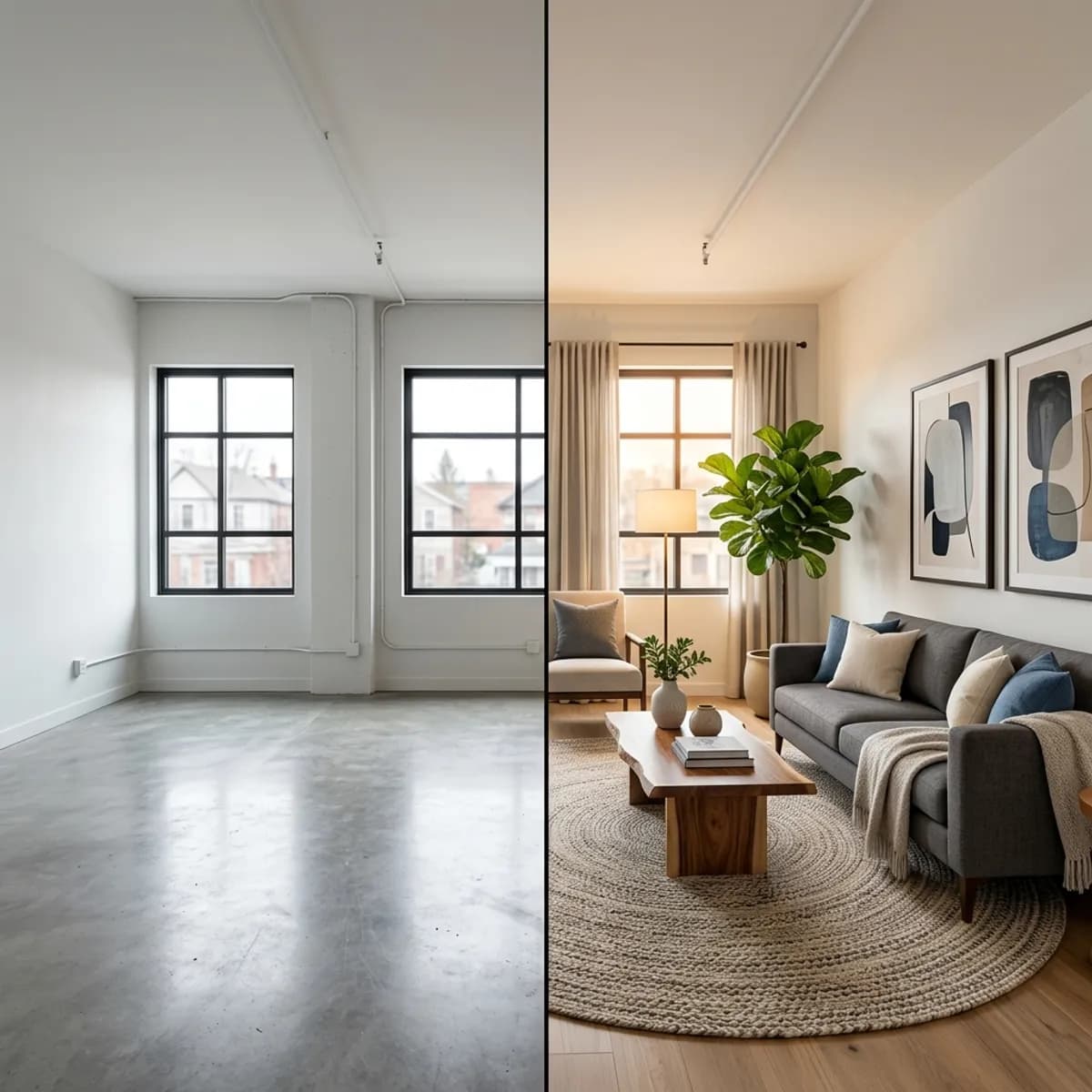
Virtual staging is a legitimate and widely used tool in property marketing. No serious objection is raised against furnishing an empty room digitally so that prospective buyers can picture how it might be used. It becomes problematic at a clearly identifiable boundary: when the image no longer shows a possibility but asserts a fact that is not true.
Knowing where that boundary lies is of practical relevance to agents, developers and property managers. Not primarily because proceedings are likely – that is the rare case – but because the typical consequences arise in everyday work: wasted viewings, renegotiations on price, discussions about withdrawal, complaints and reviews.
This article maps out the critical situations. It is a general orientation drawn from marketing practice and does not replace legal advice. In specific cases – a complaint from a buyer, or a competition-law warning letter – a lawyer is the right route.
The basic distinction: design proposal or statement of condition
The most reliable dividing line runs between two kinds of pictorial statement.
A design proposal shows how a room could be used. Furniture, rugs, plants, pictures on the wall: these objects are recognisably not part of the property, they are interchangeable and movable. A viewer understands without explanation that the sofa is not included in the sale.
A statement of condition concerns the property itself: the state of the walls, floor, windows, facade, roof and permanently installed fittings. Altering these elements in an image says something about the condition of the property – and that condition is the subject of the contract.
The practical rule follows directly: what is movable may be added, what is fixed may not be altered. Anything departing from that rule belongs expressly and unmistakably labelled.
Case 1: Concealed defects – the clearest breach
The most unambiguous and at the same time most frequent problem is the concealment of defects by virtual furnishing.
In concrete terms it looks like this: a sofa stands in front of the wall with the damp patch. A rug lies over the spot where the flooring is damaged. A large plant stands in front of the crack in the render. A picture hangs over the area of mould. A cupboard hides the removed radiator.
In all these cases the defect is visible in the source photograph and no longer visible in the edited image. That is not a design proposal but the targeted removal of information material to the purchase decision. Whether this constitutes fraudulent misrepresentation in any given case turns on the specific circumstances – the practical consequence is independent of that: the prospective buyer sees the defect at the viewing, compares it with the listing, and trust is gone.
The rule to apply is simple: what is visible in the unedited photograph stays visible in the edited photograph. If you are unsure whether a piece of furniture conceals something incidentally or deliberately, that uncertainty is itself an indication that the placement should be changed.
One special case deserves mention: retouching objects out after the fact. Removing moving boxes is unproblematic. Removing a building dryer or a dehumidifier standing in the room is not – such equipment is an indication of a moisture problem, and retouching it removes precisely that indication.
Case 2: Virtual renovation as a depiction of condition
Virtual renovation alters surfaces: walls are painted, floor coverings replaced, tiles renewed, doors changed, facades refurbished. As a design proposal this is a powerful tool – particularly for properties in need of renovation, whose potential can hardly be conveyed in their current state.
It becomes sensitive when the image is not recognisable as a proposal. An image showing a freshly renovated flat while the real property is worn out is a statement of condition. A prospective buyer travelling on the basis of that image encounters a different property.
The established approach is to label such images expressly as a renovation proposal and to show them together with photographs of the actual condition – ideally as a direct comparison. A before-and-after pair is honest, conveys the potential considerably better than the "after" alone, and forestalls disappointment.
The facade is particularly critical here. A virtually refurbished exterior in a building held in multiple ownership implies a resolution that has been passed. If no such work has been resolved and funded, the expectation is false – and the question of special levies arrives at the latest when the record of resolutions is examined.
Case 3: Sanitary ware, kitchens and fixed installations
The boundary runs closer here than many realise. A bed is movable. A bathtub is not.
Virtually inserted sanitary ware in a real bathroom is therefore problematic: it alters the property's fit-out. A bathroom shown in the image with a level-access shower, while the real one has a tray with a high step, makes a false statement – and that is a point which is decisive for certain groups of buyers.
The same applies to fitted kitchens. A kitchen inserted virtually into a room that has no kitchen must be labelled unmistakably – including the information that it is not part of the property. Otherwise the expectation of an included kitchen arises, which regularly leads to price discussions.
With new builds there is the added point that the construction specification governs. If the image shows fit-out that is not contractually owed, it belongs labelled as an optional upgrade: "shown with optional upgrades, not included in the purchase price." That single line replaces an argument at handover – and at the same time opens a sales conversation about upgrades.
Case 4: Missing or inadequate labelling
Even where everything is substantively correct, the depiction can become misleading if the labelling is missing or gets lost.
Inadequate in practice are: a note only in the imprint or on the last page of the listing; a formulation covering only part of the editing ("partially edited"); a note that, in a mixed series of images, does not make clear which image is affected; a watermark in such low contrast that it is effectively invisible.
Sufficient and workable, by contrast, is a caption immediately beside the image in question, at normal type size, with an unambiguous formulation such as "virtually furnished. Furniture not part of the property." For renovation depictions correspondingly: "virtual renovation proposal. Does not show the current condition."
One point gets overlooked: the labelling has to survive onward use. Images are transferred from listings into portals, shared on social media, used in newsletters. Labelling that exists only in the PDF layout has disappeared after the first export. If you want certainty, burn the note into the image itself.
Case 5: Distortion of scale through the furnishing
This case is more subtle but frequent in practice. The furnishing is correctly labelled but changes the perception of room size.
That happens in two ways. First, through undersized furniture: a dining table that fits a small room in the image because it was depicted 30 centimetres smaller than the real model. The room thereby looks larger than it is. Second, through the combination of an extreme wide angle and sparse furnishing: the room appears generous, and the few pieces of furniture set no corrective scale.
The consequences are predictable: at the viewing the room feels smaller than expected, and the prospective buyer has the impression of having been misled – even though no individual statement in the listing was false.
The remedy is a matter of craft: insert furniture at real dimensions, keep circulation areas realistically clear, and enclose floor areas and a floor plan. A scaled floor plan beside the staged image puts any optical exaggeration into proportion.
Case 6: Setting, outlook and neighbourhood
In exterior images and renderings the surroundings are sometimes altered: an inserted blue sky, a retouched neighbouring building, removed overhead lines, added trees, a cleared view.
Sky retouching is the most harmless case here and is broadly accepted – nobody expects the weather on the day of the viewing to match the photograph. It becomes critical when elements of the setting are removed that determine the quality of the location: the railway line behind the garden, the commercial building opposite, the high-voltage line, the busy road.
Such elements affect value. Removing them changes the statement about the location – and location is the factor in property that can least be corrected. Retouching it away produces viewings that are over in five minutes.
Case 7: Existing properties in lettings
The same principles apply to lettings, but the stakes are different. Flats are usually handed over unfurnished, and the comparison between image and reality happens directly at the viewing.
Also relevant: if a property is depicted virtually furnished in a way that creates the impression of a furnished letting, an expectation about the subject of the contract arises. In furnished lettings, rent levels and contract structures differ considerably – which makes labelling particularly important here.
The practical consequences beyond the legal position
It is worth shifting the view from the legal side to the commercial one. Even where an image goes legally unchallenged, costs arise.
A viewing based on a false expectation is wasted time for everyone involved – for the prospective buyer, the owner and the marketer. Anyone systematically producing such appointments is working inefficiently, regardless of whether anyone reproaches them for it.
Second: disappointed expectations become price arguments. A prospective buyer who notices the difference between image and reality negotiates differently – and negotiates with an argument that is hard to counter.
Third: reviews and referrals. An agent's reputation does not arise from individual listings but from the pattern across many properties.
A checklist for everyday use
Before publication the critical points can be checked in a few minutes.
Does a virtual object conceal a place where the original photograph shows a defect? Has a fixed surface been altered – wall, floor, tiles, facade, windows? Has permanently installed fit-out been added or replaced? Is furniture inserted at real dimensions and are circulation areas kept clear? Does the labelling sit directly beside the image, legibly, and does it survive export into portals? Is at least one unedited image of the actual condition part of the series? Has anything been removed from the setting that affects the quality of the location? And with new builds: does the depicted fit-out match the construction specification, or is anything divergent labelled as an optional upgrade?
If one of these questions is uncomfortable to answer, that discomfort is the answer.
The limits of this article
This text describes patterns from marketing practice, not a tested legal position in any individual case. The assessment of whether a specific depiction is misleading or amounts to a contractual statement of quality depends on circumstances no specialist article can capture: the wording of the listing, the text of the contract, the course of negotiations, what the parties knew.
What this article can do is pre-select: it names the situations in which a closer look is worthwhile. In the event of an actual complaint, or doubts about a live marketing campaign, the case belongs with a lawyer, not in a checklist.
Conclusion
Virtual staging is uncritical as long as it adds movable things and leaves fixed things untouched. It becomes sensitive at four points: when defects are concealed, when the physical condition is altered, when permanently installed fit-out is depicted that does not exist or is not owed, and when the labelling is missing or does not survive the journey into the portal.
The most effective safeguard is unspectacular: label visibly on the image, additionally show the unedited condition, and furnish to scale. That keeps the image a sales argument – and stops it becoming the other side's negotiating argument.
On the scope of services and the distinction between the methods: virtual home staging and virtual renovation.