For hotels, a virtual tour is long past being a nice gimmick. It helps decide whether a guest stays on your own website and books directly, or whether they switch back to a booking portal where they vanish into a sea of comparable offers. That is exactly why it is so frustrating when a 3D tour fails to realize its potential. Because most weak hotel tours fail not because of the technology, but because of avoidable conceptual mistakes.
At FotoEstate, we have been producing virtual tours for the hospitality industry for years, and we keep seeing the same patterns. Properties invest time and money in a scan that ends up neither found nor used, because they cut costs or overinvested in the wrong places. This article gathers the mistakes we encounter most often in practice and shows a concrete solution for each of them. Anyone who factors these points in from the start saves on production costs and gets a tour that actually serves the operational goal: more direct bookings.
Scanning Every Room Instead of Representative Categories
The most expensive mistake probably happens before the first scan, namely when planning the scope. Many hoteliers assume that a good tour must depict every single room. For a property with eighty rooms, this leads to an enormous production effort, endless loading times, and a tour in which the guest gets hopelessly lost. On top of that, every room would need to be rescanned after a renovation, a change of furniture, or a new carpet. As a result, the tour ages at a pace no operation can keep up with.
The solution lies in thinking in categories rather than individual rooms. A guest does not book a room number, but a room category: standard, superior, junior suite, suite. It is entirely sufficient to scan one particularly representative, cleanly styled sample room per category. Choose a room with a beautiful view or a well-designed layout that shows the category in the best possible light. This creates a lean, fast tour that supports the purchase decision without tiring the guest with forty nearly identical standard rooms. And at the next renovation, you only need to update a handful of sample rooms instead of the entire property.
Ignoring Guests' Privacy
A hotel in full operation is full of people, and this is surprisingly often overlooked when planning a scan. Anyone who scans the public areas during peak season between breakfast and check-out ends up with guests in bathrobes at the pool, a recognizable face at reception, or personal belongings in an otherwise neutral sample room in the finished tour. This is not only unattractive but also delicate in terms of data protection law, because these people never consented to their image being published.
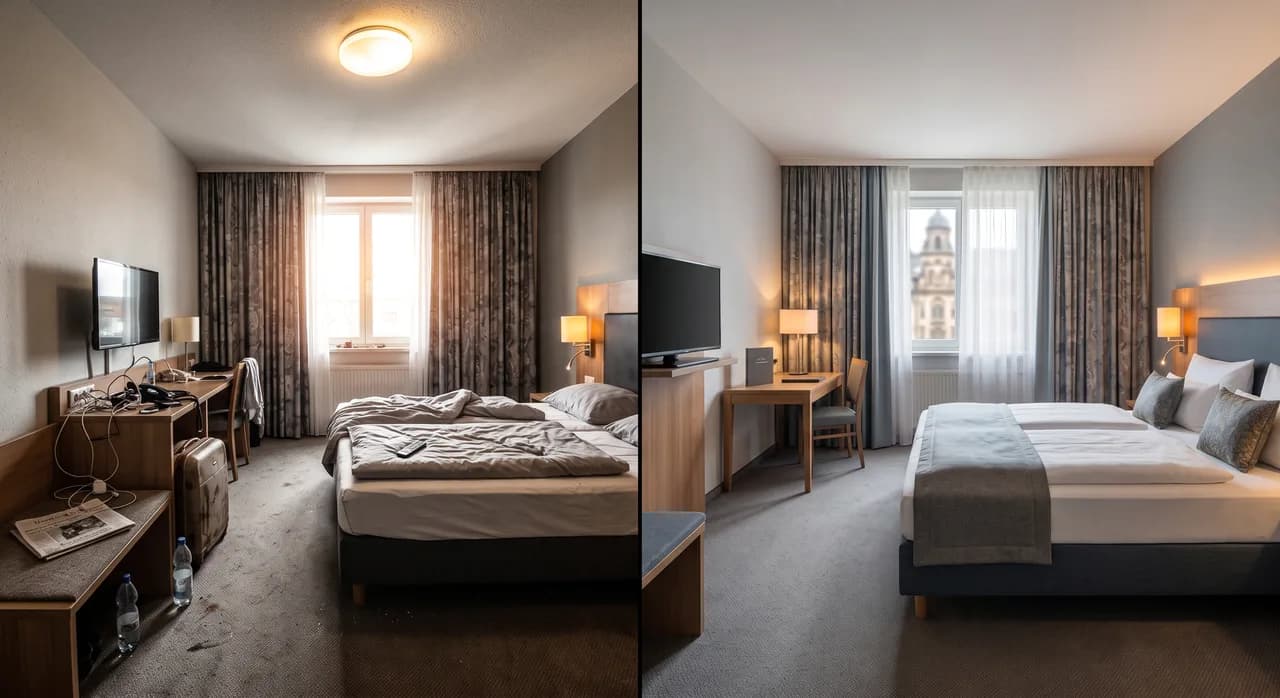
The clean solution begins with scheduling. Public areas such as the lobby, restaurant, spa, and pool are ideally scanned before opening, during off-peak times, or on a closed day when no guests are present. Rooms are captured exclusively in a cleaned, guest-free state, free of suitcases, toiletry bags, and personal traces. Should a person still end up in the frame despite careful planning, this can be retouched or made unrecognizable in post-production. Also make sure internally that your team is informed about the scan appointment. This way you avoid both legal risks and the unprofessional impression of a busy, untidy property.
Dim and Inconsistent Lighting
Light is the factor that decides the perceived quality of a tour, and at the same time it is the most underestimated one. A room scanned with half-closed curtains and a warm bedside lamp switched on quickly appears dark, yellowish, and cramped in the 3D view. It becomes even more problematic when every room within the same tour is lit differently: sometimes harsh midday light, sometimes dusk, sometimes artificial light. These jumps unconsciously make the guest doubt the diligence of the entire property.
The remedy is planning and consistency. Scan in daylight wherever possible with the curtains wide open, and use the natural light as a base, complemented by switched-on room lighting for a warm, homely touch. Aim for a consistent lighting mood across all rooms so that the tour feels all of a piece. In windowless areas such as a spa or conference rooms in the basement, additional lighting is mandatory. An experienced service provider checks the exposure directly on site during the scan and makes corrections, rather than discovering nasty surprises only in post-production. Good light makes rooms larger, warmer, and more inviting, and that is exactly what sells nights.
Neglecting Communal and MICE Spaces
When the focus is too narrowly on the rooms, a key part of the sales story is lost. In upscale hospitality in particular, the decision is rarely made on the room alone. Guests want to know how the lobby feels, how spacious the breakfast room is, whether the spa area promises relaxation, and what the bar looks like in the evening. A tour that shows only beds gives away exactly the emotions that set a property apart from interchangeable competitors.
Even more serious is neglecting the MICE spaces, meaning the meeting, event, and function rooms. This business is highly profitable, and planners of conferences, weddings, or corporate events now almost always make their shortlist digitally. A virtual tour through the event rooms, ideally supplemented with details on square meters, seating arrangements, and capacities, saves the planner a site-visit trip and your sales team valuable time. Show the rooms in a concrete seating arrangement where possible, so the prospect can picture the setup. Anyone who stages their meeting and banquet spaces strongly in the tour opens up a revenue channel that room images alone will never unlock.
No Booking Links and Interactive Tags
A virtual tour is not an end in itself but a sales tool, and yet many tours end in a dead end. The guest stands enthusiastically in the virtual suite, is ready to buy at exactly the right moment, and then nothing happens. There is no button, no link, no path to booking. They have to leave the tour, click back to the website, search for the matching category, and start over there. At each of these steps, you lose a portion of your prospects.
Modern tours can be enriched with interactive elements, and that is precisely where their real value lies. Place a clearly visible booking link in every room category that leads directly into the right category of your booking path. Add informative tags at meaningful points: equipment details at the bathroom, notes on bed size, explanations of the view, menus at the restaurant, treatment offerings in the spa. These info points answer questions exactly where they arise, and the booking link captures the purchase intent at the decisive moment. A tour without these connections is like a shop window without an entrance door.
No Path for Menu and Price Updates
Content that is correct once does not stay that way. Menus change seasonally, spa treatments come and go, prices are adjusted, opening hours shift. If a tour contains this information as a permanently embedded graphic, it inevitably becomes outdated. The guest reads last year's menu in the virtual restaurant or a price that no longer exists. This damages trust and, in the worst case, provokes discussions at reception about supposedly promised terms.
That is why changeable content should never be burned in permanently but instead embedded via maintainable tags. A well-built tour makes it possible to store a PDF menu, a price list, or a linked subpage behind an info point, which can be swapped out at any time without touching the scan. Even better is linking to a page of your website that is maintained anyway, so that updates carry through automatically. Clarify already during production who at the property is responsible for this maintenance and what the update path looks like. This keeps the tour permanently current instead of turning it into a source of errors after just a few months.
Poor Performance on Smartphones
The lion's share of travel decisions today are made on smartphones, often in the evening on the sofa. Nevertheless, many tours are optimized one-sidedly for the large desktop monitor and only reluctantly tested on the phone. Everyone knows the result: the tour takes forever to load, stutters when rotating, the buttons are too small for the thumb, and the info tags are hard to hit. A guest with fluctuating mobile reception does not wait patiently but bounces, and with them goes the booking.
A good tour therefore means uncompromising optimization for mobile devices. This includes lean data volumes through a sensibly limited scope, fast loading times through technical optimization, and an operation designed for the touch screen, with sufficiently large, easily reachable buttons. Equally important is clean integration into your website, so that the tour does not slow down the page's loading speed and fits seamlessly into the mobile layout. Test the finished tour on various devices and with a throttled connection. A tour that runs smoothly on a smartphone reaches guests exactly where they actually book.
Inconsistency Across the Chain
Operators of multiple properties face a particular challenge that simply does not exist in a single hotel. When each hotel has its tour produced independently by a different provider, in a different look, and with a different operating logic, a patchwork emerges. The guest who compares two properties of the brand experiences two completely different digital worlds. Sometimes there are booking links, sometimes not; sometimes the navigation is intuitive, sometimes clunky. This undermines brand perception and makes central control nearly impossible.
The solution is a consistent standard across the entire group. Define bindingly what a tour looks like: the same visual language, the same lighting mood, the same placement and design of the booking links, the same operating logic, the same info-tag structure. A central production partner who handles all properties according to the same concept ensures recognizability and greatly simplifies maintenance, because adjustments are defined once and rolled out everywhere. This way the tour becomes a consistent brand experience instead of a collection of random one-off solutions, and the guest senses the same reliability in every property.
Not Coupling the Tour to the Booking Engine
All the previous points lead up to this final and most important one, because this is where commercial success is decided. A tour that is beautiful but technically sits alongside the booking path remains an image factor without measurable return. The guest moves through the rooms, feels ready to buy, and then the journey breaks off, because the path from enthusiasm to a concrete booking is not built end to end. It is at exactly this break point that most potential direct bookings seep away.
The connection to the booking engine closes this gap. The booking link in the tour should not just lead somewhere on the website, but directly into the right room category of the booking form, ideally with a pre-selected date or category. This way the emotional impulse of the tour transforms seamlessly into a concrete booking step. This coupling also makes success measurable, because you can trace how many bookings originated in the tour. Only then does a pretty marketing instrument become a genuine sales channel whose value you can prove in numbers. Anyone who plans this integration from the very beginning gets the maximum out of every tour produced.
Conclusion
The biggest mistakes in hotel virtual tours almost never arise from a lack of technology, but from a lack of strategy. Anyone who scans every room instead of representative categories, overrides guests' privacy, is careless about light and consistency, neglects communal and MICE spaces, or forgoes booking links and mobile performance ends up producing an expensive tour that serves no one. And without maintainable content and integration with the booking engine, even the most beautiful tour remains a cost factor instead of a revenue driver.
The good news: every one of these mistakes is avoidable if it is factored in before production. A well-thought-out tour is lean, consistent, currently maintainable, fast on mobile, and seamlessly linked to the booking process. This turns it from a nice extra into a reliable direct-booking channel that reduces dependence on portals and presents your property digitally just as convincingly as it feels on site. Anyone who knows the pitfalls described here can ask the right questions and draw the full return from their investment. At FotoEstate, we are happy to support you from the concept all the way to a finished, booking-strong tour.