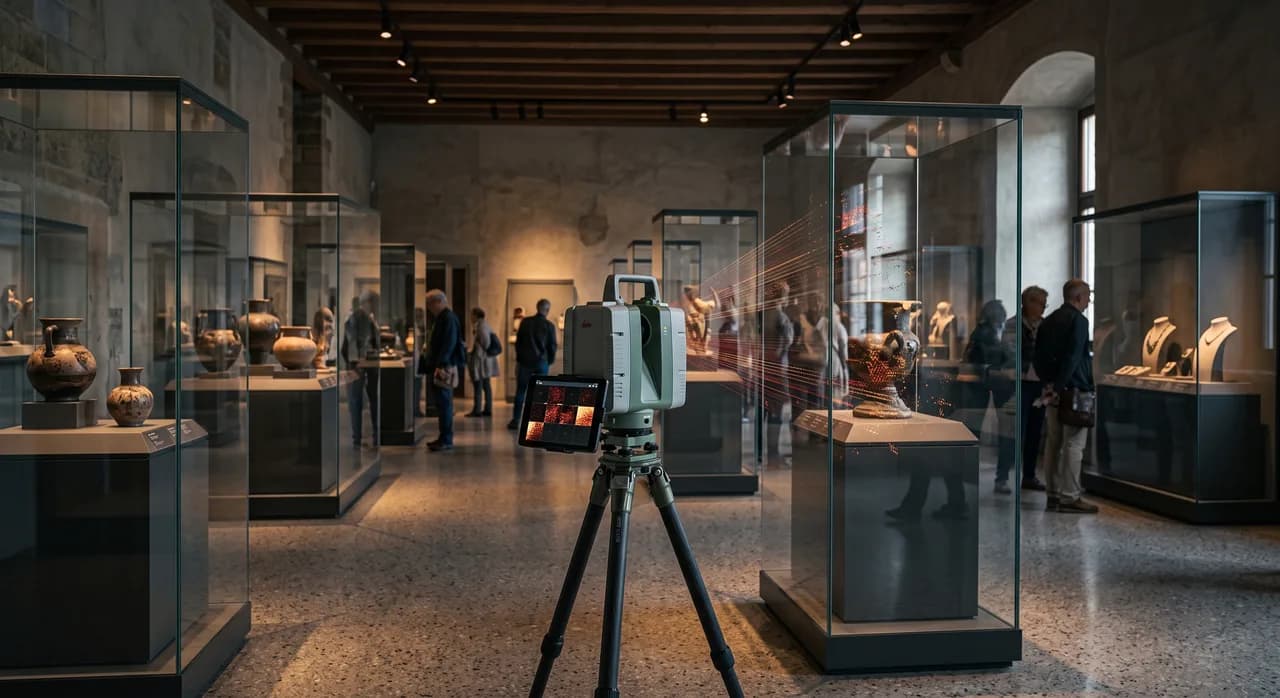
The three-dimensional digitisation of collections has become part of the standard repertoire of modern museum work. A 3D scan promises to preserve an object for posterity, make it accessible online and make it newly available for research, education and exhibition. Yet between the promise and the actual benefit lies a series of pitfalls on which digitisation projects regularly founder. Many of these mistakes are not technical in nature but conceptual and organisational.
As a service provider for high-resolution 3D capture, we encounter these patterns again and again in conversations with museum directors and collection managers. The good news: almost all of them can be avoided if you recognise them early enough. This article describes the most common and most consequential mistakes in museum digitisation and shows how to set up your project to last from the very beginning.
Ignoring Conservation Light Limits
The first mistake, and the one most dangerous to the substance of an object, concerns light. Many photogrammetric and scanner-based methods work with intense illumination in order to maximise colour fidelity and detail sharpness. For sensitive materials such as textiles, watercolours, parchment, historical photographs or painted surfaces, however, such illumination can pose a conservation risk. Heat generation, high illumination levels and ultraviolet components accelerate ageing processes that cannot be reversed. Anyone who does not know the limit values of their own conservation department, or who overrides them during the digitisation process, risks precisely the damage that digitisation is actually meant to prevent.
This mistake can be avoided through close coordination with the conservation team before a single object is placed in front of the camera. For each material, the maximum permissible illumination level and the maximum exposure duration should be defined. Modern capture methods make it possible to work with UV-free LED sources, short exposure times and timed shots, so that the cumulative light exposure remains minimal. For particularly sensitive pieces, the scanning process can be designed so that the light source is active only at the moment of capture. The guiding principle should be: digitisation is governed by the needs of the object, not the other way round. A cleanly documented lighting protocol therefore belongs in every serious digitisation concept.
It helps to regard the conservation requirements not as a tiresome restriction but as part of quality assurance. A transparently kept protocol that records the type of lighting, exposure duration and ambient conditions for each object not only provides security for the individual piece but also delivers robust documentation for lenders, insurers and the museum's own management. If the light exposure is cleanly limited and demonstrated from the outset, the later debate over whether digitisation might have harmed the object never arises. In this way, a potential source of danger becomes a controlled, repeatable and responsibly documented procedure.
Underestimating Glass Cases and Reflections
A second, very practical mistake arises at the object itself: with glossy, reflective or transparent surfaces. Glass exhibits, glazed ceramics, polished metal, lacquered furniture or objects behind display glass present particular challenges to every optical capture method. Reflective surfaces bounce the camera's light back, transparent materials let it pass through, and both result in the software finding no usable surface points. The result is riddled, noisy or simply incorrect geometry. If an attempt is made to scan an object through the display case, reflections of the surroundings and double refractions are added, rendering the model definitively unusable.
The right approach begins with an honest assessment of the material. Reflective and transparent objects must, wherever possible, be removed from the case and captured in a controlled environment. If removal is ruled out for conservation or insurance reasons, specialised methods are required, such as polarised light, cross-polarised filters or a carefully shielded capture setup that blocks out extraneous reflections. For highly reflective surfaces, a temporary, residue-free matting spray may be used in consultation with the conservation team, but with museum holdings this is justifiable only in exceptional cases and never without conservation approval. What matters is identifying these objects as special cases early in the project, rather than discovering on the day of capture that a standard workflow does not work.
In practice, it has proven worthwhile to carry out a review of the intended objects before the actual project and to sort them according to their optical cooperativeness. Matte, opaque surfaces can usually be captured without difficulty and are well suited to an efficient series workflow. Reflective, transparent and heavily structured pieces, on the other hand, belong in a separate process with more time, adapted technology and, where appropriate, test shots. Anyone who plans this separation from the outset not only avoids unusable results but also calculates time and costs realistically. Nothing derails a digitisation plan more reliably than a whole series of objects that turn out to be optical special cases only on the day of capture and throw the entire schedule into disarray.
Skipping Rights and Loan-Agreement Clearance
A particularly frustrating mistake is purely legal in nature and is often noticed only when the model has long been finished: the failure to clear usage rights. Not every object in a collection is also legally free to use. Permanent loans, new acquisitions of contemporary art, objects with subsisting copyrights and, in particular, works borrowed for a special exhibition are frequently subject to contractual restrictions. A loan agreement may explicitly regulate photographic reproduction or prohibit it entirely. Anyone who scans such an object and then publishes the model can quickly find themselves in a copyright infringement and, in the worst case, must remove the result from all channels again.
The solution lies in an upstream rights review that is a fixed part of the project workflow. For each intended object, it should be clarified before capture who holds the rights to the work and its reproduction, whether copyright protection exists and which forms of use the respective loan or acquisition agreement permits. A clear categorisation is sensible: objects that may be fully released, objects that may be used only internally for research and documentation, and objects that should not be digitised at all. This clarification takes time but spares expensive later corrections. Anyone negotiating new loan agreements can negotiate the digitisation rights at the same time and thus create clarity for future projects. A 3D model that may not be shown for legal reasons is a dead asset.
Treating Digitisation as a One-Off Project
A strategically serious mistake is the notion that digitisation is a project with a clear beginning and end. According to this logic, a budget is approved, a service provider is commissioned, a series of objects is scanned, and with the handover of the files the task is considered complete. In practice, however, the real challenge only begins with the data handover. Digital formats become obsolete, storage media fail, software for displaying the models is discontinued, and without responsible curation, painstakingly created data disappears within a few years into unreadable archives. A dataset that is created once but not maintained loses precisely the permanence that 3D digitisation is actually meant to secure.
Anyone who wants to avoid this mistake must understand digitisation as a lasting asset and not as a completed project. This means: defining responsibilities for long-term data curation, establishing a viable storage and backup concept with spatially separated copies, and choosing open, well-documented file formats that will still be readable in ten or twenty years. The raw data produced should be preserved in addition to the finished models, so that new derivatives can be generated in future without having to handle the object again. It is also advisable to integrate the digitisation into a collection management system so that each model remains permanently linked to its physical counterpart, its metadata and its provenance. Only in this way does a one-off expenditure become a lasting investment.
Neglecting Accessibility
A mistake that weighs particularly heavily given the social mission of museums is the neglect of accessibility. Digitisation is frequently justified with the promise of making collections accessible to a broad public. But if the result is a pure 3D view that can only be operated with a mouse or touchscreen, contains no textual description, is unreadable for screen readers and places high demands on device and bandwidth, then digitisation excludes precisely those people who would benefit most from digital access. Building in accessibility after the fact is laborious and expensive, whereas considering it from the outset entails hardly any additional effort.
The better path is to understand accessibility as an integral part of the digitisation concept. This includes meaningful textual alternative descriptions for each model, keyboard operability of the 3D viewers, sufficient contrast in the user interface and the provision of content at several levels of detail, so that less powerful devices and slow connections are also served. High-resolution 3D data also opens up possibilities that traditional exhibitions do not offer: from a precise model, tactile replicas and 3D prints can be produced that give blind and visually impaired people haptic access to the object. Anyone who plans for accessibility from the start not only meets legal and ethical requirements but genuinely opens up their collection to the broad public that digitisation promises.
Accessibility is not purely a question of technology but also of language and mediation. A good alternative description does not merely describe what can be seen; it contextualises the object and makes it comprehensible even without the visual view. It is likewise worthwhile to keep controls simple and self-explanatory and to accompany complex interactions with gentle guidance, so that less tech-savvy visitors are not left behind. Anyone who coordinates these requirements with the specialists for education and inclusion already in the conceptual phase anchors accessibility structurally in the project, instead of having to bolt it on at the end as an expensive retrofit to a finished system.
Poor Coordination with Curators and Conservators
Digitisation projects are not infrequently driven by the technology or the IT department, while the subject specialists are involved only late. This mistake takes its toll on several levels. Curators know which objects are particularly relevant scientifically or for education, which views and details are academically significant, and which contextual information must accompany a model for it to be useful at all. Conservators know the condition of each piece, its handling limits and the conservation requirements. If scanning is carried out without this knowledge, the result is technically flawless but academically unusable models, or avoidable risks arise during handling.
This can be avoided through genuine, early collaboration instead of a mere commission. Before the project begins, curatorial staff, conservation, collection management and the digitisation team should jointly determine which objects are to be captured, in what quality and with what aim. Each piece requires clear handling instructions and, where necessary, the accompaniment of a conservator on the day of capture. The subject-specific requirements for the model, such as particular detail resolutions for research purposes or the capture of specific surface features, should be set down in writing. This coordination slows the start a little but prevents ending up with models that nobody can use, or with objects damaged by improper handling.
No Clear Goal and No Defined Target Audience
The perhaps most fundamental mistake is to digitise without a clear purpose. Driven by the desire to keep up with the times, or by a funding opportunity, objects are scanned without any answer to the questions of what the models are actually meant to serve and who will use them. A model for scientific measurement has entirely different requirements from a model for a playful online experience or for reproduction in a 3D print. Without a defined purpose, the quality is either excessive and therefore unnecessarily expensive, or insufficient and therefore worthless for later needs. Not infrequently, this produces costly mountains of data that nobody accesses.
This mistake is avoided by asking, at the beginning of the project, not about the technology but about the questions of goal and target audience. Is the model to serve research, educational work, exhibition, marketing or pure inventory preservation? Is it aimed at a specialist audience, at school classes, at a broad online public or at people on site in the museum? The technical requirements follow from these answers: the necessary resolution, the colour fidelity, the output format and the mode of presentation. A well-defined goal makes it possible to concentrate resources where they take effect, instead of spreading them across an undirected mass digitisation. Often, a smaller number of excellently and purposefully digitised objects is more valuable than hundreds of arbitrary models with no discernible benefit.
Forgetting the Reuse Value of the Data
The final mistake is at the same time a missed opportunity: the narrow, short-sighted use of the data once it has been created. If an object is digitised only with a single specific occasion in mind, such as a particular exhibition or a web view, the data is often reduced and compressed to exactly that purpose, while the high-quality raw data is lost. In this way, a museum gives away the real added value of 3D digitisation. For a precisely captured object is a data source from which ever new applications can be drawn over the years, provided the source data is preserved in full quality.
To realise this value, digitisation projects should be designed for reuse from the outset. This means capturing at the highest reasonably useful quality and preserving the raw data permanently, even if the current occasion makes lesser demands. A single model can later form the basis for scientific publications, for educational materials, for virtual and augmented reality applications, for tactile replicas, for merchandising, for condition documentation in the event of damage and for restoration planning. Anyone who manages the data with clean metadata, clear provenance and open formats also makes it compatible for collaborations with other institutions and for supra-regional research networks. In this way, a one-off capture becomes an asset that amortises its cost over many years and many applications.
Conclusion
The biggest mistakes in museum digitisation rarely lie in technology alone. They arise where conservation limits are disregarded, material-related challenges underestimated, legal questions bypassed and strategic course wrongly set. Anyone who takes light and materiality seriously, clears rights and loan agreements in advance, understands digitisation as a lasting asset rather than a one-off project, considers accessibility from the outset, works closely with curatorial staff and conservation, defines clear goals and target audiences, and keeps the reuse value of the data in view, lays the foundation for a project that justifies its effort.
In the end, a successful digitisation is always the result of good planning and good collaboration, not merely of powerful equipment. Museums that recognise and avoid these mistakes transform their collections into living digital assets that support research, education and preservation for decades. The best time to ask these questions is before the first scan. As an experienced partner for 3D digitisation, we guide cultural institutions through precisely these decisions, so that a good undertaking becomes a viable and lasting result.