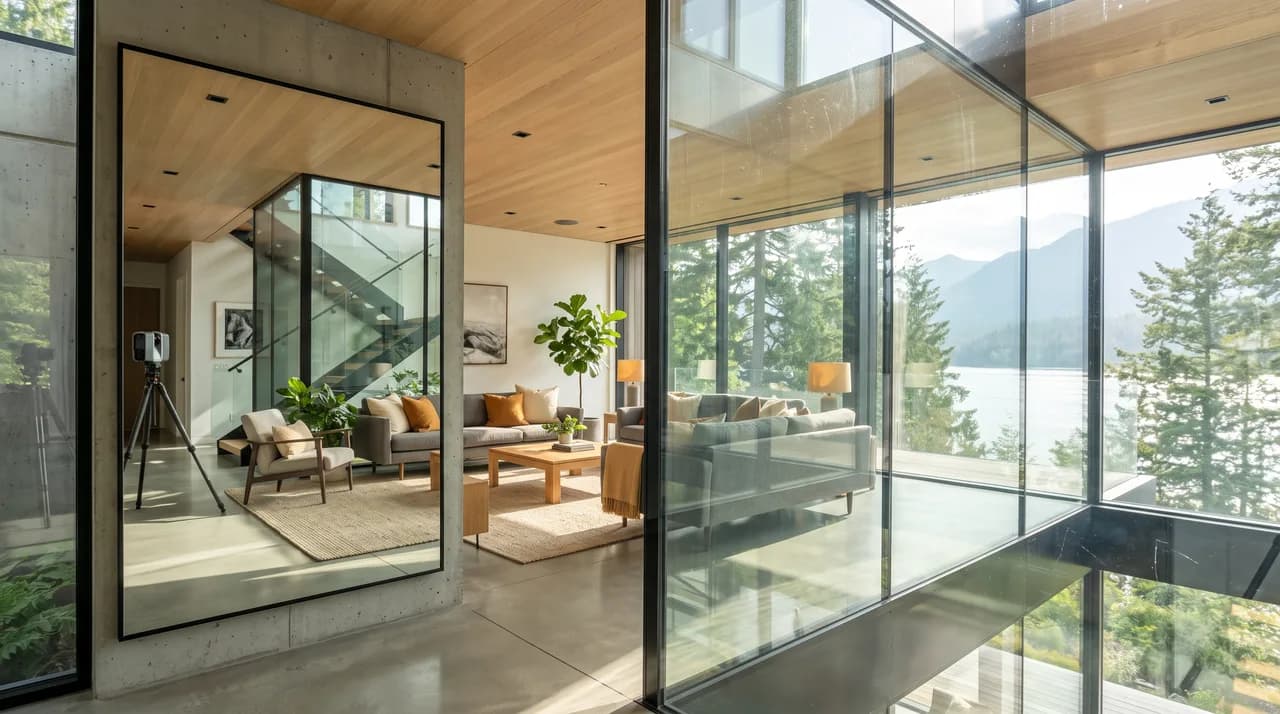
Every experienced 3D scanning technician has a story about the bathroom that took twice as long as expected, or the retail display case that produced a point cloud full of impossible geometry. Mirrors and glass are, without exaggeration, the single most disruptive material category in property digitization. They defeat the basic physical assumptions that laser scanners and cameras rely on, and if left unaddressed, they quietly corrupt the very data that a Matterport tour, a floor plan, or a marketing photo set depends on.
This article explains why reflective and transparent surfaces are so troublesome, where in a property they typically appear, and what professional teams actually do about them. Understanding this is useful not just for photographers and scan technicians, but for real estate agents and property managers who want to know why a walkthrough took an extra hour, or why a certain room needed a second visit.
Why Mirrors Break Laser and LiDAR Scanning
A laser or LiDAR scanner measures distance by emitting a pulse of light and timing its return, or by analyzing the phase shift of a continuous beam. This works reliably against matte, diffuse surfaces because the light scatters in all directions and a portion reliably bounces back to the sensor. A mirror does something entirely different: it reflects the beam specularly, at an angle equal to the angle of incidence, sending it off toward whatever the mirror is aimed at rather than back to the source.
The practical result is what the industry calls ghost geometry. The scanner interprets the reflected beam as if it had traveled in a straight line and hit a real surface, so it plots a point far behind the mirror's actual physical plane - effectively recording a phantom room extending into space where no room exists. In a small bathroom with a mirror over the sink, this can add a hallucinated few square meters to the model, doubling a vanity into what looks like an alcove that was never there. In a hallway with a full-length mirror, the effect can misrepresent the entire depth of the corridor.
At the same time, some scanners fail to register a return signal at all when the mirror deflects the beam completely away from the sensor. This produces the opposite problem: not a ghost surface but an outright hole in the point cloud, a black void where the software has no data to render. Both failure modes - ghost geometry and data holes - can occur from different scan positions in the same room, making mirrors uniquely unpredictable compared to other difficult materials like black surfaces or fine mesh screens.
Why Glass Confuses Both Scanners and Cameras
Glass presents a related but distinct problem because it is partially transparent and partially reflective at the same time, with the ratio shifting depending on the angle of view and the lighting on each side. A scanner beam hitting a glass partition at a shallow angle behaves much like it does with a mirror, bouncing away and creating false depth readings. Hit nearly head-on, however, some of the beam passes straight through, and the scanner may register a point far beyond the glass, essentially seeing through the wall into whatever room lies behind it.
This dual behavior is why glass office partitions, shower enclosures, and display cabinets are notoriously inconsistent in scan data: the same pane can produce a ghost point, a through-glass point, and a correct point within the same handful of scan positions, depending on scanner placement. Photogrammetry-based systems that build geometry from overlapping camera images suffer a related issue, because glass rarely presents consistent visual features for the software to match between frames, leaving stitching algorithms with nothing reliable to anchor to.
For HDR photography, the challenge is different but equally disruptive. Glass and mirrors reflect the photographer, the tripod, the flash, and the surrounding room back into the frame. Because HDR exposure blending combines multiple bracketed shots taken at different exposure values, any reflection that shifts even slightly between frames - a flash firing at a different intensity, a subtle change in ambient light - produces a visible double exposure or ghosting artifact around the reflective area. A glass table top or a glossy shower door can end up with a smeared, semi-transparent double image of the room that immediately signals a low-quality listing photo.
Typical Problem Rooms and Areas
Bathrooms are the most common offender in residential properties, since nearly every bathroom includes a mirror over the sink and often a glass shower enclosure as well. Small bathrooms compound the issue: the room is already tight, so a ghost reflection extending the space by even a meter is proportionally significant and immediately noticeable to anyone reviewing the finished model or floor plan.
Retail and commercial spaces bring their own version of the problem in the form of glass display cases, storefront windows, and mirrored fitting rooms. A boutique shop with mirrored walls intended to make the space feel larger to shoppers creates exactly the opposite effect for a scanner, generating recursive ghost geometry as beams bounce between facing mirrors multiple times before losing enough signal to stop registering.
Modern office environments add glass partition walls, glass meeting room fronts, and frameless glass doors, all of which are popular precisely because they let light through and look sleek - and precisely because of that transparency, they are difficult for both scanning and photography. Glass balustrades on staircases and balconies present a similar issue outdoors and in stairwells, often combined with reflections from adjacent windows that add further complexity.
Masking and Physical Coverage Techniques
The most direct and reliable solution for mirrors is physical masking during the scan or photo session. Technicians commonly cover mirrors with matte fabric, non-reflective cloth, or purpose-made covers before beginning capture, converting the reflective surface into a diffuse one that the scanner can read normally. This eliminates ghost geometry entirely for that surface, at the cost of an extra step and a few additional minutes per room during setup and teardown.
Some practitioners use temporary anti-reflective spray or removable static film on glass partitions and shower doors, particularly in commercial jobs where a client wants a completely clean data set for BIM or facility management use. These approaches work well for planar glass but are impractical for mirrors that are permanently fixed or for very large glazed facades, where the coverage would be too costly or time-consuming relative to the benefit.
For properties where masking every mirror is not feasible - a hotel with mirrored corridors, for example - technicians instead flag the affected surfaces for the client in advance, explaining that the visible model may show minor artifacts in those specific areas while the rest of the space remains fully accurate. Transparency about limitations, rather than pretending the problem does not exist, is standard professional practice.
Multi-Angle Capture and Software-Assisted Cleanup
When masking is not an option, the next line of defense is capturing the room from more scan positions than usual. Because ghost geometry from a mirror shifts position depending on where the scanner is standing, taking additional scans from varied angles gives the processing software - and the technician doing manual review - enough conflicting data points to identify which returns are real and which are artifacts, since genuine geometry stays consistent across positions while ghost points move.
Modern scanning software increasingly includes mirror and glass detection algorithms that flag statistically implausible point clusters, such as a wall segment that appears at two different distances from different scan stations. These tools speed up the identification process significantly, but they rarely resolve every case automatically, particularly with irregularly shaped mirrors or glass that only partially crosses a room.
This is why manual point-cloud cleanup remains a standard part of professional workflow rather than a fallback. An experienced technician reviewing the raw cloud can recognize the tell-tale double-wall pattern of a mirror reflection, delete the phantom points, and in-fill the resulting gap using data captured from an adjacent, unobstructed scan position. This step is time-consuming and requires genuine spatial reasoning rather than a one-click software fix, which is part of why proper scan processing takes measurably longer for mirror-heavy properties than for straightforward rooms.
Polarizing Filters and Photographic Countermeasures
For photography rather than scanning, polarizing filters are the primary tool against reflections. A circular polarizer mounted on the lens can be rotated to reduce or, in favorable conditions, largely eliminate glare and mirror reflections by filtering out light waves that have been polarized by the reflective surface. This is especially effective on glass shower doors, glossy tile, and window glass shot at an angle, and it noticeably improves color saturation and contrast in the same shot.
Polarizers are not a complete fix. Their effectiveness depends heavily on the angle between the camera, the reflective surface, and the light source, meaning a filter that works perfectly for a window on one wall may do little for a mirror on an adjacent wall in the same frame. Photographers therefore combine polarizers with camera positioning choices - shooting from an angle that avoids the camera and tripod appearing in the reflection - and with careful control of on-camera flash, since direct flash is one of the most common causes of a harsh reflected hotspot in a mirror or glass door.
For HDR sequences specifically, technicians sometimes shoot an additional bracket exposure aimed specifically at neutralizing a problem reflection, then blend that frame manually in post-production rather than relying on fully automated HDR merging, which cannot distinguish a moving reflection from a static room feature.
Impact on Measurement Accuracy If Left Unaddressed
The consequences of ignoring these issues go beyond cosmetic imperfections. In a Matterport-style 3D tour, uncorrected ghost geometry from a mirror can inflate the reported square footage of a room, which is a serious problem when floor plans or measurements feed into a listing's stated size - a figure that carries legal and reputational weight in most markets. A bathroom that scans ten percent larger than its true size because of an unmasked mirror is not a minor rendering glitch; it is a data integrity issue.
Uncorrected holes in a point cloud, meanwhile, can break the automatic room-to-room connections that virtual tour software uses to generate walkable paths, sometimes forcing a technician to patch the navigation manually after the fact or, in worse cases, requiring a return visit to rescan the affected area from additional angles. For CAD or BIM deliverables used in renovation or facility planning, a ghost wall segment can propagate into architectural drawings if not caught during quality review, creating downstream errors that are far more expensive to fix once construction planning has begun.
Even when the end deliverable is simply photography rather than a scan, an uncorrected double-exposed reflection in a listing photo undermines buyer trust in subtle ways: it reads as unprofessional, and in a competitive listing environment, images are often the first and most scrutinized part of a property presentation. None of these outcomes are inevitable, but each requires the specific countermeasures - masking, multi-angle capture, filters, and manual cleanup - described above rather than hoping the software handles it by default.
Conclusion
Mirrors and glass will always behave differently from the matte, diffuse surfaces that laser scanners and cameras are fundamentally designed to read, and no single fix eliminates every artifact they cause. What separates a professional result from an amateur one is not the absence of these challenges but the systematic response to them: masking mirrors before capture, choosing additional scan positions in glass-heavy rooms, applying polarizing filters where reflections cannot be avoided, and manually reviewing point clouds for the double-wall signature that reveals a hidden ghost surface.
For property owners and agents commissioning a scan or photo shoot, the practical takeaway is straightforward: rooms with large mirrors, glass partitions, or glazed display cases will typically need more capture time and more careful post-processing than a standard room, and that additional effort is exactly what protects the accuracy of the floor plan, the size stated in a listing, and the visual quality of the final images. Recognizing mirrors and glass as a distinct technical category, rather than an afterthought, is what keeps a 3D tour and photo set trustworthy from the first click to the final measurement.