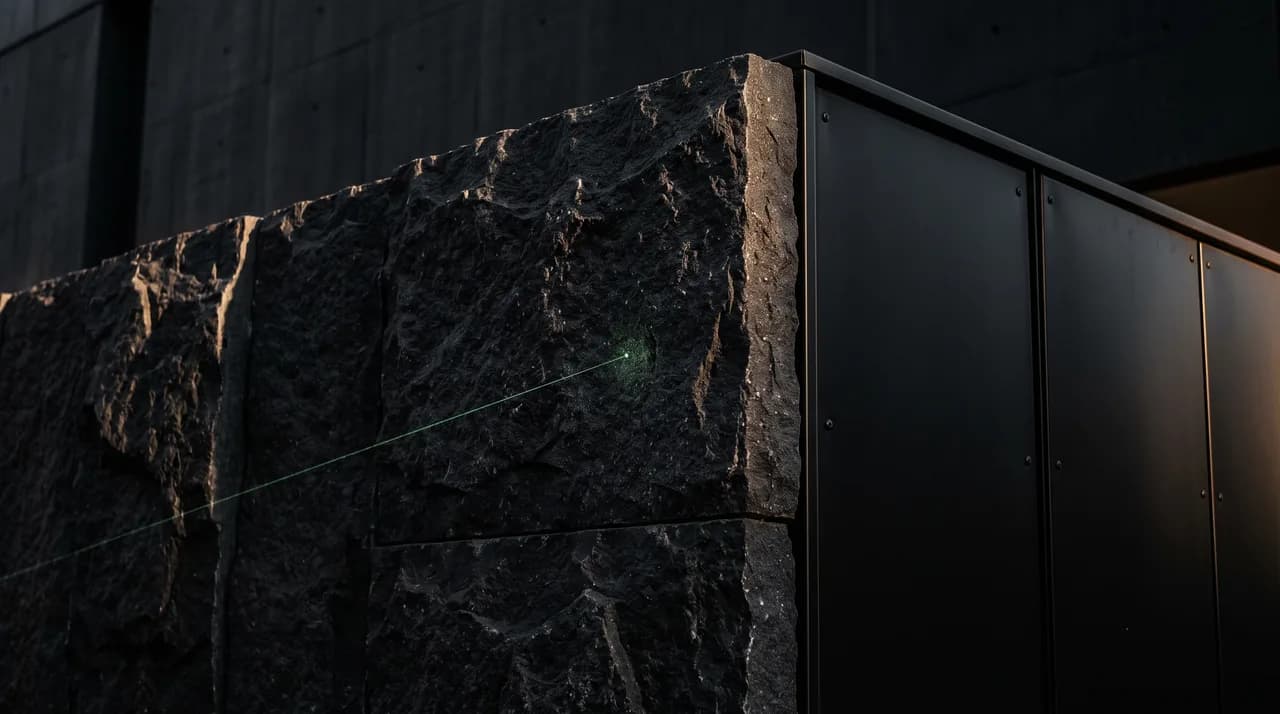
Anyone who has scanned a modern building with a black-clad facade, a loft apartment with a matte-black kitchen island, or a cinema with dark upholstered seating has likely noticed the same thing back at the desk: the point cloud looks thinner, noisier, or simply empty exactly where the black material was. This is not a software bug and not a sign of a cheap scanner. It is physics. Laser scanning depends on light bouncing back from a surface, and black absorbs light instead of reflecting it. Understanding why this happens, and what can be done about it, is essential for anyone commissioning or delivering 3D scanning services for architecture, real estate, or facility documentation.
This article explains the underlying optical problem, why it shows up so often in contemporary architecture and interior design, and the practical techniques experienced scanning teams use to still deliver accurate, complete data. It also covers how this limitation should be communicated to clients before a project starts, so that expectations and budgets are set correctly from day one.
Why Laser Scanners Depend on Reflected Light
A terrestrial laser scanner works by emitting a laser pulse or continuous beam toward a surface and measuring what comes back. Time-of-flight scanners measure how long the light takes to travel to the surface and return; phase-based scanners measure the phase shift of a continuously modulated beam. Either way, the calculation only works if enough of the emitted energy is reflected back into the receiver's sensor. The strength of that returned signal is the raw material the scanner uses to calculate distance, and by extension, to place a point in the resulting point cloud.
The amount of light that returns depends heavily on the albedo, or reflectivity, of the surface being hit. A bright white wall with a matte finish reflects a large share of the incoming laser energy in a fairly even, diffuse pattern, which is exactly what a scanner wants. A dark or black surface, by contrast, converts much more of that incoming energy into heat rather than reflecting it. Less light comes back, and the signal-to-noise ratio the scanner has to work with drops sharply. In practical terms, black paint, black stone, black textiles, and black glass can reflect only a small fraction of the light that a white painted wall reflects under otherwise identical conditions.
When the returned signal is weak, the scanner's internal electronics have to work harder to detect a clean edge in the returning waveform, and the timing or phase measurement becomes less precise. The result is not usually a clean, obvious hole in the data. More often it is a scatter of noisy points around the true surface, an increase in range error, or, in the most severe cases, no valid return at all, leaving a genuine gap in the mesh once the data is processed.
The Optical Root Cause: Absorption, Not Reflection
To understand the problem properly, it helps to separate two related but distinct issues: how much light comes back, and how precisely the timing of that light can be measured. Both get worse together on black surfaces, but they are not the same phenomenon.
The first issue is simple energy loss. Laser scanners typically use near-infrared or visible red light, and pigments that appear black to the human eye are frequently equally absorptive in those wavelengths. Carbon-based black pigments, common in architectural paints and powder coatings, are particularly effective absorbers across a broad spectral range, which is part of why they were chosen for aesthetic use in the first place. The consequence for scanning is that the receiver may only get back a few percent of the emitted energy, compared to sixty, seventy or more percent from a bright surface.
The second issue, known in the industry as range-walk error, is more subtle. Even when some light does return from a dark surface, a weak return signal shifts the point at which the scanner's detection circuitry registers the leading edge of the pulse, relative to a strong return from a bright surface at the identical distance. This systematic bias means that a black object can appear to be measured at a slightly different distance than an adjacent white object, even though both are physically in the same plane. On high-accuracy applications, such as documenting facade geometry for renovation planning or verifying as-built tolerances, this range-walk effect can introduce measurable systematic error that is worse than random noise because it does not average out with repeated scanning from the same angle.
Where This Problem Shows Up Most Often
Black and near-black surfaces have become far more common in the built environment over the last decade, which is precisely why this issue deserves more attention than it once did. Matte black aluminum composite panels, anthracite-grey to near-black window frames, black standing-seam metal roofing, and black-stained timber cladding are now standard vocabulary in contemporary residential and commercial architecture across Germany and much of Europe. A scanning team documenting a newly built or renovated building envelope for as-built documentation will frequently encounter these materials on a majority of the facade.
Inside buildings, the same trend appears in interior design. Black kitchen countertops in polished or honed granite and quartz composite, black kitchen cabinetry, dark leather or velvet upholstery, black structural steel elements left exposed as a design feature, and black-framed glass partitions all present the same optical challenge. Real estate marketing scans of high-end apartments and show homes are especially prone to this, since black fixtures and furniture are a recurring premium design choice.
Cultural and entertainment venues bring their own version of the problem at scale. Theaters, cinemas, and concert halls are typically finished in black or very dark tones throughout, specifically to control stray light and improve visual contrast for the audience, which is exactly the opposite of what a scanner needs. Black stage curtains, black seating upholstery, and black-painted technical grids can turn an entire venue into one continuous low-reflectivity environment, compounding the problem because there are few or no bright reference surfaces nearby to help the scanner or the processing software cross-check geometry.
Impact on Point Cloud Quality and Measurement Accuracy
The practical consequences of scanning black surfaces vary by severity. At the milder end, a scan of a black surface will simply contain more noise: individual points scattered a few millimeters off the true surface, giving the resulting mesh a rougher, less clean appearance than the surrounding data. For general visualization purposes, such as a walkthrough tour or a marketing render, this may be barely noticeable after processing.
At the more serious end, particularly with highly specular black materials like polished black granite or glossy black lacquered furniture, the scanner may receive almost no usable return at all. Specular surfaces reflect light in a narrow, mirror-like direction rather than scattering it diffusely back toward the sensor, so unless the scanner happens to be positioned at exactly the right angle, the beam bounces away entirely. This combination of low albedo and specular behavior is the worst case scenario, and it commonly produces genuine holes in the point cloud that later have to be filled or approximated during modeling.
For projects where dimensional accuracy actually matters, such as generating as-built floor plans for a building permit, verifying installed clearances, or producing a BIM model intended for facility management, these gaps and errors are not just a cosmetic issue. A missing edge on a black stone countertop or an inaccurately placed corner on a black steel beam can propagate into downstream deliverables, resulting in floor plans or models that are subtly wrong in exactly the areas where a client might later want to place new furniture, cut an opening, or coordinate trades.
Practical Countermeasures: Scanner Settings and Scan Strategy
Experienced scanning teams have developed a set of reliable techniques to reduce the impact of dark surfaces, even though none of them eliminate the underlying physical limitation entirely. The first line of defense is adjusting the scanner's own acquisition settings. Many modern terrestrial laser scanners allow the operator to increase integration time or reduce scan speed for a given setup, which allows the receiver to gather more signal per point and partially compensate for the weak return. This trades scan duration for data quality, and on projects with significant black surface area, that trade is usually worth making.
The second technique is positional: adding extra scan positions and shooting the same black surface from multiple angles. Because the amount of light returned from a dark, semi-specular surface can vary considerably depending on the angle of incidence, a position that yields almost nothing from one viewpoint may still capture a usable partial return from another. Registering multiple partial captures of the same black element from different stations, then merging them during processing, often produces a serviceable representation of a surface that would otherwise be a hole in a single-position scan.
A third, more manual technique involves temporary reference targets or markers. Placing small, non-invasive reflective or bright-colored markers at known points on or near a problematic black surface gives the scanner and the registration software strong, unambiguous reference points nearby, which helps constrain and correct the geometry in the surrounding low-signal area during processing. This is particularly useful on features like black window reveals or dark structural edges where precise corner placement matters for the final deliverable.
Supplementing with Photogrammetry and Hybrid Workflows
When laser data alone cannot resolve a black surface adequately, many professional workflows now fall back on photogrammetry as a complement rather than a replacement. Photogrammetry reconstructs geometry from overlapping photographs rather than direct light-time-of-flight measurement, and while it has its own challenges with uniformly dark, texture-less surfaces, it can sometimes pick up subtle surface detail, color variation, or specular highlights that a laser scanner misses entirely, especially under controlled, diffuse lighting.
In practice, this means a hybrid capture approach: laser scanning to establish the overall accurate spatial framework of a building or space, supplemented by targeted photographic capture of problematic black elements, with the two datasets aligned and merged during post-processing. This is more time-consuming and adds a step to the workflow, but for projects where a black element is both large and important to the final deliverable, such as a black stone reception desk in a lobby scan intended for a high-fidelity architectural model, it is often the only way to close the gap left by laser data alone.
Controlled supplementary lighting can also help in interior settings. Positioning additional diffuse light sources to reduce the contrast between a black surface and its surroundings, or in some cases applying a temporary, removable matte coating or spray to genuinely mirror-like black surfaces before scanning, are techniques occasionally used on projects where accuracy requirements are strict and the client has approved such intervention in advance. These are more invasive measures and are generally reserved for cases where nothing else has produced acceptable results.
Setting Expectations: Communicating the Limitation to Clients
Perhaps the most important part of managing black surfaces well has nothing to do with equipment or technique at all: it is communication. Clients commissioning a 3D scan of a building or interior space frequently have no reason to know that the color and finish of their materials affects data quality, and a scanning provider that raises this issue during project scoping, rather than after delivery, builds trust and avoids disputes.
A short conversation before the site visit, ideally supported by a walk-through of the space or a review of architectural drawings and material specifications, allows the scanning provider to flag likely problem areas in advance: a black facade, a dark kitchen island, a theater interior. This is the moment to discuss whether extra scanning time, additional scan positions, or a supplementary photogrammetry pass will be included in the scope and the price, rather than discovering after the fact that a deliverable has unexpected gaps.
It is equally important to set accuracy expectations proportionate to the project's actual purpose. A marketing walkthrough of an apartment with a black kitchen island can usually tolerate a small amount of extra noise that a skilled modeler cleans up during processing, while a construction documentation project involving a black structural element demands the fuller set of countermeasures described above, and a corresponding allowance in schedule and budget. Being explicit about this trade-off upfront, rather than treating it as an unfortunate surprise, is what separates a scanning provider clients trust with complex projects from one they use only once.
Conclusion
Black and dark matte surfaces will remain a genuine physical challenge for laser scanning for as long as the technology depends on measuring reflected light, because no amount of software cleverness can invent signal that was never returned to the sensor in the first place. What has changed is how well the industry now understands and manages the problem: adjusted scanner settings, deliberate multi-angle capture strategies, temporary reference markers, and hybrid workflows that bring in photogrammetry where laser data alone falls short all give experienced teams reliable ways to close the gap. Combined with clear, proactive communication about where these challenges are likely to appear on a given project and what it will take to address them, black surfaces become a manageable planning factor rather than an unpleasant surprise, allowing accurate, complete 3D documentation even in the increasingly common buildings and interiors that make heavy use of black design elements.