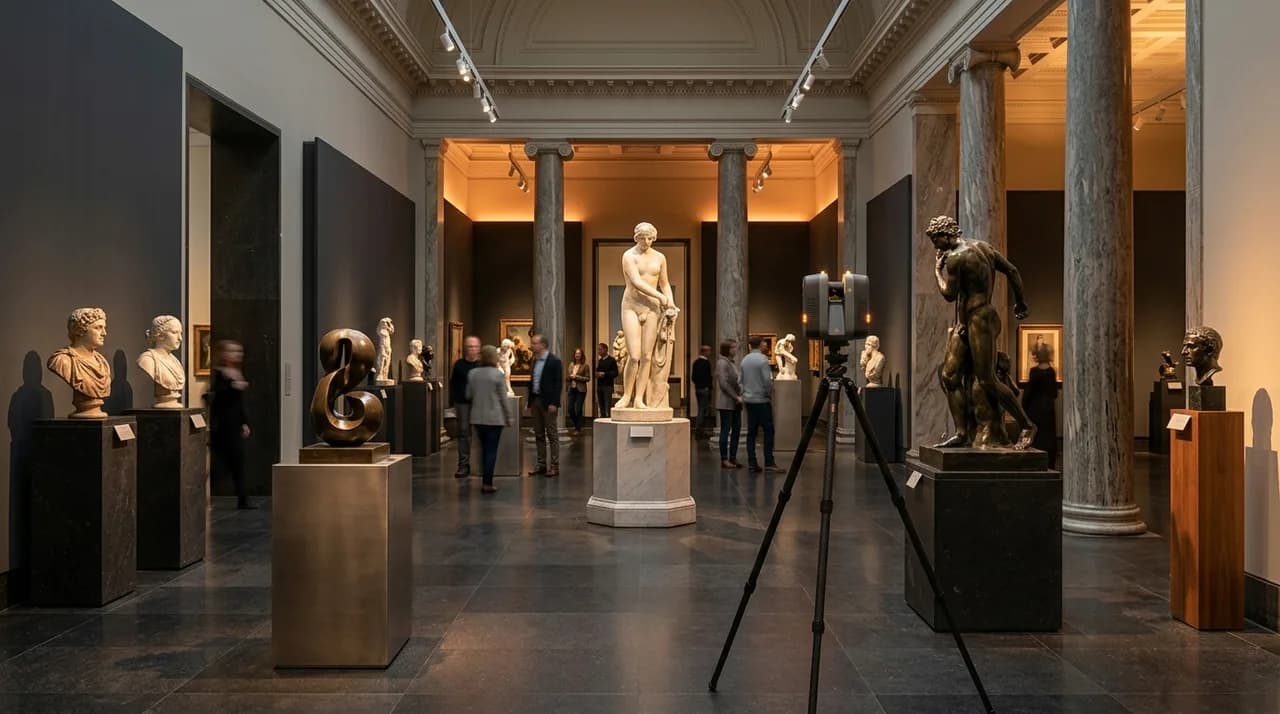
Capturing a museum or a temporary exhibition is unlike almost any other visual media assignment. The objects are irreplaceable, the lighting is dictated by conservation rather than aesthetics, and every square metre is shared with curators, conservators, registrars, and — often — visitors. After working across a wide range of cultural projects, from permanent collection halls to touring shows and heritage interiors, a consistent set of lessons keeps resurfacing regardless of the institution's size or subject matter.
This article collects the practical knowledge that matters most for museum directors and cultural institution managers who are considering photography, 3D scanning, or a digital twin of their spaces. None of it is theoretical. It comes from the reality of working inside living institutions where the artwork always comes first, the schedule is never entirely your own, and the data you produce has to serve far more purposes than a single brochure image. The goal here is to help you plan a project that respects the collection, satisfies your stakeholders, and produces assets you can genuinely reuse.
Lighting That Respects Conservation Before Composition
In most commercial photography, light is a creative tool you shape at will. In a museum, light is a constraint you inherit. Many sensitive materials — works on paper, textiles, photographs, natural history specimens, and painted surfaces — have strict limits on both light intensity and cumulative exposure. Flash is frequently prohibited outright, not because a single burst is catastrophic, but because institutions rightly protect against the precedent and the cumulative effect of repeated capture. The practical consequence is that we plan around the existing gallery lighting rather than fighting it.
Working without flash means embracing longer exposures, stable tripods, and careful sensor settings to hold detail in dim, warm, and often deliberately uneven light. Gallery lighting is designed for the human eye and for object protection, not for a camera, so mixed colour temperatures and pools of shadow are the norm. Rather than flattening this with added light, the better approach is usually to capture the room as it is intended to be experienced, then correct colour and balance in post-production where the object is never at risk. When supplementary light is permitted at all, it is low-intensity, filtered, kept well away from sensitive surfaces, and always cleared with the conservation team first.
The lesson that repeats is simple: the lighting brief is written by the conservator, not the photographer. Institutions that share their light-level limits, UV and infrared policies, and any per-object restrictions before the capture day save everyone time and avoid the awkward moment of discovering on site that a centrepiece cannot be lit the way a shot was planned. Good results in these conditions come from preparation and patience, not from brighter equipment.
Glass, Vitrines, and the Physics of Enclosed Objects
A large share of museum objects live behind glass, and vitrines are among the most technically demanding subjects in any capture project. Glass reflects the room, the lighting, the camera, and the operator, and it often sits at an angle or carries a subtle curve. For both photography and 3D scanning, transparent and reflective surfaces confuse the process: a scanner may read a reflection as geometry, or fail to register the glass at all and instead capture a ghost of whatever is mirrored in it. Ignoring this reality is the fastest route to disappointing results.
The techniques that work are methodical rather than dramatic. Polarising filters cut a significant amount of reflection when the angle is right. Careful positioning — shooting slightly off-axis, controlling what is behind and beside the camera, and using dark cloth to absorb stray reflections — removes much of the rest. For enclosed objects we often capture the case as it appears to visitors for context, and, where the institution permits and a conservator is present, capture individual objects with the glass temporarily removed for a clean, reflection-free record. That decision always belongs to the museum, never to the capture team.
For digital twins and walkthroughs, vitrines require honest expectations. A scan will represent the room and the cases convincingly, but the objects inside heavily glazed cases may show reflection artefacts that no automated process fully resolves. The most reliable outcome combines a spatial scan of the gallery with separate high-quality photography of key objects, linked together so a viewer can move through the room and then examine a chosen piece in clean detail. Setting this expectation early prevents the mismatch between what a scanner promises and what physics allows.
Digital Twins for Accessibility and Wayfinding
One of the most valuable and underused applications of a museum digital twin has nothing to do with marketing. A dimensionally accurate model of your galleries is a powerful accessibility and wayfinding resource. Visitors with reduced mobility, sensory sensitivities, or anxiety about unfamiliar spaces benefit enormously from being able to preview a route before they arrive: where the step-free entrances are, how far it is between rest points, which rooms are quiet, and what a given gallery actually looks and feels like. A digital twin turns an abstract floor plan into something a person can genuinely understand in advance.
Internally, the same model supports operational wayfinding and planning. Staff can rehearse visitor flow, identify pinch points before a busy exhibition opens, and plan clear routes for guided tours or school groups. When accessibility audits are required, a measurable digital model lets teams check door widths, turning circles, and sightlines without repeatedly occupying the galleries with tape measures. The institution effectively gains a shared spatial reference that everyone — from front-of-house to facilities — can consult from a desk.
The recurring lesson is that accessibility is best designed in from the start of the capture, not retrofitted afterwards. If wayfinding is a goal, we plan the scan to include entrances, transitions, lifts, and rest areas rather than only the showpiece rooms, and we make sure the navigation is intuitive for someone who has never set foot in the building. A digital twin built with accessibility in mind serves a far wider audience than one built purely to look impressive, and it signals that the institution takes inclusion seriously.
Copyright, Loans, and the Right to Photograph
Owning or displaying an object does not automatically grant the right to photograph it and publish the result. This is one of the most common surprises for institutions embarking on a comprehensive capture project, and it deserves attention long before anyone arrives with a camera. Loan agreements frequently restrict or forbid the photography of borrowed works, sometimes permitting documentation for internal records but not for public-facing use. Contemporary works may still be under copyright held by the artist or their estate, which can limit reproduction independently of who owns the physical piece.
The practical implication for a virtual tour or a photographic survey is that not every object can appear, and a blanket capture of an entire gallery may inadvertently include works that cannot legally be shown online. The workable solution is a clearance list agreed with the registrar and rights team before the project: which objects are fully cleared, which may be documented for internal use only, and which must be excluded or obscured in any published output. For touring exhibitions this list can differ from venue to venue, so the same physical show may need different published versions.
The lesson that keeps proving its worth is that rights clearance is a project workstream, not an afterthought. Institutions that treat it as such — mapping restrictions early and building the capture plan around them — avoid costly re-editing, takedown requests, and strained relationships with lenders. A capture partner who understands these constraints will ask about them proactively and design the deliverables so that internal and public versions are cleanly separated from the outset.
Virtual Tours as Outreach and Inclusion
A well-made virtual tour is far more than a digital substitute for a visit. For many institutions it has become a genuine outreach channel, reaching audiences who cannot travel, who live in other countries, or who are researching a collection for study. It extends the life of temporary exhibitions that would otherwise vanish when the show closes, preserving a walkable record long after the objects have returned to their lenders. For education teams, a tour becomes teaching material that a class can explore before or after a physical visit, or in place of one when a trip is not possible.
Inclusion is where virtual tours quietly do their most important work. A carefully produced tour can incorporate readable labels, zoomable detail on objects, audio description, and text alternatives that make a collection approachable for people with a range of needs. Someone who finds a busy gallery overwhelming can explore it calmly at home; a researcher can examine a surface far more closely than the barrier rope would ever allow in person. These are audiences an institution rarely sees in its visitor numbers, yet they are precisely the people a public mission is meant to serve.
The recurring lesson is to treat the virtual tour as a product with its own audience, not as a leftover by-product of the photography. That means considering navigation, load times, captioning, and the story the tour tells, rather than simply publishing a raw walkthrough. The most successful tours are curated: they guide a remote visitor with the same care a curator brings to a physical route, and they are built to be genuinely usable rather than merely impressive at first glance.
Coordinating With Curators and Conservators
No museum capture succeeds without close coordination with the people who care for the collection. Curators understand the intended narrative of a display, which objects are central, and how a room is meant to be read; conservators understand what each material can and cannot tolerate. The most productive projects begin with a walk-through alongside both, during which restrictions, priorities, and sensitivities are mapped room by room. This conversation shapes everything that follows, from lighting choices to the running order of the capture day.
In practice, this coordination is continuous rather than a single briefing. Conservators may need to be present when certain objects are approached, cases are opened, or any supplementary light is used. Curators often have strong views about how a display should be represented — a considered arrangement can be undermined by a careless angle that flattens its meaning. Building in time for their input, and respecting their authority over the objects, is not a courtesy but a requirement. The capture team works within the museum's rules; it does not set them.
The lesson that repeats across projects is that the best outcomes come from treating conservators and curators as collaborators from day one, not as approvers at the end. When the capture team listens to their constraints early, the work goes faster on site, fewer compromises are discovered too late, and the resulting assets reflect the institution's own understanding of its collection. Trust, once established, also makes future projects far smoother, because the team has demonstrated that the collection's safety genuinely comes first.
One Capture, Many Uses: Planning, Insurance, and Reuse
A common mistake is to commission museum photography or scanning for a single purpose — a website, say — and then discover later that the same effort could have served many needs at once. High-quality capture data is expensive to gather because of the constraints involved, so the smart approach is to plan from the start for reuse. A single well-executed campaign can feed public-facing tours, internal condition records, exhibition planning, marketing, and grant applications, provided the data is captured at sufficient quality and organised sensibly.
Exhibition planning benefits enormously from accurate spatial data. When a gallery has been scanned to scale, teams can test layouts, plan the placement of large objects, model sightlines, and check that a proposed arrangement actually works before anything heavy is moved. This reduces the physical handling of objects and the guesswork that comes with planning on paper. For touring shows, the ability to rehearse an installation digitally against a real set of dimensions is a genuine saving in time, cost, and risk to the works themselves.
Insurance and risk management are the other quiet beneficiaries. Detailed visual and dimensional records support valuations, condition reporting, and — in the worst case — loss or damage claims and recovery. A documented baseline of an object's state, captured under controlled conditions, is far more useful than photographs taken hastily after an incident. The recurring lesson is to agree the full set of intended uses before the capture, so the data is gathered once, to the right standard, and organised so that each department can draw on it for years rather than commissioning the same work repeatedly.
Planning the On-Site Day Around a Living Institution
Museums do not pause easily. Even when a gallery is closed to the public, it remains an active workplace with security protocols, environmental controls, and staff whose time is limited. The single biggest factor in a smooth capture is realistic scheduling that respects this reality. Trying to photograph or scan around open visiting hours rarely produces clean results and adds risk, so the most successful projects secure dedicated access windows — early mornings, closed days, or the quiet period between exhibitions when a space is being reset.
The change-over between exhibitions is often the ideal moment for spatial capture, because objects may be temporarily accessible and the room can be worked without a public audience. Timing a scan to coincide with an install or de-install, however, requires careful negotiation, since those periods are already busy with handling and logistics. The trade-off is between a quieter but object-free empty gallery and a fuller but more chaotic active one, and the right choice depends on what the deliverable needs to show. Deciding this in advance avoids conflict on the day.
The lesson that keeps proving true is that logistics deserve as much planning as the photography itself. Access, security clearance, supervision, insurance requirements for the capture team, and a clear point of contact who can make decisions on the day all matter as much as the equipment. Institutions that assign an internal coordinator and agree a detailed run sheet consistently get better results with less disruption, because everyone knows what is happening, when, and who is responsible for the objects at every stage.
Conclusion
Museum and exhibition projects reward institutions that plan them as collaborations rather than transactions. The constraints that make these spaces challenging — protective lighting, glass and vitrines, rights restrictions, and the primacy of conservation — are not obstacles to work around so much as the framework the entire project should be built upon. When the capture team treats the collection's safety and the institution's rules as the starting point, the technical difficulties become manageable and the results genuinely serve the museum's mission.
The institutions that get the most value are those that think beyond a single deliverable. A digital twin can widen access, support wayfinding, and preserve a temporary show; the same data can inform exhibition planning and strengthen insurance and condition records. Clearing rights early, coordinating closely with curators and conservators, and scheduling realistically around a living institution are what turn a one-off shoot into a lasting asset. Approached this way, visual media and 3D capture become tools that help a cultural institution protect, explain, and share its collection far more widely than its walls alone ever could.