Every residential property is different, but the patterns behind what makes a listing succeed or fail are remarkably consistent. After working across many residential projects — from compact city apartments to detached family homes and new-build developments — certain truths keep resurfacing regardless of location, price segment, or property type. This article collects the practical lessons that matter most for agents and developers who want their listings to perform.
None of this is theoretical. It comes from watching how listings behave once they go live: which ones generate inquiries within hours and which ones sit quietly on page three of a search result. The differences are rarely about the property itself. They are almost always about how it was presented.
The Cover Photo Decides in Seconds
On every portal, in every search result grid, the cover photo is doing more work than any other single asset in a listing. Buyers scroll through dozens of thumbnails before they click on anything, and that decision happens in under two seconds. The cover image is not just a photo — it is the filter that determines whether the rest of the listing gets seen at all.
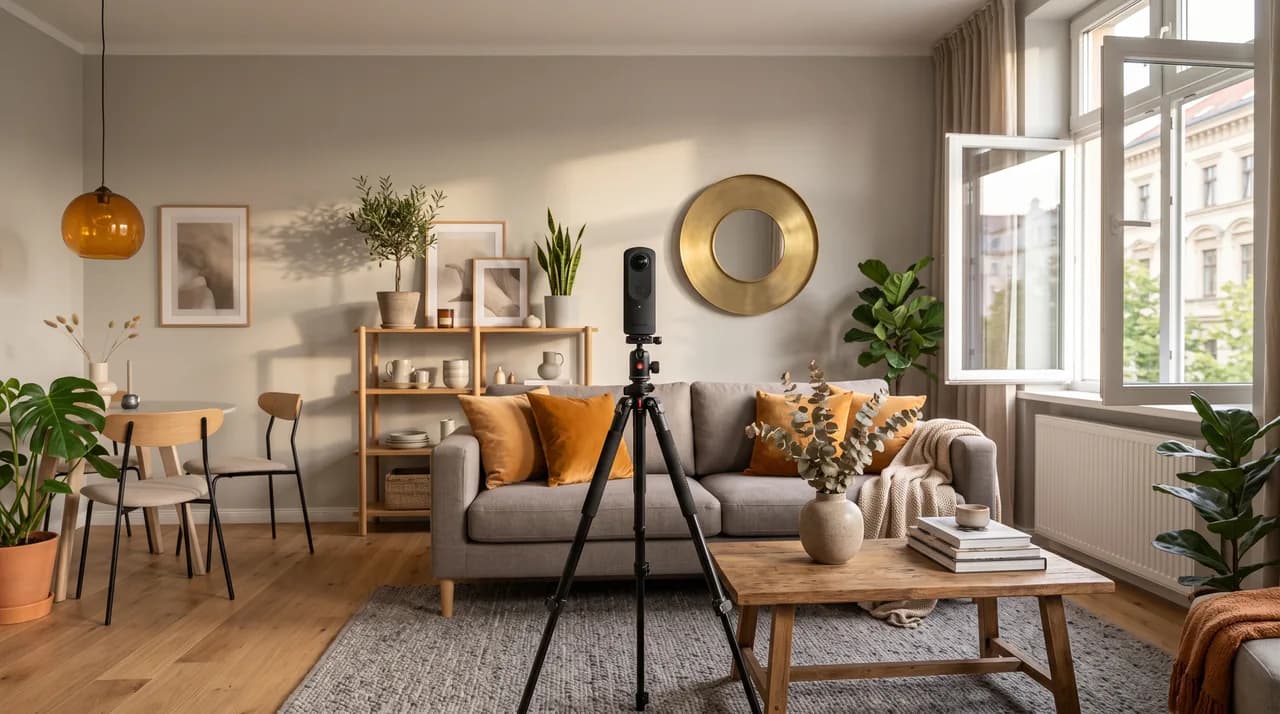
The recurring mistake is choosing the cover photo based on what looks impressive to the seller rather than what will stop a scroll. A dramatic wide-angle shot of an empty room is often less effective than a warm, well-lit image of a space that immediately signals livability. Facade shots work well for houses with genuine curb appeal, but for apartments, an inviting interior almost always outperforms an exterior view. The best-performing cover photos tend to share three traits: strong natural light, a clear sense of scale, and a composition that lets the eye rest rather than search for the point of interest.
What is often underestimated is how much this one decision affects the return on every other photo taken. A property can have twenty excellent images, but if the cover photo is mediocre, most potential buyers never see the other nineteen. Agencies that treat cover photo selection as a deliberate, tested decision — rather than defaulting to whatever image came first in the folder — consistently see stronger click-through rates on their listings.
Light Is the Most Underrated Factor
Of all the variables that separate an average listing from an excellent one, light is consistently the most undervalued. Agents and sellers focus heavily on staging, angles, and equipment, but the quality and direction of light shapes a viewer's emotional response to a space more than almost anything else. A room photographed in flat, overcast light at midday looks fundamentally different from the same room shot an hour before sunset with warm light spilling across the floor.
This is not simply an aesthetic preference. Light affects how buyers judge a property's condition, its orientation, and even its perceived value. South-facing rooms photographed at the wrong time of day can look dim and uninviting, undermining one of the property's genuine selling points. Conversely, a north-facing room shot with the right supplemental lighting can appear bright and welcoming even without direct sun. Getting this right requires planning the shoot around the property's actual orientation, not around whatever time slot happens to be convenient.
The practical lesson for agents is to treat the timing of a photo shoot as a strategic decision, not a scheduling afterthought. Properties with strong natural light in the morning should be shot in the morning. Properties that only come alive in the late afternoon should wait for that window, even if it means an extra visit. The cost of a second visit is negligible compared to the cost of a listing that undersells a property's best feature because the photographer arrived at the wrong hour.
Staging Helps Buyers Judge Scale
Empty rooms are notoriously difficult to read. Without furniture or reference points, buyers consistently misjudge the size of a room — usually underestimating it, sometimes by a significant margin. This is one of the clearest, most repeatable findings across many residential projects: staged rooms generate more inquiries and more accurate buyer expectations than empty ones, even when the underlying square footage is identical.
Staging does not need to be elaborate or expensive to be effective. A simple bed, a small table and chairs, or a sofa positioned to show traffic flow gives viewers an immediate anchor for scale. Virtual staging has become a practical middle ground for vacant properties, allowing agents to furnish a space digitally without the cost and logistics of physical staging. The key requirement, regardless of method, is that the furniture proportions look realistic — oversized or clearly artificial staging erodes trust rather than building it.
There is a secondary benefit that is often overlooked: staged spaces help buyers picture their own life in the property, which shortens the emotional distance between viewing a listing online and booking a physical visit. An empty room asks the buyer to do the imaginative work themselves. A well-staged room does that work for them. Agents who stage even one or two key rooms — typically the living room and a bedroom — routinely see better engagement than those who present a fully empty property.
Floor Plans Are Underrated Despite Heavy Use
If there is one asset that is consistently undervalued relative to how much it actually gets used, it is the floor plan. Photos generate the emotional pull that gets someone to click on a listing, but floor plans are what serious buyers study before deciding whether to request a viewing. Analytics on listing engagement repeatedly show floor plans receiving disproportionately high view times relative to how little effort agents typically put into them.
The common mistake is treating the floor plan as an afterthought — a rough sketch attached at the bottom of the listing, sometimes without room dimensions, sometimes without a clear orientation indicator, and often inconsistent in style with the rest of the marketing material. Buyers who are seriously evaluating a property use the floor plan to answer practical questions: does the furniture I already own fit, how do the rooms connect, is there a logical flow between the kitchen and the living area. A poorly produced floor plan leaves these questions unanswered and pushes hesitant buyers toward listings that make the decision easier.
A well-produced floor plan, ideally generated from an accurate 3D scan rather than a rough manual sketch, does more than inform — it builds confidence. It signals that the agent or developer has invested real effort into the listing, which by extension suggests the property itself has been well cared for. In new-build and off-plan marketing especially, where buyers cannot walk the actual finished unit, an accurate, clearly labeled floor plan is often the single most-referenced document in the entire sales process.
Recurring Mistakes That Undermine Good Properties
Certain mistakes appear again and again, regardless of property type or market segment, and they are almost always fixable with minimal effort. Clutter is the most common: personal items, overflowing counters, cables, and general household mess distract the eye and make rooms feel smaller and less cared for. A thorough declutter before any shoot is one of the highest-return, lowest-cost improvements available to any seller.
The second recurring issue is shooting at the wrong time of day, discussed above, but it is worth repeating because it is so frequently the difference between a listing that performs and one that does not. The third is an incomplete or disorganized set of images — too few photos, missing key rooms, no exterior or building context shots, or photos presented in an order that does not follow a logical walkthrough of the property. Buyers want to mentally move through a home the way they would in person: entrance, main living spaces, bedrooms, bathrooms, then outdoor areas. Listings that jump between rooms in no particular order create friction that measurably reduces time spent on the listing.
A less obvious but equally damaging mistake is inconsistency across a portfolio. When one listing from an agency looks professionally produced and the next looks like it was shot on a phone in poor light, it undermines trust in the agency as a whole, not just in that one listing. Buyers browsing multiple properties from the same agent form an impression of reliability based on the weakest listing they see, not the strongest.
How Sales Marketing Differs from Rental Marketing
The psychology behind marketing a property for sale is meaningfully different from marketing the same property for rent, and treating the two the same way is a subtle but common error. Rental buyers are typically making a shorter-term, lower-commitment decision. They care about practical details — proximity to transport, condition of appliances, move-in readiness — and tend to decide quickly based on functional criteria.
Sales buyers, by contrast, are making a long-term financial and emotional commitment. They need to be convinced not just that a property is functional, but that it is a place they can imagine building a life in, and that it represents sound value over years, not months. This means sales marketing benefits from a stronger emotional arc: lifestyle-oriented imagery, a sense of light and atmosphere, and marketing materials that support a longer decision-making process, including detailed floor plans, neighborhood context, and often a virtual tour that allows repeated, unhurried exploration.
Agents who reuse rental-style marketing — quick, functional, minimal — for sales listings tend to underperform, because they are not giving buyers the material needed to justify a much larger and more permanent decision. Conversely, over-produced, heavily styled marketing on a rental listing can feel disproportionate and even suspicious to renters looking for practical information. Matching the marketing approach to the actual decision the buyer is making is a distinction worth deliberately building into any agency's process.
Why 3D Tours Improve Lead Quality, Not Just Aesthetics
Virtual 3D tours are often positioned as a premium aesthetic upgrade, but their real value shows up further down the funnel, in the quality of the leads they generate. A buyer who has spent several minutes navigating through a 3D tour before requesting a viewing arrives at that viewing with a genuinely informed sense of the property — its layout, its scale, its condition. This filters out a meaningful share of viewings that would otherwise be driven by curiosity or misunderstanding rather than real intent.
This matters enormously for agents, because unproductive viewings are one of the largest hidden costs in residential sales. Every viewing consumes time, coordination, and often travel, and a viewing that ends within two minutes because the buyer immediately realizes the property is not what they expected represents pure waste. 3D tours reduce this by letting buyers self-select before booking, so the people who do request a viewing are considerably more likely to be genuine candidates.
There is also a geographic benefit that is easy to overlook. Buyers relocating from another city or country, or simply juggling limited free time, use 3D tours to shortlist properties remotely before committing to travel for a viewing. For these buyers, a 3D tour is not a nice-to-have but the deciding factor in whether a property makes it onto their shortlist at all. Agencies that adopt 3D tours as standard practice, rather than reserving them for premium listings only, tend to see this lead-quality effect across their entire portfolio, not just their flagship properties.
Consistent Quality Across a Portfolio Is a Competitive Advantage
Individual great listings are useful, but the agencies that consistently win market share are the ones where every listing meets a baseline standard, regardless of property size or price point. Buyers who work with an agent across multiple properties, or who simply browse an agency's full portfolio while comparison shopping, form judgments based on the whole body of work, not any single listing. An agency that produces five excellent listings and one poor one is remembered for the poor one.
Consistency also compounds in less obvious ways. When photography, floor plans, and virtual tours follow a recognizable style across an agency's listings, it builds a form of brand recognition that makes buyers trust the source, not just the individual property. This becomes particularly valuable in competitive markets where multiple agencies list similar properties in similar price brackets — the deciding factor for a buyer's initial click often comes down to which listing simply looks more trustworthy and more professionally produced.
Maintaining this consistency at scale requires standardized processes: agreed shoot timing based on orientation, a consistent staging or virtual staging approach, floor plans produced to the same specification every time, and a clear checklist that prevents the recurring mistakes described earlier from creeping back in on busy weeks. This is less about any single technique and more about treating visual marketing as infrastructure — a repeatable system rather than a one-off task performed differently for every property.
Conclusion
The lessons that emerge from many residential real estate projects are not complicated, but they are easy to neglect under the pressure of listing volume and tight timelines. The cover photo determines whether a listing gets seen at all. Light shapes how a space feels far more than most sellers realize. Staging gives buyers the scale reference they need to judge a room accurately. Floor plans, despite being routinely underinvested in, are among the most heavily used assets by serious buyers. Recurring mistakes like clutter, poor timing, and disorganized image sets are avoidable with modest planning. Sales and rental marketing require different psychological approaches, and 3D tours pay off less in aesthetics than in the quality of leads they attract. Above all, the agencies that perform best over time are the ones that apply these lessons consistently, across every listing, not just their flagship properties. That consistency, more than any single photo or feature, is what turns visual marketing into a lasting competitive advantage.