Vacation rentals are a category of their own. A guest booking a holiday home or short-term apartment is not buying a place to live for years, but they are committing money, time off, and often a family's expectations to a property they have never set foot in. That gap between the screen and the doorstep is where visual media does its real work. Over many projects photographing and scanning holiday apartments, coastal homes, mountain chalets, and city rentals, a handful of patterns keep repeating. Some are about what makes a guest click "book now." Others are about what keeps that same guest from leaving a one-star review after check-in. This article gathers the practical lessons that matter most for owners, property managers, and platforms, framed around what we have consistently seen move results rather than around any single case.
The stakes are slightly different from a residential sale. In a rental, the same property is presented hundreds of times a year to different people, and each of those presentations either builds trust or quietly erodes it. Good visuals are not a one-off marketing expense but an asset that earns its keep booking after booking. That framing changes how you should think about photography, staging, and 3D documentation from the very first shot.
What Actually Drives Booking Conversion
When a potential guest scans a search results page, they are making a series of fast, almost subconscious decisions. The cover image carries most of that weight. In our experience the images that convert best are rarely the most technically elaborate; they are the ones that instantly communicate a promise. For a beach apartment that promise is light and the view. For a mountain cabin it is warmth and coziness. For a city flat it is space and a sense of arrival. The strongest cover photo answers the guest's core question, "will I enjoy being here," within a fraction of a second.
Light is the single most reliable lever. Bright, naturally lit interiors read as clean, spacious, and inviting, while dim or flat images read as small and tired even when the space is neither. This is why timing and window management matter so much on a shoot. Beyond light, the second lever is a small amount of honest staging: a set table on a terrace, folded towels, an open book on a lounger, a made bed with layered textiles. These cues do not deceive; they help the viewer picture their own stay, which is exactly the emotional step that precedes a booking.
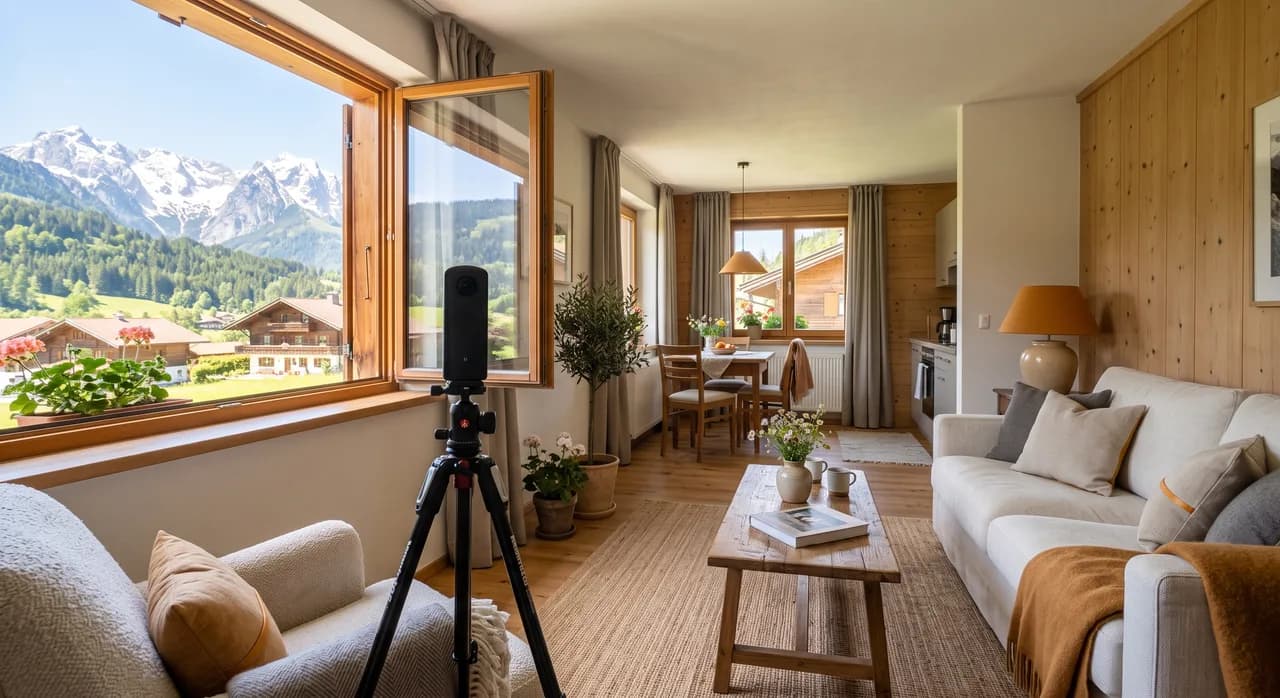
The third lever is view emphasis, and it deserves particular care in the vacation segment. If a property's selling point is what you see out the window, the imagery should treat that view as a headline feature rather than an afterthought glimpsed through glare. That often means shooting at a time of day when the exterior and interior are balanced in exposure, so the sea, the skyline, or the alpine ridge is actually visible rather than blown out to white. Guests pay a premium for a view, and imagery that fails to prove it leaves money and bookings on the table.
The Seasonal Timing Problem
Few property types are as season-dependent as holiday rentals, and this creates a genuine photography challenge that owners underestimate. A coastal home photographed under grey November skies with bare terraces and stacked-away furniture will struggle to sell a July stay, no matter how good the composition. A ski chalet shot in the green shoulder season cannot convey the snow-blanketed fantasy that fills its winter calendar. The visual expectation a guest holds for a given season is specific, and imagery that contradicts it introduces doubt.
The practical implication is that photography timing has to be planned around the property's peak-demand seasons, not around whenever the crew happens to be available. Ideally, a rental that trades on summer sun is documented in summer, with the pool uncovered, the garden green, and the outdoor furniture in its full arrangement. This is not always possible, and here honesty and planning intersect: if you must shoot off-season, the responsible approach is to prepare the property to reflect its in-season state as closely as reality allows, and to be transparent about anything that genuinely changes. What you should avoid is presenting an off-season shell and letting the guest imagine the rest.
For properties that earn across multiple seasons, there is a strong case for building a small library that shows each season honestly. A lakeside home is a different product in August than in October, and guests booking either month want to see the version they will actually experience. The upfront investment in a second or third shoot pays back through fewer mismatched expectations and, just as importantly, through the ability to market each season with imagery that feels true. Weather and daylight simply cannot be faked convincingly, so the calendar becomes part of the production plan.
Why Accurate Space Representation Protects Your Reviews
In the vacation segment, reviews are currency. A run of enthusiastic reviews lifts ranking and conversion; a cluster of disappointed ones can quietly kill a listing. What we have observed repeatedly is that a meaningful share of negative reviews are not really about the property being bad. They are about the property being different from what the imagery promised. "Smaller than the photos suggested." "The second bedroom is really a windowless nook." "The beautiful terrace faces a car park." These are expectation failures, and expectation is set almost entirely by visuals.
Accurate space representation is therefore not a nicety but a form of risk management. When photography and, ideally, a floor plan or 3D model give a guest a truthful sense of room sizes, layout, and flow before they book, the person who arrives is the person who chose the property with open eyes. They are far less likely to feel misled, because nothing at check-in contradicts what they saw. This alignment reduces disputes, refund requests, and the kind of review that references deception rather than quality. Truthful media effectively pre-qualifies guests, filtering out those who would have been unhappy and reassuring those who will be delighted.
There is a commercial subtlety worth naming. It can feel tempting to flatter a smaller or quirkier property with generous angles and selective framing, and in the short term that may lift bookings. But a rental is a repeat-play business. Every guest who arrives disappointed writes a review that the next hundred prospective guests will read. Over a full season, the honest listing usually outperforms the flattering one, because it accumulates trust instead of spending it. Accuracy is not the cautious choice; it is the profitable one.
The Honest Limits of Wide-Angle Photography
Wide-angle lenses are indispensable in interior work. Rooms are shot from corners and doorways where a standard lens would capture only a fragment, and a moderate wide angle is simply how you show a room's shape and contents in a single frame. Used well, it is an honest tool that helps a viewer understand a space. The problem begins when wide angle becomes a device for making rooms appear substantially larger than they are, with extreme focal lengths that stretch a modest bedroom into something it is not.
The tell-tale signs are familiar to anyone who books rentals often: furniture that seems marooned in acres of floor, bathrooms that appear to have impossible depth, and a bed that looks lost in a room that turns out to barely contain it. Guests have grown wise to this, and there is a subtle penalty for overreach. Sophisticated viewers discount visibly distorted images, and the guest who arrives to find a room half the size they pictured moves straight into that expectation-failure territory that fuels bad reviews. The short-term gain in perceived size is paid back with interest.
Our practical rule is that wide angle should reveal a room, not reinvent it. Shooting at sensible focal lengths, keeping vertical lines true, and choosing angles that a person could actually stand at all keep the imagery within the bounds of honesty. This is precisely where spatially accurate media complements photography. A floor plan or a measured 3D model provides an objective reference for scale that no lens choice can distort, so a guest can enjoy the atmosphere of the photographs while confirming the real dimensions for themselves. The two formats together let you be both appealing and truthful, which is the only combination that survives contact with an actual guest.
How 3D Tours Reduce Uncertainty for Remote Bookers
The defining feature of a vacation booking is distance. The guest is almost always remote, often in another country, frequently booking months ahead for a place they cannot visit. That distance breeds uncertainty, and uncertainty suppresses bookings and pushes guests toward the safety of large, generic, heavily reviewed properties. Anything that lets a remote guest feel they truly understand a space works directly against that hesitation, and this is where interactive 3D tours have proven especially valuable in the rental context.
A well-made 3D tour lets a prospective guest walk through the property at their own pace, from the entrance to each bedroom, out onto the terrace, and back. Crucially, it answers the spatial questions that still photos leave open: how the rooms connect, how far the bathroom is from the bedroom, whether the kitchen really opens onto the living area, how big the outdoor space actually feels. These are the questions that keep a hesitant booker clicking away to compare, and every one of them answered on your own listing is a reason to stay and book rather than leave and doubt. The tour converts curiosity into confidence.
There is a second benefit that matters for guests traveling with specific needs. Families want to understand sleeping arrangements and whether a layout works with small children. Groups want to gauge privacy between bedrooms. Guests with mobility considerations need to see steps, thresholds, and bathroom access. A photo gallery forces these guests to guess; a 3D tour lets them verify. By letting people self-qualify on the details that matter to them, the tour not only lifts conversion but again reduces the mismatched bookings that lead to disappointment on arrival. For remote, high-consideration bookings, giving the guest a genuine sense of place is one of the most effective trust signals available.
Common Mistakes We See Owners Make
Across many projects, the same avoidable mistakes surface again and again, and most of them cost bookings silently. The most common is outdated imagery. Owners renovate a bathroom, replace tired furniture, or upgrade a kitchen, and then leave the old photos in place for another two seasons. The property is now better than its listing, which is the wrong direction to be wrong in: the guest books based on the old images and, at best, is pleasantly surprised, while many prospective guests never book at all because the dated photos undersold a space that had genuinely improved. Imagery should be refreshed whenever the property meaningfully changes.
The second recurring mistake is misleading angles and selective omission. A single flattering shot of the one good corner, with the rest of the room and the less appealing features carefully kept out of frame, sets up the arrival disappointment we keep returning to. Related to this is the missing photo: rooms or features that are simply not shown because they are unimpressive. Guests notice absence. A listing that shows the living room, the main bedroom, and the view but never the second bedroom or the bathroom reads as evasive, and cautious bookers assume the worst about anything hidden. Completeness is itself a trust signal.
A third cluster of mistakes is about neglecting the practical alongside the beautiful. Owners invest in a gorgeous cover shot but never photograph the kitchen equipment, the workspace, the parking situation, or the actual bed configuration, all of which are decisive for particular guests. Cluttered, un-staged shots taken on a phone in poor light sit next to one professional image and undercut it. And many listings fail to lead with their single strongest asset, burying the sea view or the fireplace on the tenth image where hurried browsers never reach it. The fix in every case is the same: plan the shoot around what guests actually decide on, show the property fully and honestly, and put the best foot first.
Consistency Across a Portfolio
For owners of a single property, visual quality is a self-contained project. For property managers, agencies, and hosts running many units, a new challenge appears: consistency across the portfolio. When units are photographed at different times by different people with different equipment and different instincts, the collection becomes a patchwork. One apartment glows with bright, corrected, professionally styled images; the next looks dim and crooked. On a platform listing page or an agency's own site, that inconsistency does real damage, because guests read the weaker listings as lower quality even when the underlying properties are comparable.
Consistency is partly an aesthetic matter and partly an operational one. A shared visual standard, covering framing conventions, the shot list every unit must include, staging expectations, white balance, and image count, means that a guest moving between listings experiences a coherent brand rather than a lottery. This matters most at the margins of the portfolio: the smaller or plainer units benefit enormously from being held to the same standard as the flagships, because professional, consistent treatment signals that the whole operation is well run. Guests infer reliability of the stay from the reliability of the presentation.
There is also a workflow argument for treating a portfolio as a system rather than a set of one-off shoots. When units are documented to a common specification, the resulting assets are easier to manage, refresh, and deploy across the multiple platforms a modern rental business sells on. New acquisitions can be brought up to standard on intake rather than retrofitted later. Spatially accurate 3D documentation adds a durable layer here, since a scanned model and floor plan remain useful across redecorations and re-listings and can be reused wherever the unit appears. For any operator at scale, the goal is not a handful of stunning listings but a portfolio where every unit clears the same trustworthy bar.
Conclusion
The through-line of every lesson here is trust. A vacation rental is sold, again and again, to people who cannot visit before they commit, and the imagery is the entire basis of that commitment. Light, honest staging, and a well-chosen cover photo win the click. Accurate space representation, restrained use of wide angle, and immersive 3D tours win the thing that matters more over a full season: a guest who arrives to exactly the property they were promised and leaves the review that brings the next guest. The two halves are inseparable, because a booking secured by exaggeration is repaid with a refund request and a warning to others.
The practical path forward is not complicated. Photograph properties in the season they actually sell. Show every space, including the ordinary ones, and lead with the genuine highlight. Let wide angle reveal rooms without reinventing them, and back the atmosphere of photography with the objective scale of floor plans and 3D models. Give remote guests a real sense of place so they can qualify themselves in rather than hesitate away. And for anyone running more than one unit, hold the whole portfolio to a single, consistent standard so that trust compounds across every listing. Done this way, visual media stops being a marketing cost and becomes what it should be: an asset that earns its keep, booking after booking, by telling the truth beautifully.