Matterport Tours: Why the Digital Twin Is the Gold Standard
Experience real estate in detail in the 'dollhouse view'. Why Matterport technology multiplies the interaction rate of your listings.
Only a few years ago, a series of stitched-together 360-degree photos was considered the epitome of a "virtual tour." Today, professional real estate agents, developers, and asset managers (not least through the current real estate marketing trends for 2026) know: the market has evolved. Property seekers and investors expect maximum transparency and a true, three-dimensional spatial experience.
The technology leading this change is called Matterport. In combination with modern LiDAR sensors (Light Detection and Ranging), as built into the Matterport Pro3 camera, it doesn’t just create a tour – it creates a Digital Twin. In this comprehensive B2B guide, we explain why this technology is revolutionizing real estate sales and how it helps you win premium mandates and execute faster.
1. 360-Degree Panorama vs. Digital Twin: The Difference
Many real estate agents confuse simple panoramas with genuine 3D tours. A classic 360-degree photo (taken with a simple consumer camera) is merely a flat image projected onto a sphere. The user jumps from sphere to sphere. A real sense of space, an assessment of proportions or distances? Not to be found.
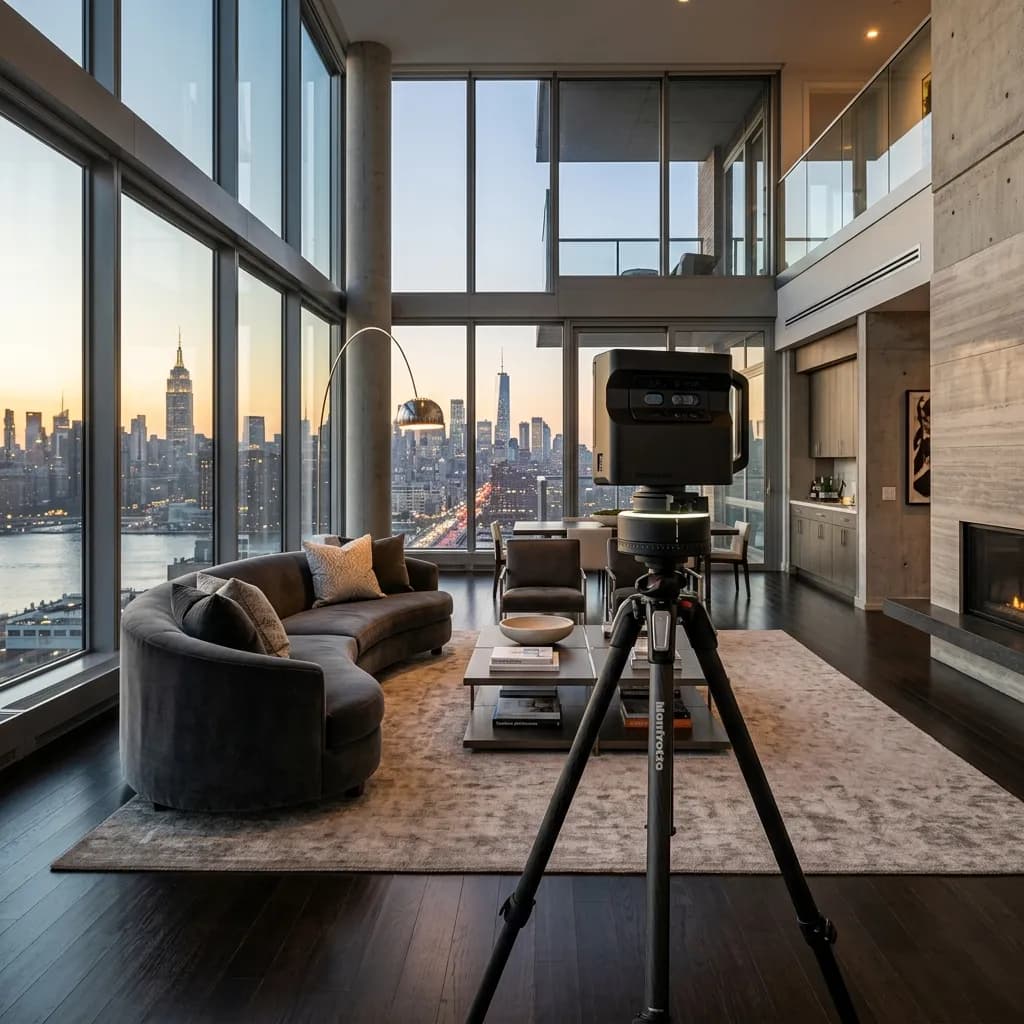
The Matterport Difference (LiDAR): When FotoEstate scans a property with the Matterport Pro3, the camera not only takes 134-megapixel HDR images but simultaneously fires millions of laser beams (LiDAR). These lasers measure the exact distance to every wall, piece of furniture, and windowsill.
The result is a dense, three-dimensional point cloud. The software maps the high-resolution photos (textures) precisely onto this 3D mesh. The user does not move through a series of images, but rather walks smoothly through a real, geometrically accurate 3D model of the property.
2. The Dollhouse View as a Gamechanger
The most iconic feature of a Matterport scan is the so-called 'Dollhouse.' With one click, the user zooms out of the property and views the entire building as a freely rotatable 3D model – as if the roof and exterior walls had been removed.
The psychological advantage:
This view solves the biggest problem in real estate sales: the buyers' lack of spatial imagination. In the dollhouse, customers immediately see how the living room is intertwined with the open kitchen, where the stairs lead to the upper floor, and how large the hallway is relative to the bedroom. Cognitive barriers fall away instantly; the buyer 'understands' the property in seconds.
3. Precise Measuring: A Dream for Buyers and Craftsmen
Since the digital twin is based on real laser measurement data (accuracy of about 99%), it offers a feature that simple 360-degree tours can never provide: The digital measuring tape.
Use Cases:
- The Buyer: They can measure directly in the browser – on a smartphone or PC – whether their 2.50-meter-wide corner sofa fits against the living room wall or whether the refrigerator fits into the kitchen niche.
- The Craftsman / Investor: For renovation projects, external trades (floor layers, window installers) can take an initial virtual measurement without having to enter the property. This massively speeds up the preparation of quotes for conversions.
4. Mattertags: The Interactive Exposé in Space
A digital twin of FotoEstate is upgraded to an interactive information center through so-called Mattertags (digital information points).
We place these clickable points deliberately in the 3D space to argue the value of the property:
- Technical room: A Mattertag on the boiler contains the PDF of the energy certificate and the latest maintenance report of the heat pump.
- Kitchen: A tag on the countertop links to the manufacturer's page of the installed premium Miele appliances.
- Materials: An info point on the floor explains that it is high-quality, oiled oak parquet.
The prospect no longer has to laboriously flip through the text brochure, but consumes the information exactly where it is spatially relevant.
5. Added-Value Derivatives: Layouts and BIM Data
A Matterport scan is a data goldmine. We do not only create the link to the virtual tour for you. From the same scan data, we extract highly precise, dimensioned 2D floor plans. You save yourself the expensive architect or draftsman for preparing the exposé.
For commercial customers (B2B), we deliver the raw data of the point cloud (E57, XYZ) or generate .OBJ / .SKP files from it. Architects can seamlessly import this data into their CAD programs (Building Information Modeling - BIM) to build renovation and remodeling plans on a millimeter-accurate existing model.
Conclusion: Acquisition Turbo and Efficiency Booster
The digital twin is far more than a marketing tool for buyers – it is your strongest argument in purchase acquisition. If you demonstrate to a property seller that you present their house as a state-of-the-art 3D twin, you outclass competitors who only turn up with a smartphone camera.
In addition, the Matterport tour serves as a perfect filter. It eliminates unproductive "viewing tourism." Anyone who schedules a physical appointment after the 3D tour has already accepted the layout and has genuine purchase interest. With FotoEstate as your digitization partner, you increase your efficiency, stand out as a premium brand, and significantly accelerate your closings.
Related articles
Explore Matterport 3D tours
See what the service includes, which source material is useful and how a typical project starts.