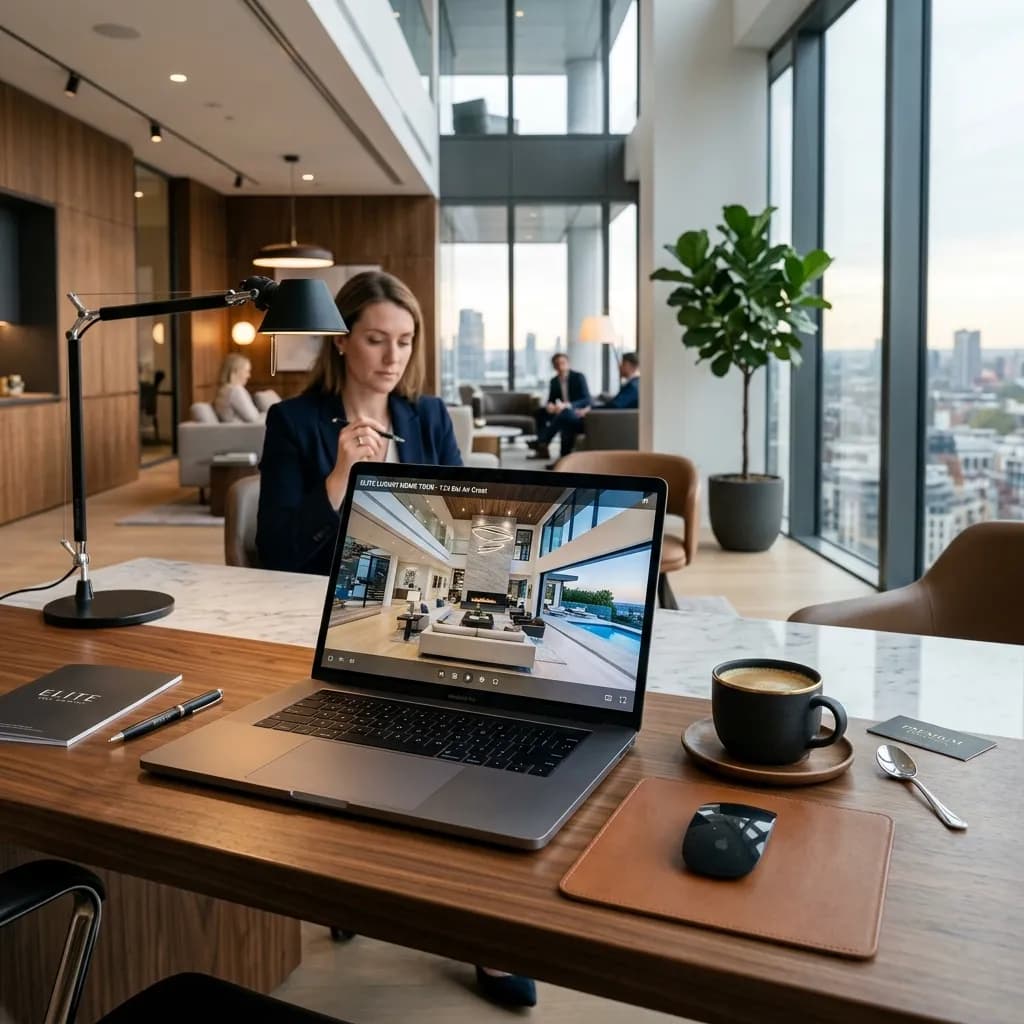
An end to sightseeing tourism: Time savings through virtual tours
Pre-qualify potential buyers in advance. Virtual 360-degree tours ensure that only genuine buyers show up for the real viewing.
Time is by far the most valuable, yet the worst managed resource in traditional real estate sales. Analyses show that real estate agents waste up to 60% of their productive working time on completely worthless property viewings.
The phenomenon is known throughout the industry as viewing tourism: interested parties who, on Sunday afternoons, out of pure curiosity, look at other people's houses, undecided search clients without financing confirmation, or buyers who only realize on site that the ceiling height in the bedroom is too low for them.
Each of these appointments costs the real estate agent travel time, gasoline, preparation, and above all, nerves. For the property owner, who has to polish their house to a high shine every time, it is an absolute imposition. The solution to this B2B problem in 2026 lies in consistent pre-qualification through virtual 360-degree tours (Digital Twin). In this guide, we show real estate agents and property management companies how to implement this sales hack.
1. The Illusion of the Wide Angle (Why Normal Photos Fail)
The core problem of traditional exposés is the lack of spatial honesty. To make spaces appear attractive on the Internet, photographers use strong wide-angle lenses. The small 12-square-meter children's room suddenly appears like a dance hall in the 2D photo.
The result: The prospect builds up an expectation that immediately collapses in reality. The first second upon entering the real room leads to disappointment, the deal has already mentally fallen through before the realtor could even start his pitch.
The radical filter of the 3D tour:
A Matterport 3D scan from FotoEstate cannot be beautified. It shows the property exactly as it is – precise to the millimeter, honest and transparent. The prospective buyer moves through the rooms at their own pace, sees the narrow corridors, the sloping ceilings, and the real lighting conditions.
The effect: inappropriate candidates sort themselves out. Anyone who still calls after the virtual tour and wants an on-site appointment is a highly qualified lead. Their expectations are calibrated. The real viewing only serves for final confirmation and signing the preliminary contracts.
2. The New Sales Funnel for Top Brokers
Successful real estate agencies radically changed their sales process in 2026. Genuine physical viewings are a privilege that the buyer must first earn.
The modern funnel looks like this:
1. Teaser Exposé: Only a few, very high-quality (cinematic) photos are shown on ImmoScout24 to spark basic interest.
2. The Barrier: To receive the exact address, the interested party must provide their complete contact details.
3. The Mandatory Task: The broker sends the customer the link to the virtual 3D tour with the clear instruction: "Please explore the property virtually first. After that, we will have a phone call."
4. The Qualification: In the phone call, the broker specifically asks about details from the 3D tour (e.g., "How did you like the layout of the master bathroom?"). Only those who have demonstrably completed the tour and have their financing in place get the actual appointment.
This process reduces the number of physical appointments by up to 70%, but exponentially increases the conversion rate per appointment. The broker's hourly wage rises massively.
3. Remote Sales: Global Capital for Local Assets
Especially in the premium segment or with commercial real estate (apartment buildings, office complexes), the liquid buyer is rarely located in the same city. Investors from London, Dubai, or Munich want to buy an apartment building in Leipzig but do not have time for an initial on-site visit.
Virtual 3D tours break through this geographical barrier. Asset managers and investors inspect the property (including the basement and boiler room) directly from their desks. They measure the width of escape routes or the height of roller doors in the 3D model with digital tape measures. FotoEstate provides these millimeter-precise LiDAR scans, which are so accurate that million-dollar transactions (remote sales) are initiated almost exclusively based on the digital twin.
4. The strongest argument for the purchasing pitch (sole mandate)
The greatest struggle of a real estate agent is not selling the property, but the acquisition (purchase) of the mandate. When you are sitting at an owner's kitchen table to negotiate the exclusive contract, the strongest argument is not your network, but your promise of protection.
Sellers (especially families) are panically afraid that for weeks hordes of strangers with dirty shoes will walk through their private bedroom.
Your Pitch with FotoEstate:
"Mr. Müller, if you give me the order, I guarantee you complete discretion. We will scan your house in 3D just once. I will let no one physically into your house who has not first walked through the property digitally and shown me their financing confirmation. We will bring a maximum of 3 to 4 real buyers through your door, and one of them will buy. Your family life will remain completely undisturbed."
This promise of discretion and exclusivity will win you every sole mandate in 2026.
5. Scaling Through Digital Efficiency: Why 3D Scans Increase Your Margin
Many real estate agents are initially hesitant to invest in professional 3D scans. However, the calculation is simple: if a high-quality scan from FotoEstate costs around 200 to 500 euros once, but in return saves just a single unnecessary trip (including working time and fuel), the investment has already paid off.
If one also takes into account the time saved in creating floor plans (since these can be automatically generated from the scan), the real estate agent gains back 5 to 10 hours of work per property. This time can be directly invested in acquiring new clients. A digital tour is therefore not a cost item, but an investment in one's own scalability.
6. Psychology of Attachment: The 'Endowment Effect'
Research shows that a buyer's emotional attachment to an object increases significantly the more time they spend with the property. A prospective buyer who navigates through a 3D model for 20 minutes has already mentally settled in the house. They have virtually arranged the furniture (for example, using options offered by the latest trends in virtual home staging), analyzed the room layout, and become accustomed to the environment.
This 'Endowment Effect' leads to the fact that the threshold for making a purchase offer is significantly lower for digitally previewed objects. The buyer no longer sees the house as 'the broker's property,' but has already 'owned' parts of it through the digital walkthrough. This psychological groundwork is not provided by a static photo of the world.
7. Technological Advantage in Competition
Real estate marketing in 2026 is a digital competition for customers' attention. Portals like ImmoScout24 prefer listings that are enriched with interactive content. A 3D tour significantly increases the dwell time on your listing. The portals' algorithms recognize this and rank your offer higher.
By using FotoEstate's technology, you also distinguish yourself from the 'standard agent' who still walks through the rooms with a smartphone. You position yourself as a tech leader. This particularly appeals to affluent clients who value professionalism and the latest marketing standards.
Conclusion: Work smart, not hard
Anyone who still takes 20 people through a house every weekend in 2026 in the hope that one might buy is working unprofitably. The future of real estate sales is data-driven, selective, and highly efficient.
Virtual tours from FotoEstate are not a marketing gimmick, but the most important operational tool to protect your most valuable resource – your time. Filter out tourists, qualify real leads, and elevate your sales to a completely new, professional level.
Related articles
Explore Virtual 360° tours
See what the service includes, which source material is useful and how a typical project starts.