A building is rarely finished. Walls move, doorways are bricked up, new lines run where a cable duct sat only yesterday. Every change of tenant, every adjustment in use, every seemingly minor modernization alters the physical substance. As long as these changes are properly recorded, a building remains manageable. When they go undocumented, a creeping problem takes hold that often only becomes visible years later and is expensive by then.
For facility managers, owners and architects, the undocumented change is one of the most underestimated risks across the entire lifecycle of a property. It costs nothing as long as nothing happens. And it costs many times over the moment someone plans, drills or sells on the basis of false assumptions. Using concrete scenarios, this article shows what goes wrong when renovations remain hidden, and how consistent documentation and 3D capture can bring the situation back under control.
When Plans and Reality Drift Apart
The as-built plan in the drawer or on the server has one decisive drawback: it shows a state that was valid at some point in the past. With every undocumented change, the gap between paper and reality grows. First it is a repositioned partition wall, then an additional office cubicle, later a completely rerouted escape path. The plan stays the same, the building does not.
This drifting apart is especially insidious because no one notices it immediately. The plan looks plausible, it carries a stamp, it feels authoritative. Whoever opens it assumes it is correct. That very assumption is the problem. An outdated plan is more dangerous than no plan at all, because it invites decisions that rest on a fiction. You rely on something that reality has long overtaken.
In large portfolios the effect multiplies. When small things are changed again and again over twenty or thirty years and never entered afterward, in the end not a single document remains that can be fully trusted. Every figure, every dimension, every routing of a line has to be verified on site before it can be used. That costs time and money on every project anew and turns planning into a guessing game.
The Hidden Risk in Every Drilling
There is hardly an activity in a building as everyday and at the same time as risky as drilling into a wall or ceiling. A tradesperson is meant to fit a bracket, mount a shelf, install a new light. They look at the plan, see a solid wall with no installations, and start the drill. What the plan does not show: during a renovation seven years ago, a water pipe or a high-voltage cable was laid at exactly that spot and never entered.
The consequences range from a severed data cable that knocks out half a floor, to water damage that eats its way through several storeys, all the way to a life-threatening contact with a live line. In each of these cases the information existed. It was simply never recorded. The damage arises not from a lack of care while drilling, but from a lack of documentation years earlier.
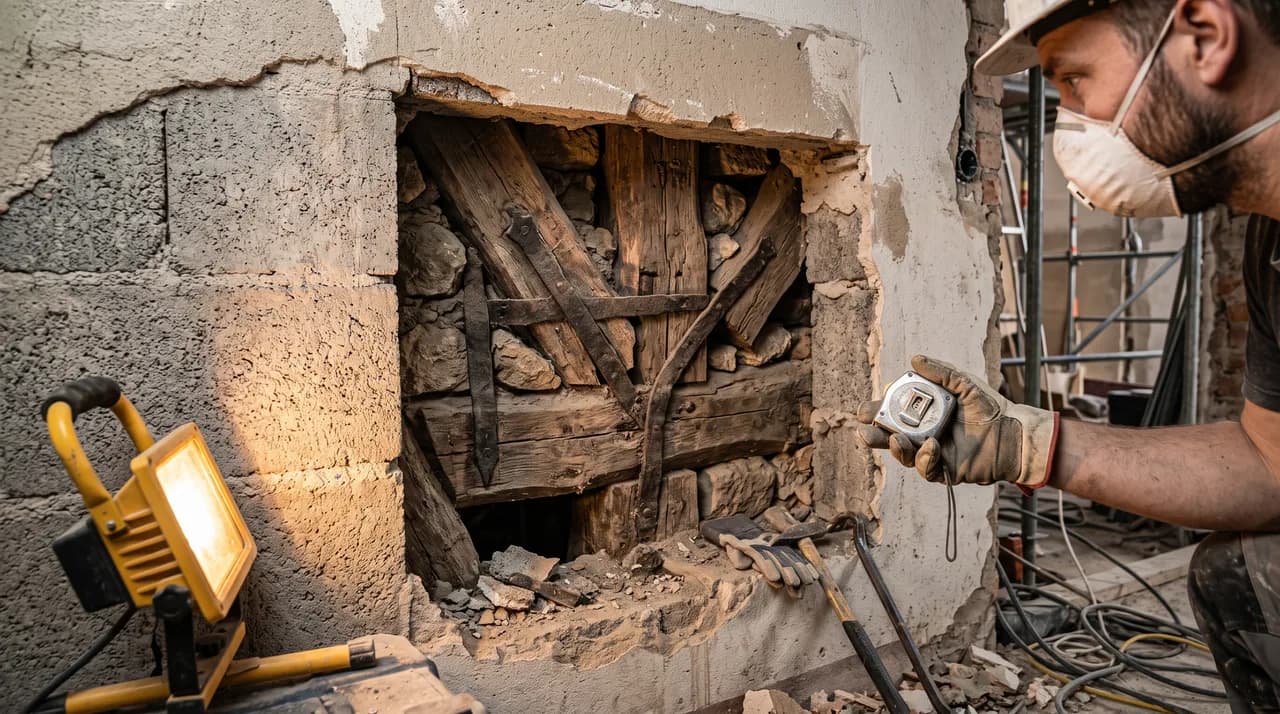
It becomes especially tricky with components that can no longer be seen after the renovation. A line laid before a wall was closed disappears into the component forever once the plaster is on. From that moment it exists only in the documentation, or in no one's head anymore. Whoever failed to record its course has lost the information irretrievably. That is precisely why the moment before a wall is closed is so valuable for a capture.
When Fire Compartments Lose Their Effect
Fire protection only works if it stays intact as a system. Fire compartments divide a building into areas that, in an emergency, prevent fire and smoke from spreading unhindered. Walls, doors, seals and the firestopping of line penetrations together form a continuous barrier. This barrier is only as strong as its weakest point.
An undocumented renovation can breach this barrier unnoticed. If a fire wall is drilled through for a new line and the penetration is not properly resealed, a hole opens up in the fire protection concept. If a fire door is replaced by an ordinary door because it happened to be more convenient, the required resistance is missing at that point. From the outside everything looks unremarkable. In the event of a fire, however, the compartment fails at exactly the place where it was supposed to hold.
The real tragedy is that such interventions often happen with the best intentions and without any ill will. No one wanted to undermine fire protection; there was simply no awareness and no follow-up. If a claim arises, the operator is held responsible. They must prove that the fire protection concept was upheld. Without current documentation of the actual building substance, this proof can barely be provided, and the liability consequences can be existentially threatening.
False Assumptions as the Basis of Every New Plan
Every refurbishment or renovation project begins with a survey of the existing conditions, at least on paper. The architect or specialist planner takes the available documents and develops the design from them. If these documents are wrong because earlier changes are missing, the entire planning is built on a false foundation. The error propagates through all trades.
A classic example: a load-bearing wall was replaced by a downstand beam during an earlier renovation in order to create an open space. The plan still shows the continuous wall. The new design counts on a load transfer that no longer exists in that form, or plans an opening where in truth a structurally relevant component sits. In the best case such discrepancies surface during the site inspection and lead to costly replanning. In the worst case they go undetected until it is too late.
False assumptions also come through in the cost calculation. Anyone who assumes a wall is easy to remove but finds on site that the central electrical distribution now sits there must replan, rebudget and push back deadlines. Every one of these surprises costs nerves, money and trust between the parties. All of them could have been avoided if the renovation had been recorded at the time.
The Dispute Over Who Changed What
As long as everything works, no one asks about a building's history. The moment damage occurs or a responsibility has to be clarified, the question of who and when suddenly becomes central. Who moved this wall? Which tradesperson laid this line? Was the change approved? Without documentation these questions cannot be answered, and open questions quickly turn into conflicts.
Tenants blame the landlord, the landlord blames the previous owner, the operator blames the service provider. Everyone points to someone else, no one can prove anything. Without a traceable chain of records, the resolution comes down to one person's word against another's. That not only paralyzes the relationship between the parties, it can also have tangible legal and financial consequences when compensation or warranty is at stake.
A clean change record acts here like a neutral witness. It documents which state existed at which point in time and what has changed. Whoever regularly captures the actual state can prove at any time how the building looked before and after a measure. This not only protects against unjustified accusations, it also creates clarity about one's own responsibility. In many disputes, what decides the outcome is not who is right, but who can prove it.
Safety and Liability Are at Stake
The operator of a building bears a comprehensive duty of care to ensure safety. They must make sure that no danger emanates from their property for users and third parties. This duty presupposes that they know the state of their building. Whoever does not know which renovations have taken place effectively cannot fulfill their duty of care. They are managing an asset whose actual condition is unknown to them.
If personal injury or property damage occurs, insurers and courts examine closely whether the operator did everything reasonable to avert dangers. If current documentation is missing, they are hard-pressed to explain themselves. They cannot prove that they knew the substance and monitored it regularly. In case of doubt, case law treats this as an organizational fault, and insurance cover can lapse in whole or in part. A documentation effort that was avoided then turns into open liability.
On top of this comes the responsibility toward one's own people and external service providers. A maintenance technician working on the basis of false information is exposed to a danger the operator should have known about. Safety is not an abstract quantity; it depends directly on whether the people who work in the building know what they can rely on. Undocumented renovations undermine this foundation piece by piece.
When Due Diligence Becomes a Stumbling Block
At the latest when a property is sold or financed, the moment of truth arrives. As part of due diligence, buyers, investors and banks scrutinize the asset down to the last detail. They want to know what they are acquiring, what risks lie in the substance and whether the documents reflect the actual condition. Undocumented renovations become a serious problem here.
When the reviewers find that the existing plans do not match reality, confidence in the entire asset drops. Every further statement is called into question. In the favorable case this leads to a price reduction, because the identified risk is priced in. In the unfavorable case the prospective buyer withdraws or demands extensive evidence and expert reports that delay the process for months. Missing documentation stalls transactions and depresses value.
Questions of permits are especially sensitive. If a renovation was carried out without the required approval, this can jeopardize the grandfathered status and, in the worst case, lead to obligations to reverse the work. A buyer who inherits such legacy issues will either want them expensively secured or back out entirely. Whoever, by contrast, can present complete, up-to-date building documentation negotiates from a position of strength. Transparency about the existing building is a genuine value argument in the sales process.
The Solution: Capture Every Change, Keep the Records Current
The good news is that all these risks can be avoided with comparatively little effort. The key lies in a simple discipline: every structural change is documented before it disappears into the component. The best moment for this is the open state, that is, before a wall is closed, a shaft is clad or a ceiling is suspended. At that moment everything is visible that later remains hidden.
This is where three-dimensional capture plays to its full strength. A 3D scan does not record the state selectively, as a hand sketch or a single photo does, but captures the space completely and to scale. Line routings, penetrations, beam positions and firestops are preserved with their exact position in space. From this point cloud you can derive at any time what was installed where, even for questions that no one had yet asked at the time of capture. The scan becomes the building's digital memory.
What matters is that documentation is understood not as a one-time event but as an ongoing process. The building record must grow with every measure. When a renovation is completed, the as-built is updated so that plan and reality are congruent again. Over time this creates a reliable data base that all parties can rely on, from the facility manager through the tradesperson to the future buyer. A building model kept up to date turns the creeping risk of the undocumented change into a manageable, transparent process.
Conclusion
Undocumented renovations are not a problem of the moment but a mortgage on the future. They let plans and reality drift apart, turn every drilling into a risk, punch holes in fire protection concepts, undermine every new plan and become a costly stumbling block in disputes, in claims and during due diligence. The insidious part is that the costs stay invisible until they hit with full force.
The remedy is concrete and achievable. Whoever captures every change, ideally in three dimensions and before walls close, and keeps the building record consistently current, protects themselves against drilling damage, liability risks and loss of value. The investment in clean documentation is always smaller than the damage its absence can cause. For owners, facility managers and architects, current, reliable building documentation is therefore not a bureaucratic burden but the foundation for safety, plannability and value retention across the entire lifecycle of a property.