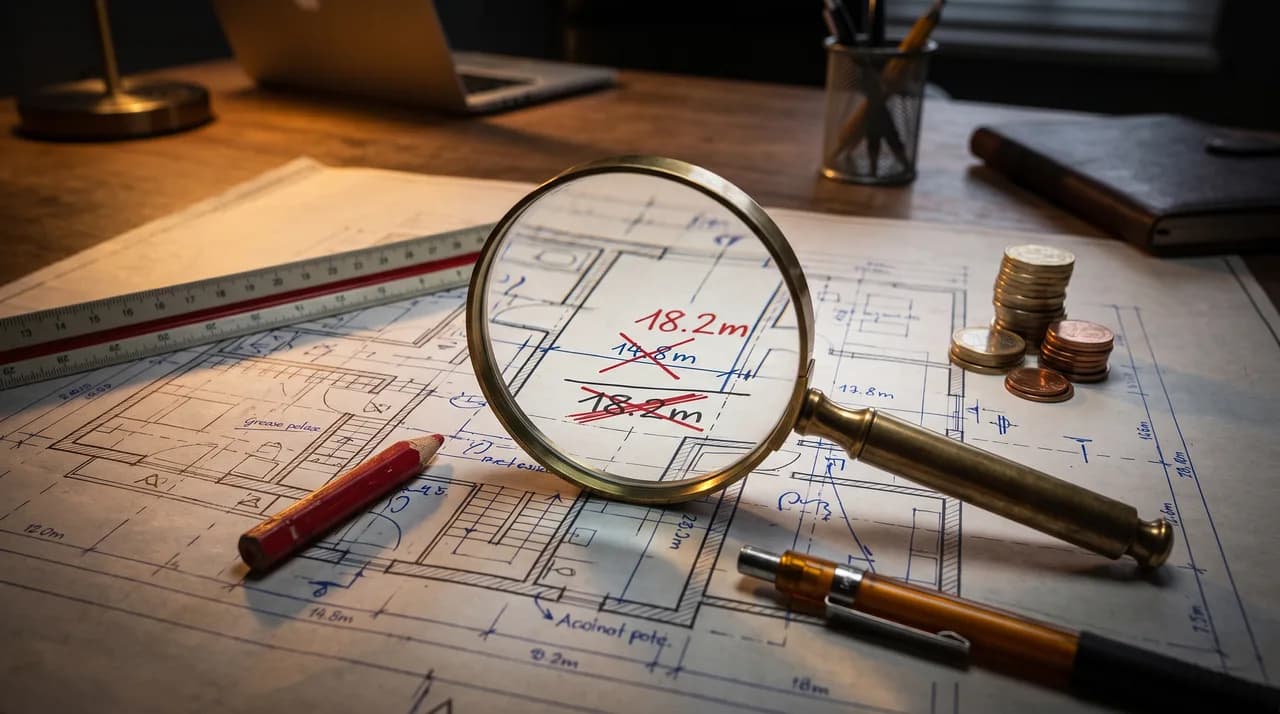
An as-built survey stands at the beginning of almost every construction project involving existing buildings. It is the basis for planning, tendering, approval and execution. And because it comes first, it is often treated like a tiresome obligation to be gotten out of the way as cheaply and quickly as possible. A folding rule, a few hand measurements, an old as-built drawing from the archive, supplemented with a handful of corrected values, and off we go. The apparent benefit: a few thousand euros saved and a week of time gained.
The problem is that the costs of an inaccurate as-built survey do not arise where the money was saved. They surface months later, spread across change orders, mistaken orders, delayed approvals and disputes over floor areas. By then no one has the cheap survey in mind anymore. That is precisely why it pays to work through the economics honestly rather than push them aside. This article shows the typical mechanisms through which imprecise as-built data destroys money, and why the saving at the start is almost always smaller than the damage at the end.
Why Errors in Existing Buildings Systematically Become More Expensive
There is a well-documented rule in construction projects: the later an error is discovered, the more expensive it is to fix. A transposed figure in the as-built survey may cost a corrected drawing during the planning phase. That same transposed figure, noticed only on site, costs a construction stoppage, a redesign, newly ordered material and, in the worst case, contractual penalties for missed deadlines. Between these two states there are often factors in the double digits.
The reason is error propagation. An as-built survey is not an isolated document but the reference on which all subsequent trades build. The architect plans on its basis, the structural engineer calculates with it, the specialist planners for heating, ventilation and electrical derive their routing from it, and the estimator draws his quantities from it. If the foundation is wrong, every one of these derivations is wrong too, without anyone noticing. The error does not shrink as it travels through the project; it multiplies.
On top of that, imprecise as-built data is rarely recognized as such. A plan that looks accurate to two decimal places appears trustworthy, even when the underlying measurements were estimated diagonally with a folding rule. This deceptive precision is dangerous because it legitimizes decisions built on sand. No one questions a dimension that looks authoritative. Only when the prefabricated component does not fit does it become clear that the neat drawing never depicted reality.
Change Orders on Site: The Most Expensive Place for Corrections
The construction site is the most expensive conceivable place to correct an as-built error. Here crews stand ready, equipment is rented, the construction schedule is tightly timed, and every interruption costs money immediately. If it turns out that a wall really is out of plumb, a ceiling is lower than assumed, or a shaft runs somewhere other than shown on the plan, a change order arises at once. And change orders are not billed at competitive prices, but at the terms the executing firm can enforce from a position without competition.
This is the actual economic lever. In the tender, several bidders compete for the contract, and the price is driven down. A change order, by contrast, arises in the middle of execution, when switching contractors is practically impossible. The client has almost no bargaining power, because a construction stoppage would be more expensive for him than the inflated change-order price. Errors in the as-built survey therefore systematically shift costs out of a competitive environment and into a monopoly environment, and that is exactly what makes them so expensive.
Then come the knock-on effects of a single change order. If a trade stands still because a dimensional discrepancy has to be resolved, the following trades fall out of rhythm. The screed layer cannot work because the shell is not yet finished, the painter waits for the screed, and in the end handover slips. For properties intended to be rented or sold, every week of delay means lost rent or forfeited financing terms. A single as-built error can thus set off a chain whose total cost far exceeds the original error.
Prefabrication Without a Reliable Basis: When the Finished Part Does Not Fit
Modern construction processes increasingly rely on prefabrication. Stairs, facade elements, steel components, ventilation ducts, entire sanitary modules are produced in the factory under controlled conditions and delivered to the site. The advantage lies in quality, speed and cost certainty, as long as the dimensions are right. The entire logic of prefabrication rests on the assumption that the component fits on the first attempt, because it was designed precisely to match the existing structure.
This is exactly where the as-built survey is the critical point. A prefabricated stair element that is two centimeters too long because the floor-to-floor height was measured incorrectly cannot simply be trimmed on site. It has to be rejected, produced again and delivered again. In the meantime the construction sequence stalls, the scaffolding stays up, the crane is blocked. For facade elements or steel structures with long lead times, such a re-production can cost weeks and blow up the entire schedule.
The damage here is particularly galling, because prefabrication was originally chosen to reduce costs. A wrong dimension turns this advantage into its opposite: instead of predictable factory quality, you get improvised on-site adjustments, custom fabrications and expensive express deliveries. Anyone who invests in prefabrication without investing in a precise as-built survey undermines the very foundation of their own efficiency strategy. The two decisions belong together, and at this point the cheap as-built survey is the most expensive wrong decision.
Wrong Quantities in the Tender: The Built-In Dispute
The tender translates the planning into quantities and prices. From the as-built survey are derived the areas, volumes, lengths and item counts that feed into the bill of quantities. If these quantities are wrong, the dispute is already built into the project before the first handshake. Quantities set too low lead to change orders as soon as the actual masses are billed on site. Quantities set too high artificially inflate the bid and distort the comparison of bidders.
The situation is especially problematic with unit-price contracts, where the quantities actually installed are billed. Here bidders have an incentive to deliberately price items with erroneously low reference quantities cheaply, because they know the real quantity is higher and additional money can be earned through change orders. An inaccurate as-built survey provides the perfect setup for this game. The client believes he has bought cheaply, and ends up paying considerably more because the quantities spiral out of control.
The comparability of bids suffers as well. If the tendered quantities do not correspond to reality, bidders calculate on a false basis, and the apparently cheapest provider may not be so after final billing. The entire award decision then rests on shaky ground. A precise quantity determination from reliable as-built data protects not only against change orders but also ensures in the first place that the award is based on a fair and dependable comparison.
Delayed Approvals: When the Authority Does Not Play Along
Approval procedures depend on reliable documents. The building application, change of use, fire safety concept, setback areas, all of it presupposes correct as-built data. If the authority or an approved inspector determines that the submitted plans do not match reality, the procedure is halted. Follow-up requests, corrected documents and a new round of review ensue. Each of these cycles costs weeks, sometimes months.
The economic damage of delayed approvals is often underestimated because it does not appear as an invoice. It shows up in tied-up capital that yields no return, in extended bridge financing with its interest, in postponed leasing or sale dates, and in idle project teams that must still be paid. For larger undertakings, the cost of a single lost quarter can exceed the entire savings on the as-built survey many times over.
It becomes particularly delicate with fire safety and safety-relevant verifications. If escape route lengths, room heights or opening dimensions are documented incorrectly, the verifications built upon them are not only formally flawed but potentially safety-critical. A subsequent correction then often pulls a cascade of dependent verifications along with it, all of which have to be produced anew. Reliable as-built data is not a formality here, but the precondition for an approval procedure to succeed in a single pass at all.
Disputed Rental Areas: The Error That Echoes for Years
For rented or to-be-rented properties, area determination carries particular economic force, because it feeds directly into the rent. If the rental area is set too high, the tenant gains a claim to a rent reduction as soon as the discrepancy is noticed, and this claim can be asserted retroactively. If it is set too low, the owner gives away income year after year. In both cases, a one-time survey error echoes across the entire term of the lease.
Area disputes are a recurring nuisance for asset and property managers, because case law recognizes reduction rights even for relatively small discrepancies. An area that deviates by a few percent from the contractually agreed figure can be enough to trigger rent adjustments, additional claims and, in case of doubt, court proceedings. Multiply a small area discrepancy by the per-square-meter rent and the lease term, and a seemingly marginal survey error becomes a substantial sum.
Then there is the effect on property value. Real estate valuations are based on the achievable rental income, and this depends directly on the underlying areas. A wrong area figure thus distorts not only individual tenancies but the valuation of the entire property, with consequences for financing, purchase and sale. A precise area determination carried out according to recognized rules is therefore not a detail, but a foundation for the lasting value of a property.
Rework Discovered Only During Construction
A large share of the costs of inaccurate as-built surveys falls on rework that only becomes visible during construction. Clashes between trades are the classic example: a ventilation run passes where the plan showed space, but where in reality a downstand beam sits. A duct has to be rerouted, a suspended ceiling set lower, an opening moved. Each of these corrections means additional labor time, additional material and often coordination effort between several parties.
The insidious thing about this rework is that it is hard to predict and even harder to attribute. When a clash comes to light, it is often not immediately clear whether the cause lies in the planning, in the execution, or precisely in the faulty as-built survey. Discussions about responsibility follow, while the site waits. These clarification phases are unproductive and tie up exactly the people who should actually be moving the project forward. The coordination effort is a real, if rarely cleanly quantified, block of cost.
Modern planning methods such as model-based clash detection can uncover such conflicts early, but only if the underlying as-built model correctly depicts reality. A digital model based on wrong as-built data does not find the decisive clashes, because it feigns clearance in the wrong place. The investment in elaborate planning tools comes to nothing if the data basis is not sound. Precisely captured geometry is the condition for digital planning to unfold its error-avoiding effect at all.
The Honest Calculation: Saving Versus Downstream Costs
Set the numbers soberly side by side and the imbalance becomes clear. The saving from a cheap, quick as-built survey stays within the frame of the survey costs themselves, that is, a one-time, manageable amount. The downstream costs of an inaccurate survey, by contrast, spread across change orders, re-productions, delayed income, area disputes and rework, and each of these items can on its own already be larger than the original saving. In sum, a small, certain advantage stands against a large, probable risk.
There is also an asymmetric distribution: the saving occurs surely and immediately, while the downstream costs are at first only a risk. It is precisely this asymmetry that seduces people into wrong decisions, because the certain small advantage feels more tangible than the diffuse large risk. In practice, however, this risk materializes frequently, because existing buildings almost always hold surprises, especially where work was done with outdated plans and without reliable measurement. Anyone who realistically assesses the probability arrives at a clear conclusion.
A precise as-built survey, for example based on a dense three-dimensional measurement, is therefore not an expense to be minimized, but an insurance against the most expensive phases of the project. It shifts error discovery from the construction site back into planning, where corrections are cheap. It creates a dependable basis for tendering, prefabrication, approval and area billing. And it removes the ground from under change orders by simply ensuring that reality and the plan agree.
Conclusion
An inaccurate as-built survey is rarely expensive where it arises. Its costs surface later, spread across change orders on site, prefabricated components that do not fit, wrong tender quantities, delayed approvals, disputed rental areas and rework that only becomes visible during construction. Each of these mechanisms shifts costs out of a cheap, controlled environment into an expensive one under time pressure. The supposed saving at the start thus regularly becomes a multiple in downstream costs.
For developers, facility and asset managers this means a simple but uncomfortable consequence: the as-built survey is not an item on which it makes sense to economize. It is the foundation on which all subsequent decisions rest, and its quality decides whether a project stays predictable or slides into a chain of expensive surprises. Anyone who works through the economics honestly would rather invest in precision at the start than pay for imprecision at the end. In the end, the cheapest as-built survey is almost always the accurate one.