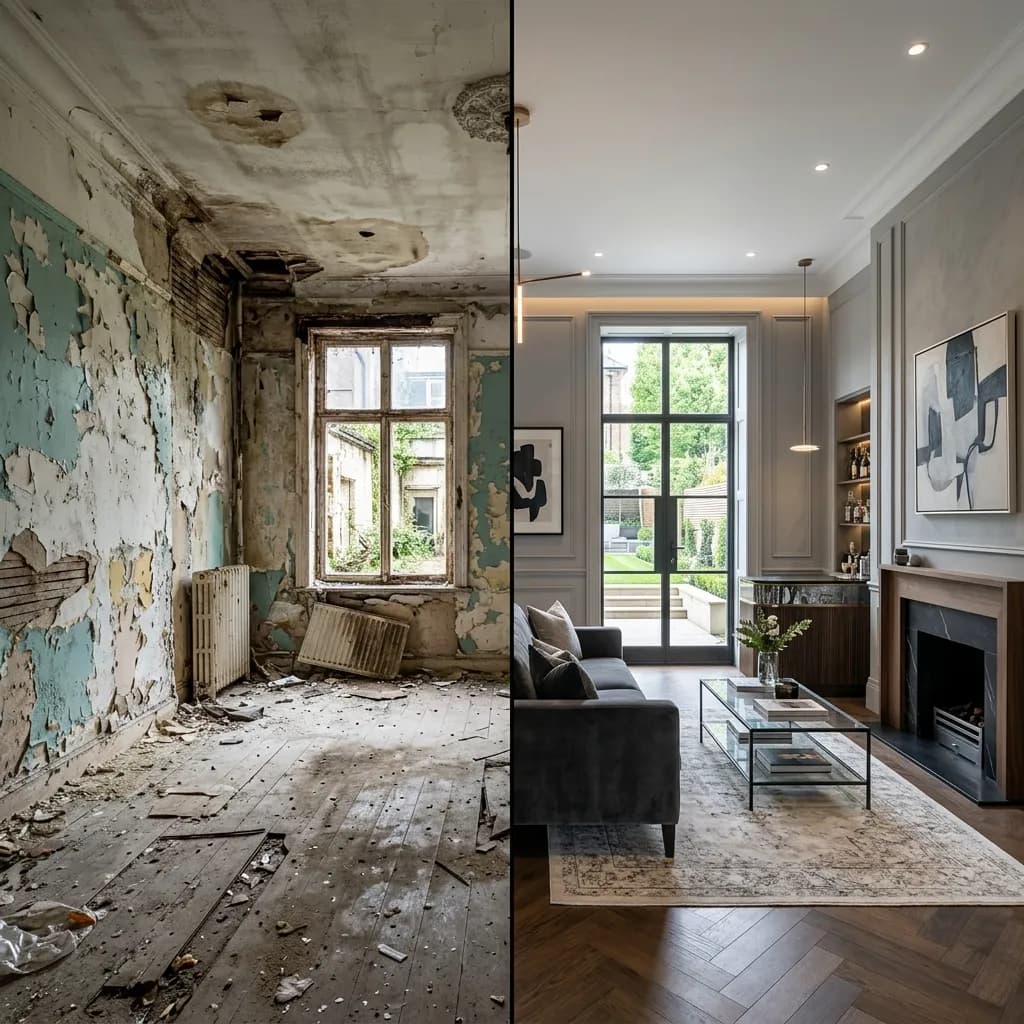
Old building with a future: How virtual renovation makes renovation backlogs invisible
Show your customers what a property in need of renovation can become. Lower the purchasing barrier through photo-realistic renovation ideas.
Real estate agents, fix & flip investors, and project developers know the problem: Selling properties in need of major renovations is often an exhausting task. When potential buyers walk through narrow, dark hallways during a viewing, look at light green bathroom tiles from the 1970s, and smell yellowed floral wallpaper, the brain switches to defense mode.
The imagination of most end customers (B2C) is not sufficient to recognize the hidden potential of the architecture. Instead, they only see stress, dirt, and incalculable costs. The consequence: low click-through rates on real estate portals, endless price negotiations, and ultimately a sale far below the actual value.
The most powerful tool in the PropTech arsenal of 2026 to break through this cognitive purchasing barrier is Virtual Renovation. In this comprehensive B2B guide, we show how to turn problem properties into highly profitable investment assets.
1. The Psychology of Buying an Old Building (The Fear of the Unknown)
Buying a property is a highly emotional decision that is only justified rationally (through Excel spreadsheets) in hindsight. However, a renovation project does not evoke positive emotions, but fear.
Buyers often drastically overestimate the renovation costs because they lack spatial imagination. A small, dark room with old furniture feels oppressive.
The digital solution:
The virtual renovation does not simply clumsily retouch away the backlog of repairs (which could legally be considered deception). Instead, it provides – transparently labeled as an architectural vision – a photorealistic blueprint of the future (often combined with interactive elements, as currently shaped by the trends in virtual tours). When the prospective buyer scrolls through ImmoScout24, they do not see just the dark cave in the before-and-after slider, but a light-filled loft with oak parquet flooring and a freestanding kitchen island. The fear immediately gives way to excitement.
2. Wall Openings and Floor Plan Optimization
A purely cosmetic replacement of flooring is often not enough. Living habits have changed: Nowadays, no one wants a separate, small kitchen and a separate dining room. Open-space (open living) is the absolute standard.
The high-end 3D artists from FotoEstate structurally change the virtual space:
- Virtual wall removal: We remove non-load-bearing walls in the 3D model to demonstrate the potential of an open floor plan.
- Bathroom renovation: The old tube bathroom is transformed into a wellness oasis with a walk-in shower flush with the floor and large-format porcelain stoneware tiles.
- Light axes: We virtually enlarge the window fronts (e.g., installation of floor-to-ceiling lift-and-slide elements) to show how the property would appear with modern lighting.
The broker no longer sells the depressing past of the property, but a highly modern vision of the future.
3. The Gamechanger for Bank Financing
A major pain point in selling renovation properties is financing by the end customer. When a buyer applies to their bank for a loan for the house (purchase price) plus 150,000 euros for the renovation, the bank's appraiser often looks skeptically at the old brochure pictures.
The Lever of Visualization:
However, if the buyer places a photorealistic exposé of the completely renovated property created by FotoEstate on the bank advisor's desk – ideally combined with a reliable construction cost estimate from a trades company – the conversation changes immediately.
The bank's appraiser can assess the future market value (the target value) of the property much more precisely and higher. The risk for the bank decreases in the valuation, the loan is released faster, and the realtor can secure the notary appointment.
4. Fix & Flip: Maximize margin without building yourself
For real estate investors (Fix & Flip), time is money. The classic method: buy a house cheaply, coordinate craftsmen for 4 months, renovate, and resell it at a high price.
More and more smart investors are using a hybrid strategy in 2026: the Virtual Flipping.
The investor buys the property, merely clears it out to a broom-clean state (gutting) and paints the walls white. Instead of spending hundreds of thousands of euros and months of time on a real renovation, he has the property virtually renovated to luxury standard by FotoEstate.
The property is being sold as a 'refined shell including planning concept.' The buyer can use the visualizations to complete the renovation according to their own taste (and at their own expense). The investor avoids all the developer's risk but generates a significantly higher selling price through the convincing visualization than with a pure shell sale.
5. Maximum ROI: Less Discount, More Demand
The figures from the real estate agent practice are clear: Listings with before-and-after sliders for virtual renovations receive up to 60% more qualified inquiries.
Due to the drastic increase in demand, the negotiation dynamics change. When there are suddenly three serious interested parties for a renovation property because everyone recognizes the potential, the classic 'renovation discount' that bargain hunters otherwise always try to push through disappears.
Conclusion: The vision is the seller
Virtual renovation is far more than a nice graphic. It is a strategic tool for increasing value. For a fraction of the cost of a real renovation (usually a few hundred euros per image), you provide your buyers, investors, and financing banks with the ultimate proof of concept.
Transform your hard-to-sell old buildings into coveted premium projects with FotoEstate. Don't show your clients what is – show them what could be.
Related articles
Explore 2D & 3D floor plans
See what the service includes, which source material is useful and how a typical project starts.