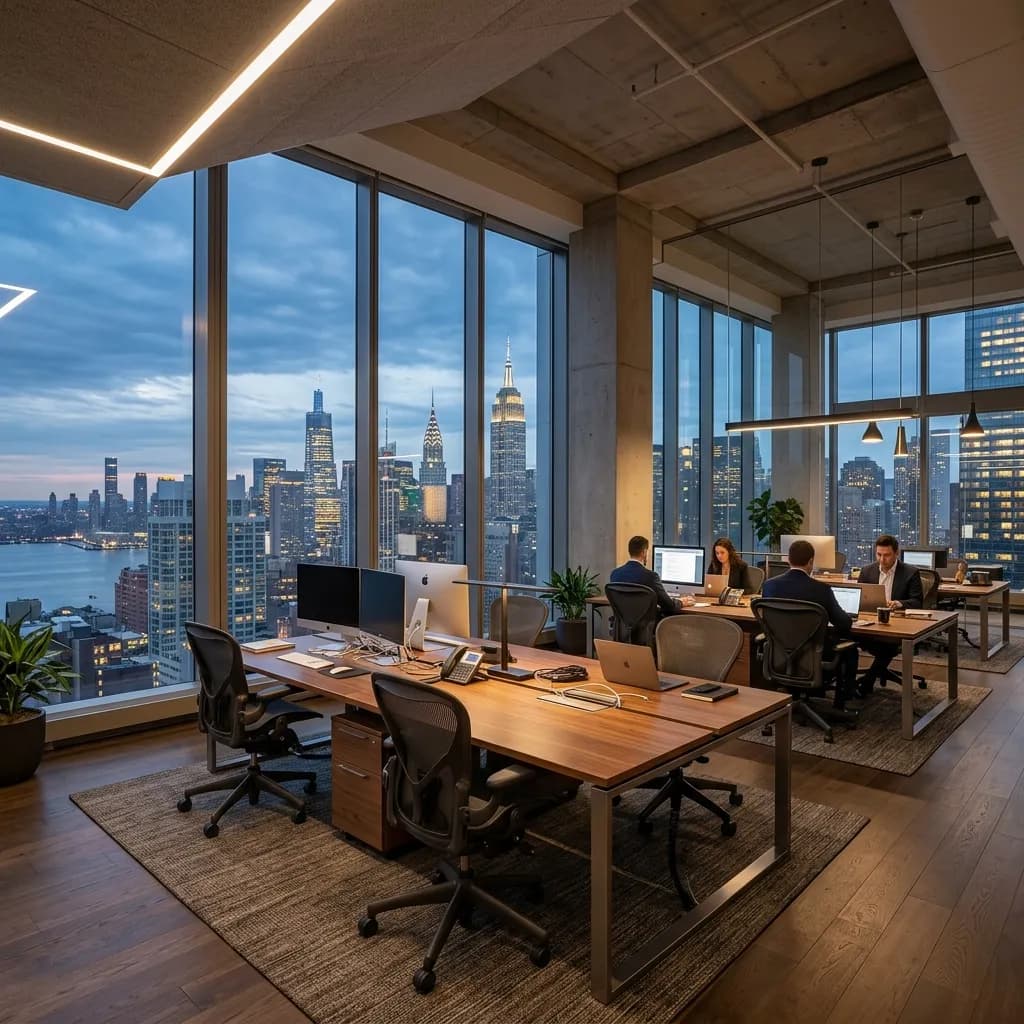
Rent commercial spaces faster with virtual office staging
Gray carpets and empty halls often look uninspired. We show you how to digitally visualize modern work environments and convince tenants.
The marketing of commercial real estate (office, retail, light industrial) follows completely different rules than the residential market. While in the private sector it is about emotions and coziness, in the B2B environment, hard KPIs decide: space efficiency, representation, and increasingly the topic of employer branding.
Nevertheless, many commercial brokers, project developers, and asset managers repeatedly make the same mistake: They present potential tenants with empty, cold office floors. A bare raised floor, gray drywall walls, and hanging cables from the ceiling do not spark expansion fantasies in any CEO or HR director.
The Virtual Office Staging from FotoEstate closes this imagination gap. We transform dull vacancies into photorealistic new work environments. In this guide, we show how you can drastically reduce vacancy rates and enforce your target rent (prime rent) on the market.
1. Employer Branding: Why the HR Director Rents the Office
In 2026, the office is no longer just a workplace, but the most important recruiting tool of a company in the fight against the shortage of skilled workers. When you rent out office space, you are not just selling square meters to the tenant – you are selling them a tool to attract top talent.
If your exposé looks like a gray government office from the 90s, the modern tech startup or the dynamic consulting agency will immediately click away. Imagination is not enough to recognize a creative headquarters in the dreary room.
The Digital Transformation: Through virtual office staging, we mentally tear down walls. We implement digital acoustic panels, stylish coffee lounges, ergonomic standing desks, plant walls (biophilic design), and glass focus boxes for deep work.
The CEO sees the rendered image on ImmoScout24 Commercial and thinks: 'My developers will feel comfortable here.' The emotional connection to the space is created before the first viewing appointment.
2. The Proof of Concept: Visualizing Occupancy Density
One of the most common questions during a commercial property viewing is: "Can I fit my 40 employees plus three meeting rooms here without it feeling like a battery cage?"
An empty, square room is extremely difficult to gauge visually. If the tenant doubts, he does not rent.
Virtual staging delivers the immediate proof of concept. Our 3D artists work precisely to scale. If we integrate 40 desks and a ping pong table into the rendering, they will also fit exactly in reality with the prescribed escape routes in the room. The rendering becomes the visual occupancy plan and eliminates the tenant's greatest concern.
3. The Multi-Target Strategy (Target Group-Specific Rendering)
As an asset manager, you often do not know in advance which industry your future anchor tenant will come from. Do you design the space for a trendy advertising agency or for a conservative auditing firm?
The solution lies in the flexibility of digital rendering. We photograph the empty space once. Afterwards, we create three completely different virtual work environments (multi-styling):
1. Tech / Start-up: Open bench workspaces, colorful lounges, foosball tables, exposed ventilation pipes (industrial style).
2. Law Firm / Consulting: Noble walnut desks in private offices, heavy carpets, representative reception desk made of marble.
3. Creative Agency: Agile project areas, writable glass walls, colorful beanbags, and flexible furniture.
As a broker, you can now conduct targeted marketing (Account-Based Marketing). If you offer the property to a network of lawyers, send the law firm rendering. Launch LinkedIn ads for IT companies, use the tech image. A single property thus becomes maximally relevant for completely different industries.
4. Risk Minimization: Renting Before the Expensive Tenant Fit-Out
Traditionally, project developers often expanded office spaces 'on speculation' (speculatively), hoping that the chosen carpets and glass doors would appeal to the future tenant. This is extremely capital-intensive and risky.
The trend for 2026 is: Sell the vision, build after signing.
They leave the space in the 'refined shell' (Core and Shell) condition and use virtual office staging to present the potential expansion options to the customer in the highest photorealistic quality.
Only when the lease agreement with a commitment of 5 or 10 years is signed do you commission the dryliners and the construction costs (Tenant Improvements) flow. The virtual staging thus saves you hundreds of thousands of euros in potentially misinvested construction costs (similarly impressive to the high ROI of classic virtual home staging).
5. Integration into virtual 3D tours (Matterport)
Especially in the B2B sector, decisions are often made by a committee (Board of Directors). Rarely do all decision-makers have time to fly to Frankfurt, Munich, or Berlin for an inspection.
We integrate the digitally staged furniture directly into interactive 3D tours (Matterport). The board in London can navigate through the future, virtually furnished office in Germany with a VR headset or on a laptop, measure distances, and approve the lease – without ever setting foot in the actual building (Remote Leasing).
Conclusion: The space must tell the tenant's story
Marketing commercial real estate without a visual vision inevitably leads to price reductions, endless negotiations, and long vacancies.
Virtual office staging from FotoEstate is your strongest marketing asset. It delivers architect-quality in 48 hours, costs a fraction of a real model office, and greatly increases the perceived value of the space. Don't show your future tenants empty shells, but the perfect place for their business growth.
Related articles
Explore Virtual home staging
See what the service includes, which source material is useful and how a typical project starts.