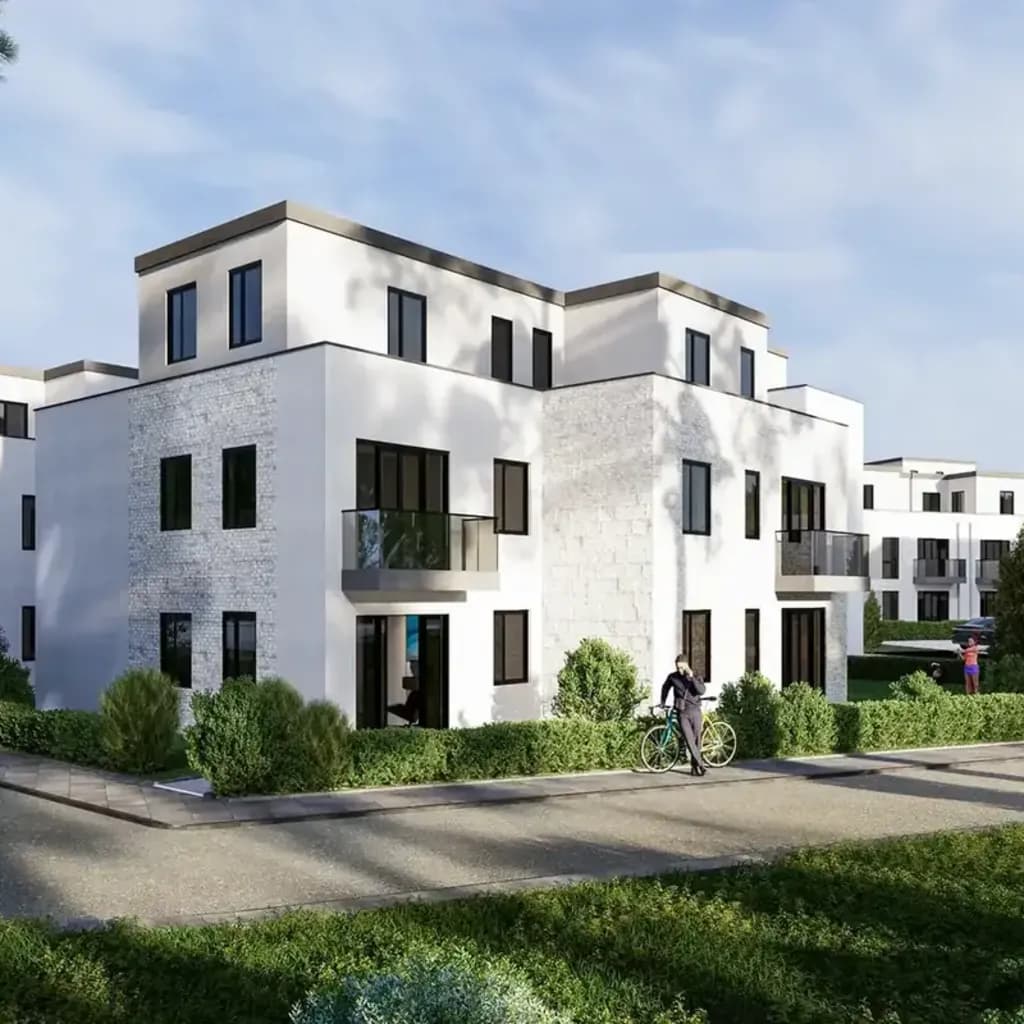
Real Estate Rendering Costs: What Does a 3D Rendering Really Cost?
What does a 3D rendering cost? The four cost drivers, why the first image of a project is always the most expensive, and when a package beats a single image.
"What does a 3D rendering cost?" is the first question in almost every initial conversation. And the most honest answer is unsatisfying at first: it depends. But it does not depend on arbitrary judgement — it depends on four clearly identifiable factors. Anyone who understands these four factors can read a quote, compare offers and, above all, actively reduce their own costs.
At FotoEstate, an exterior or interior visualisation starts at 399 EUR per visualisation. This article explains what that figure covers, when it rises, why the first image of a project is always the most expensive one, and why a cheap rendering can end up being the most expensive image in your project.
The four cost drivers at a glance
Every serious quote for a property visualisation is built from the same components:
- Source data: How much modelling work has to be done before the first image exists?
- Number of perspectives: How many images are produced from the same 3D model?
- Level of environmental detail: A detached house on neutral ground, or embedded in the real streetscape?
- Revision rounds: How many review rounds are planned, and what does the fifth one cost?
Everything else is a side issue. Get these four points under control and you have the price under control.
Cost driver 1: Your source data
The largest single cost block is not the rendering, it is the modelling. And how much has to be modelled is decided by your documents.
If a clean CAD or BIM model exists, the geometry is already there. The 3D artist prepares it instead of building it. That is the most economical case.
If dimensioned PDF plans are available — floor plans, elevations, at least one section — the building is rebuilt from them. That takes time, but it is reliable work without guesswork.
If only a sketch exists, interpretation is required. Every interpretation triggers a query or a correction, and both cost money. A project that starts from a hand drawing can end up considerably more expensive than an identical project based on CAD data — for exactly the same final image.
Which documents are needed in practice and which formats we can process directly is described in detail in our article on documents for rendering. It is worth working through that list before requesting a quote. It is the most effective price lever you hold in your own hands.
Cost driver 2: Why the first image is the most expensive
This is the point most clients underestimate — and the one that can save them the most money.
A rendering is not created as an image, it is created as a 3D model. The building is constructed in full: walls, ceilings, windows, roof, railings, facade materials, vegetation, lighting. That model then exists in virtual space. Only at that point is a camera placed inside it and an image calculated.
The entire effort of building the model occurs exactly once. It sits entirely in the first image.
If you then move the camera somewhere else — a view from the street instead of the garden, a bird's-eye view instead of eye level — the additional effort is comparatively small: camera position, framing, possibly an adjustment of lighting and foreground, render time, post-production. The model itself is reused.
The practical consequence: anyone who orders one image today and adds three more four weeks later pays noticeably more than if all four had been commissioned from the outset. Not because reorders are penalised, but because the model has to be archived, reloaded and brought up to the current planning status in the meantime.
Our recommendation: before you start, think about which images you will need across the entire sales period — brochure, portal, site hoarding, website, advertisement, sales folder. And commission them together.
Cost driver 3: The level of environmental detail
A building on its own is quickly built. The world around it is not.
- Neutral background: The object stands on its own, the background is a sky or a plain surface. The most economical option, well suited to early concept phases.
- Generic surroundings: Lawn, a few trees, a road, a vehicle. Looks lively, but is not true to the location.
- True-to-location embedding: The actual neighbouring buildings, the real streetscape, the existing trees. This is the most demanding level — and often the only sensible one for planning approval or public information.
In addition: people, vehicles, rain, snow, dusk with illuminated windows — each of these elements is work. It does not have to be expensive, but it is never free. Decide deliberately what the image is really meant to achieve.
Cost driver 4: Revision rounds
A serious quote names the revision rounds it includes. At FotoEstate, review rounds are planned in, and we work with an intermediate step that makes most of them unnecessary: the grey clay render without materials, in which you sign off geometry and camera position before texturing and lighting even begin.
Revision rounds become expensive when they come late. Changing the camera position costs almost nothing before texturing. After the final render, the same change means: set up again, calculate again, retouch again.
Revision rounds also become expensive when nobody decides. Three people commenting on the same design without coordination and in contradictory ways multiply the effort. Appoint one person with decision-making authority. That costs nothing and takes effect immediately.
What budget providers deliver
There are providers offering renderings for under 100 EUR. That works — technically. You get an image. You just do not get the image that sells your project.
What you typically see in this price bracket:
- Plastic-looking surfaces: the render has no texture, the wood no grain, the glass no depth. Everything looks cast from a single mould.
- Flat, hard lighting without soft shadows and without atmosphere.
- Building components that do not match the plans, because nobody asked.
- Stock vegetation that shows up identically in every second project.
- Resolutions that are enough for a portal but not for a site hoarding or a print advertisement.
The real damage is not the image, it is the signal. A prospective buyer who sees a cheap-looking rendering unconsciously transfers that impression to the development itself. A project that looks cheap in the image also feels like a cheap investment. With an apartment in the six-figure range, that is a selling point you have taken away from yourself.
The calculation developers really care about
Put the numbers in proportion.
An apartment building with twelve units has a construction budget in the millions. A package of five high-quality visualisations — two exterior views, two interiors, one bird's-eye view — comes to a low four-figure sum at the 399 EUR per visualisation mentioned above.
That is a fraction of a percent of the construction budget.
The leverage on the other side is incomparably greater. Renderings make it possible to start sales before the first shovel hits the ground. Every unit sold before construction begins reduces the pre-financing burden and increases confidence at the bank. A property that stands out on a portal receives more enquiries. A prospective buyer who has seen a room in good images arrives at the appointment prepared and no longer needs to be convinced, only confirmed.
Put differently: the question is not whether you can afford good visualisations. The question is whether you can afford a sales launch delayed by weeks.
Package or single image?
A single image is the right choice when you are preparing an internal decision, offering a plot with a concept idea or testing feasibility. One image, one purpose, done.
A package pays off as soon as you go to market. At that point you need several views anyway, and the saving compared with commissioning images individually is substantial, because the model is only built once.
And there are cases in which a rendering is not the right tool at all. If the property already exists, virtual home staging at 59 EUR per image is the faster and considerably cheaper route — all it takes is good photographs. Floor plan staging costs 29 EUR, 2D and 3D floor plans 19 EUR, a Matterport tour 199 EUR, professional image editing 49 EUR, drone photography and real estate photography 199 EUR each. A virtual renovation costs 149 EUR per image, office staging 79 EUR per image.
Which service suits your project stage is something we clarify in the initial consultation. You do not have to decide that on your own.
Conclusion: You help control the costs
The price of a rendering is not a matter of fate. It is the result of four factors, and three of them lie wholly or partly with you: supply good documents. Commission all the perspectives you will need across the sales period in one go. Appoint a decision-maker and give feedback early rather than late.
Save on the image itself — and you save exactly where your project is supposed to sell itself. For a detailed look at how the process works, read our guide to real estate rendering and the page on real estate rendering.
Want to know what your project costs specifically? Send us your documents. You will receive a clear quote — and on request a free, no-obligation sample rendering in advance, so you can judge the quality before you decide.
Related articles
Explore Property rendering
See what the service includes, which source material is useful and how a typical project starts.