Real Estate to Go: How AR Visualization is Revolutionizing Property Viewing
View the future home on the empty lot with the smartphone – augmented reality makes it possible and excites modern buyers.
The sale of off-plan properties and large-scale project developments has always faced a massive cognitive hurdle: the lack of spatial imagination among investors and end buyers. Where there is currently only a brown construction pit, a gutted existing building, or a green field, the buyer is supposed to see their future dream home or the investor their profitable office complex. Traditional 2D floor plans, static architectural renderings, and printed glossy brochures reach their psychological limits here. The solution that is currently radically transforming property developer sales is called Augmented Reality (AR). FotoEstate uses highly complex AR architectural visualizations to project yet-to-be-built real estate projects into the real world with centimeter accuracy – thereby measurably accelerating the pre-sales process.
1. What is Augmented Reality in Real Estate Marketing?
In contrast to Virtual Reality (VR), where the user is completely isolated from their physical environment through a closed headset (such as the Meta Quest) and immersed in a purely digital world, Augmented Reality (AR) enhances the real environment. Through the camera and sensors of a standard smartphone or tablet (e.g., iPad Pro with LiDAR scanner), highly detailed, photorealistic 3D BIM models are seamlessly and accurately overlaid onto the real landscape.
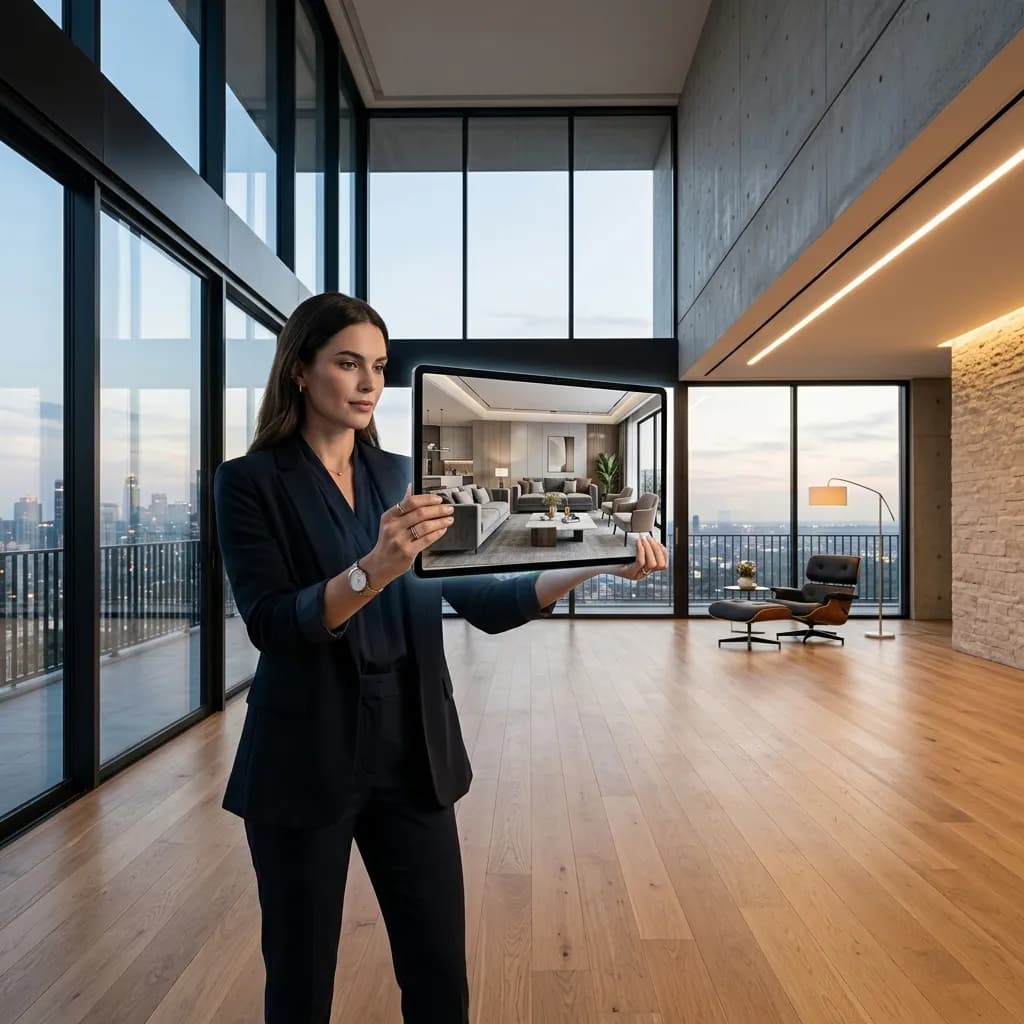
This means for sales: The real estate agent or project developer stands together with the interested party on the undeveloped building plot. The customer points their smartphone at the empty area – and on the display, in real time and at a 1:1 scale, the turnkey multi-family house rises. They can step through the digital front door, experience the light entering through the planned floor-to-ceiling windows, and estimate the dimensions of the garden. The architecture becomes tangible long before the first excavator rolls in.
2. WebAR: Maximum Reach Without App Download
A historical stumbling block of AR technology was the requirement to download special, memory-intensive apps. This hurdle (friction) often led to massive dropout rates in the digital sales funnel. FotoEstate solves this problem through state-of-the-art WebAR technology.
Our 3D architecture models can be accessed directly through the user's native web browser (Safari, Chrome). Interested parties who are studying your property brochure on the iPad in the evening on the sofa click on a button ('View in AR'), the camera opens, and the 3D model of the planned penthouse is placed photorealistically on the home coffee table (tabletop AR). The customer can rotate the model with their fingers, zoom in, and inspect the rooftop terrace. This playful, frictionless interaction (gamification) extends the time spent on your project landing page extremely and emotionally binds the customer to the property before they have even made contact.
3. The unbeatable B2B advantages for property developers and project developers
The use of augmented reality is not a technical gimmick, but a hard sales tool that directly translates into a positive ROI (Return on Investment):
A. Overcoming Purchase Resistance in Pre-Sales
The biggest fear of a buyer when purchasing from the plan is the uncertainty regarding the actual dimensions. 'How close is the distance to the neighboring house?' 'Does the planned carport block too much light?' AR provides immediate, visual, and impartial answers to these questions. By eliminating spatial doubts, the purchasing hesitation decreases drastically. Developers who use AR record a significantly higher closing rate (conversion rate) in the critical pre-opening phase, which secures the return of capital and interim financing.
B. Convincing Investor Meetings (B2B Pitches)
When project developers pitch to city councils, building authorities, or institutional investors (family offices, funds), a 2D site plan is often not sufficient to demonstrate the urban integration of a new district. With an AR tabletop model (tabletop scale), you bring the entire neighborhood digitally into the conference room. You can switch between different construction phases with a tap of your finger, demonstrate the shading of neighboring buildings throughout the day (sun position simulation) in real time, and visually counter concerns of building committees. AR provides absolute planning and decision-making certainty in this context.
C. Positioning as a Premium Brand
Real estate agencies that rely on the latest spatial data technologies automatically position themselves as innovative premium providers. This perception not only reflects on the buyers but also massively helps brokers in acquisition (property purchasing). A seller of an expensive plot of land is more likely to grant their mandate to the agency that markets their property with forward-looking AR technology than to the broker with the standard PDF brochure.
4. Conclusion: Become a Pioneer of Digital Sales
Augmented Reality has long left the phase of being a gimmick and has established itself as a high-performance, conversion-boosting tool in the real estate industry. Today, anyone marketing high-priced new construction projects or commercial project developments must provide buyers with maximum visual transparency. FotoEstate transforms your 2D architectural plans or BIM data into high-performance, photorealistic WebAR experiences. Give your clients the opportunity to literally take their future property home with them or experience it directly on the construction site. Secure the decisive competitive advantage and significantly accelerate your sales cycle.
Related articles
Explore AR property visualisation
See what the service includes, which source material is useful and how a typical project starts.