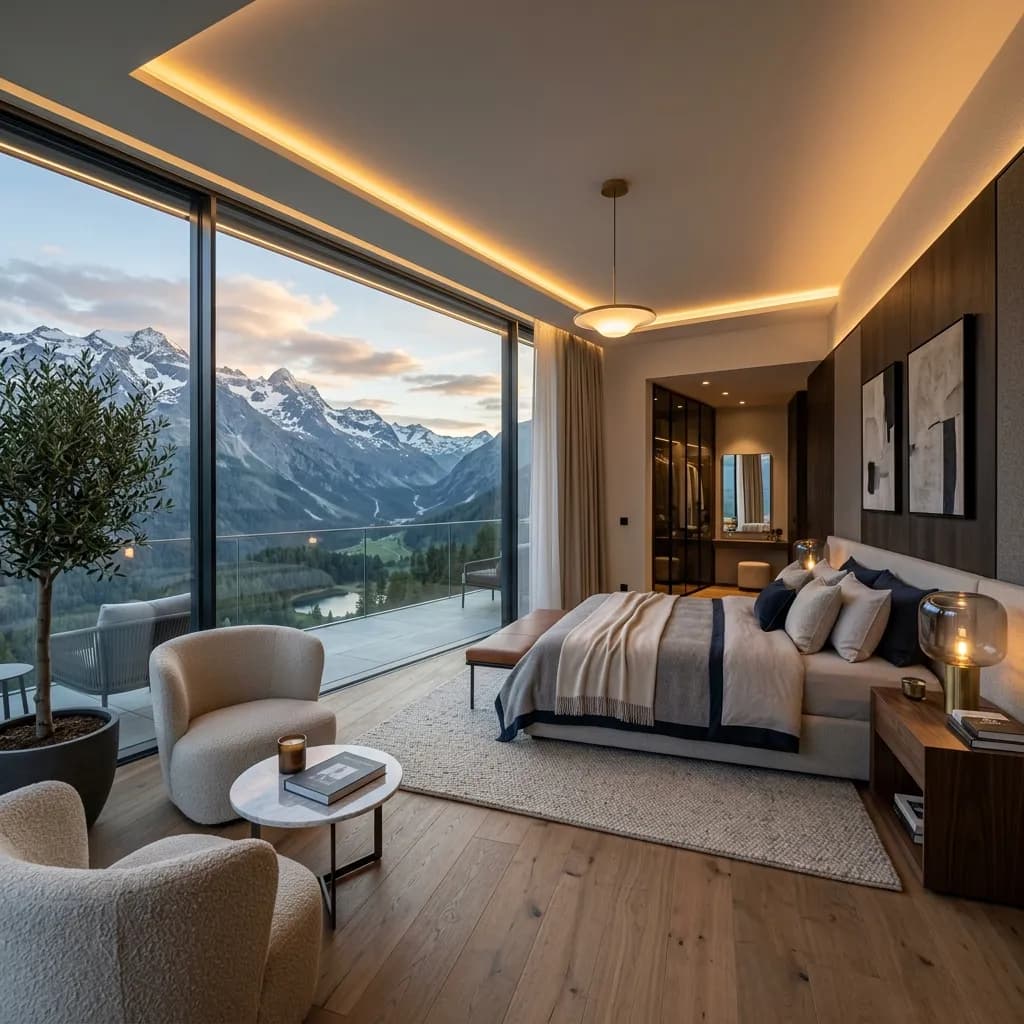
Marketing luxury properties: Why virtual home staging is indispensable
How to captivate sophisticated premium buyers with virtual home staging and reduce purchase barriers.
In the sales of Prime Real Estate – luxury villas, penthouses, and high-priced investment properties – the first visual impression determines success or failure.
The core problem of many high-end real estate properties: they are either completely empty or are furnished by the current owner with very specific (often outdated) furniture that does not match the taste of the modern, wealthy target audience (High-Net-Worth Individuals).
Empty rooms – even if they are equipped with finest marble and oak parquet – appear cold, uncomfortable, and paradoxically much smaller in photos than they actually are. The viewer's eye lacks reference points (furniture) to be able to assess the volumetry of the room.
In this B2B guide, we show why physical home staging in the luxury sector often poses a financial risk and how Virtual Home Staging by FotoEstate revolutionizes the marketing process, lowers purchase barriers, and massively increases margins for real estate agents and developers.
1. Eliminating the cost risk of physical staging
Physical home staging has established itself in recent years. However, in the luxury segment, it quickly reaches logistical and financial limits.
If you have a villa with 500 square meters of living space in Bogenhausen or on Sylt physically staged, you cannot place furniture from the Swedish furniture store there. The target group expects Minotti sofas, B&B Italia armchairs, and exquisite artworks.
The Invoice:
The rent for this high-end furniture, combined with the immense costs for shipping, assembly, insurance, and the monthly downtime, quickly swallows budgets of 30,000 to 50,000 euros for a marketing period of six months.
The ROI of Virtual Staging:
Virtual home staging completely eliminates this financial risk. Our 3D artists digitally furnish the rooms. You only pay a fraction of the cost for photorealistic high-end images (CGI). This drastic reduction of the marketing budget significantly increases the profit (ROI) of the real estate agent or developer, without compromising on aesthetics.
2. Target Audience Targeting: One Room, Three Design Worlds
One of the biggest disadvantages of physical furnishings is their inflexibility. You have to choose a furnishing style.
But what if the lakeside villa is interesting for two completely different buyer groups?
- Buyer A: A tradition-conscious family office that prefers classic elegance, heavy fabrics, and warm colors.
- Buyer B: A young tech CEO who loves uncompromising minimalism, dark tones, and futuristic design.
With virtual home staging, you can conduct A/B testing in real estate marketing. We take a photo of the empty (or cleared) living room and render it in different style worlds. You can present the room in the brochure as both "Classic-Elegant" and "Modern-Minimalist." This way, you emotionally reach every target group where their personal taste lies.
3. Quality Determines: Why Cheap CGI Destroys the Price
An important warning for the luxury market: Inferior virtual staging is more harmful than presenting the house empty.
When an investor opens a property brochure for a 5-million property and sees that the chairs appear to 'float' on the carpet, the shadows do not match the light coming from the windows, or the proportions are distorted, the perceived value immediately collapses. The property appears 'cheap' and unreliable.
The FotoEstate Premium Guarantee:
We use leading architectural visualization software (3ds Max, V-Ray, Corona Renderer) for the virtual home staging of premium properties.
- We calculate the exact light incidence (Global Illumination) based on the real photo.
- We use high-resolution 3D models of real designer brands.
- We pay attention to the smallest details: reflections of the furniture in the window glass, realistic fabric textures, and perfect vanishing point integration.
The result is so photorealistic that even experienced experts cannot tell at first glance whether the piece of furniture was actually in the room or digitally integrated.
4. Selling Visions: Luxury Properties in Need of Renovation
Virtual staging is particularly exciting when selling unrenovated 'treasures.' A villa from the 1970s in a prime location that has not been modernized for decades.
If you show the brown tiles and the dark wooden ceilings, the buyer sees only work, dirt, and costs. The cognitive barrier is extremely high.
We use the method of Virtual Renovation. We take the photo of the old room, digitally remove the dark ceilings, replace the tiles with elegant herringbone parquet, and furnish the room in a highly modern way.
In the exposé, you present the buyer with a 'Before-After Slider'. He no longer buys the current condition in need of renovation, but falls in love with the vision of potential. This psychological lever is enormously strong and prevents aggressive price reductions (dumping offers), as the future value of the property is already visible.
Conclusion: The Must-Have for High-End Brokers
Those who market Prime Real Estate must sell dreams and lifestyles. Empty spaces cannot achieve that.
Virtual home staging from FotoEstate offers you flexibility, cost efficiency, and above all, unbeatable visual brilliance to perfectly position your premium listings. Create the "I-want-it" reflex in your buyers, accelerate the sales process (for example, in combination with the advantages of Matterport tours for luxury properties) and at the same time strengthen your image as a modern, tech-savvy top agent in your market.
Related articles
Explore Virtual home staging
See what the service includes, which source material is useful and how a typical project starts.