Marketing luxury properties: Why AR real estate visualization is indispensable
How to captivate sophisticated premium buyers and reduce purchase barriers with AR real estate visualizations.
The sale of luxury real estate (prime real estate) in the price segment starting at 2 million euros follows entirely different rules than the classic housing market. High-net-worth individuals (HNWI), family offices, and wealthy investors do not simply buy "living space" – they invest in status symbols, quality of life, and architectural masterpieces.
This exclusive group of buyers lacks two things: time and tolerance for gaps in imagination. If you try to explain to a CEO or top athlete on a muddy construction site or in a gutted old building where the infinity pool or the freestanding bathtub will be in the future, the pitch will fail.
The year 2026 brings a massive paradigm shift for premium brokers and project developers: Augmented Reality (AR) real estate visualization. In this B2B guide, we show you how to revolutionize off-plan sales with AR (e.g., via Apple Vision Pro or iPad Pro) and maximize your closing rates.
1. Off-Plan Sales: The 5-Million House on the Empty Meadow
Banks often require project developers to achieve high pre-sale rates for premium new buildings before financing for the first groundbreaking is approved. Selling the penthouse "on paper" (off-plan) is the absolute pinnacle of the craft.
So far, elaborate brochures and printed floor plans have been used for this. However, the completion rates were often slow, as the emotional attachment to a piece of paper is low.
The AR Effect:
You meet with your HNWI client on the undeveloped property. You hand him an AR headset (or a tablet). Suddenly, through the glasses, the finished three-story luxury estate rises millimeter-precisely and life-sized on the lawn.
The customer walks physically across the lawn, steps virtually through the entrance door, and looks through the projected glass fronts at the real sunset. He feels the size of the living room and the height of the ceilings. FotoEstate's AR technology merges the real environment (the actual view) with the virtual architecture. This immersive experience produces an immediate 'wow' effect and triggers the buying impulse far more strongly than any 2D rendering.
2. Upselling through Real-Time Material Selection (Sampling)
In the luxury segment, individualization (customization) is the key to closing. Once the buyer has fallen in love with the house, the detailed negotiations about the fittings begin.
"I like the architecture, but the white marble floor feels too cold for me. How would dark walnut wood look?"
Until now, this meant for the broker or developer: commissioning new renderings from the architect, waiting 5 days, and hoping that the client does not lose interest by then.
The solution through AR: With interactive AR visualization, the material selection takes place in real time. A tap on the iPad by the broker, and the white marble throughout the virtual space instantly transforms into noble walnut wood. The countertop in the kitchen changes from stainless steel to black granite.
This live configuration not only dramatically accelerates decision-making, but is also the perfect leverage for upselling special features. The customer immediately sees why the extra charge for the more exclusive flooring is worth it.
3. The Hybrid Approach for Empty Inventory Villas
AR also fully exploits its strengths when marketing empty luxury properties. Physical home staging for a 600-square-meter villa with original designer furniture costs tens of thousands of euros and carries enormous logistical risks.
The Process 2026:
1. Digital First Contact: The listing on the premium portals contains photorealistically virtually staged high-end renderings from FotoEstate.
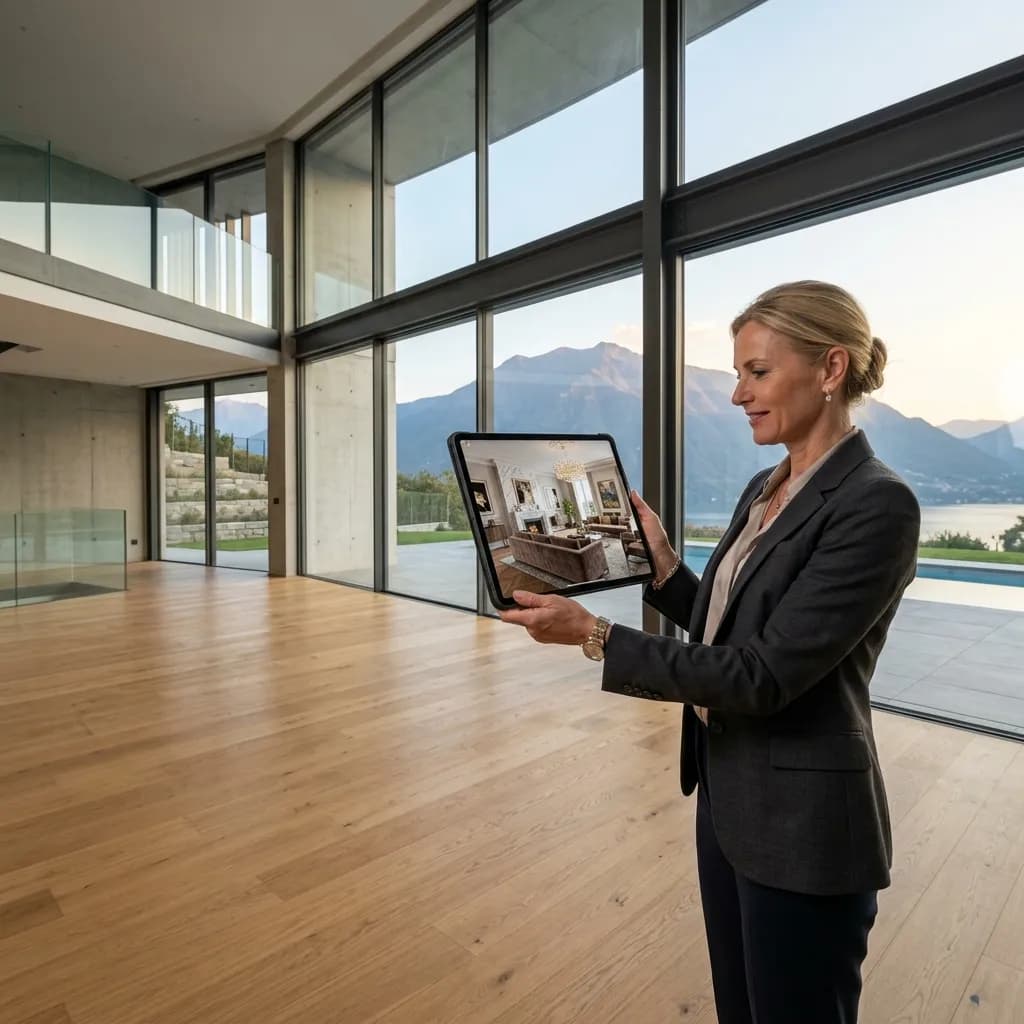
2. The Real Viewing (Hybrid): The client enters the real, empty villa. The agent uses AR to project exactly the furniture that the client saw and loved on the internet as holograms, precisely placed down to the millimeter in the empty rooms.
3. The Effect: The client experiences the real lighting conditions and the actual feel of the walls, while the AR glasses visualize the luxurious room concept. The risk (empty rooms) is reduced to zero, at a fraction of the cost of physical staging (more on this in our Cost-Benefit Comparison of Virtual vs. Real Home Staging).
4. Tech Leadership: How to Win the Sole Contract
The toughest competition for top brokers does not take place in finding buyers, but in securing the mandate. When you apply for the exclusive contract to sell a 10-million villa, you are competing with the best brokers in your city.
A standard marketing plan (photos, drone, brochure) is no longer enough here to convince the owner. Wealthy owners expect innovation and absolute top performance.
Your Pitch:
Bring an iPad to the sales meeting and demonstrate live to the seller in their own living room how you will furnish empty rooms using AR or visualize building potentials (e.g., the virtual addition of a conservatory).
You immediately position yourself as a tech leader and innovative premium service provider. This clear unique selling point (USP) will secure you the exclusive contract because the seller senses that you have tools that the competition does not have.
Conclusion: Emotion decides the million-dollar deal
In the high-end real estate market, it is not enough to sell facts. You have to awaken desires and make an elite lifestyle tangible.
Augmented reality is by 2026 no longer a futuristic gimmick, but a measurable conversion booster. AR overcomes buyers' lack of imagination, enables real-time customizations, and positions you as the ultimate premium expert. Rely on the high-end visualizations from FotoEstate to not only satisfy your most demanding customers but to sustainably fascinate them.
Related articles
Explore Property rendering
See what the service includes, which source material is useful and how a typical project starts.