Inherited a property: what to settle before anyone talks about selling
Inherited properties rarely become difficult on the market, but in the coordination. Knowing the sequence saves months.
An inherited property is rarely a market problem. It almost always becomes difficult in the coordination – between co-heirs, with the probate court, with the tax office. Knowing the order of steps saves months and avoids the conflicts that arise from uncertainty.
This article outlines the typical sequence under German law. It does not replace legal or tax advice – with communities of heirs in particular, professional counsel is usually money well spent.
Step 1: Establish who actually owns it
Before everything else stands the question of who inherited. If a will exists, the answer follows from it; otherwise statutory succession applies. Frequently a community of heirs of several people arises.
For the land register correction, a certificate of inheritance or a notarised will with opening protocol is generally required. Obtaining it takes weeks to months depending on the court – the reason sales of inherited property often start later than planned.
Practical note: the land register correction is free of charge within a certain period after the inheritance. Postponing it costs money unnecessarily.
Step 2: Make the community of heirs capable of acting
A community of heirs can only sell a property jointly. Every co-heir must agree – including the one holding only a small share.
That is the most common blocking point. Clarifying three things early has proven itself:
- Does anyone want to keep the property? If so, buying out the others is the cleaner route than a forced sale.
- Who coordinates? One person with power of attorney from the others saves countless rounds of coordination.
- What price is acceptable to all? Settling this in advance prevents an offer failing at the end on a single vote.
If no agreement is reached, the partition auction remains. It regularly produces markedly worse results than a private sale and should stay the last resort.
Step 3: Check the tax deadlines
Two points matter:
Inheritance tax depends on the degree of kinship and the allowances. For spouses and children the allowances are comparatively high, for more distant relatives markedly lower.
Speculation period: on a sale within ten years of the original acquisition, income tax on the gain can arise. Decisive is the deceased's acquisition date, not the inheritance – a point regularly misunderstood. With long family ownership the period has usually long expired.
An exception exists for owner-occupation. Clarify the details with a tax adviser before selling, not afterwards.
Step 4: Assess the condition realistically
Inherited properties have often been lived in for decades. Typical: outdated heating, single glazing, no insulation, bathroom and kitchen from the seventies or eighties.
Here lies the central decision: renovate or sell as is?
For most communities of heirs, selling as is is the right route. A renovation ties up capital that several people would have to raise jointly, takes months and rarely pays back fully at market.
The condition is no obstacle to marketing
What matters is how the property is presented. A vacant, unrenovated house regularly looks worse in photos than it is – dark rooms, old furniture, full cellars.
Two tools help considerably:
Virtual home staging furnishes empty rooms digitally. Buyers recognise the usability instead of staring at bare walls.
Virtual renovation shows on the actual photo how the house could look after refurbishment. Particularly effective with inherited properties, because it relieves the buyer of the imaginative work that otherwise deters them.
Labelling matters: both must be clearly marked as visualisations in the brochure. Anyone creating the impression the bathroom is already renovated risks rescission.
Step 5: Consider discretion
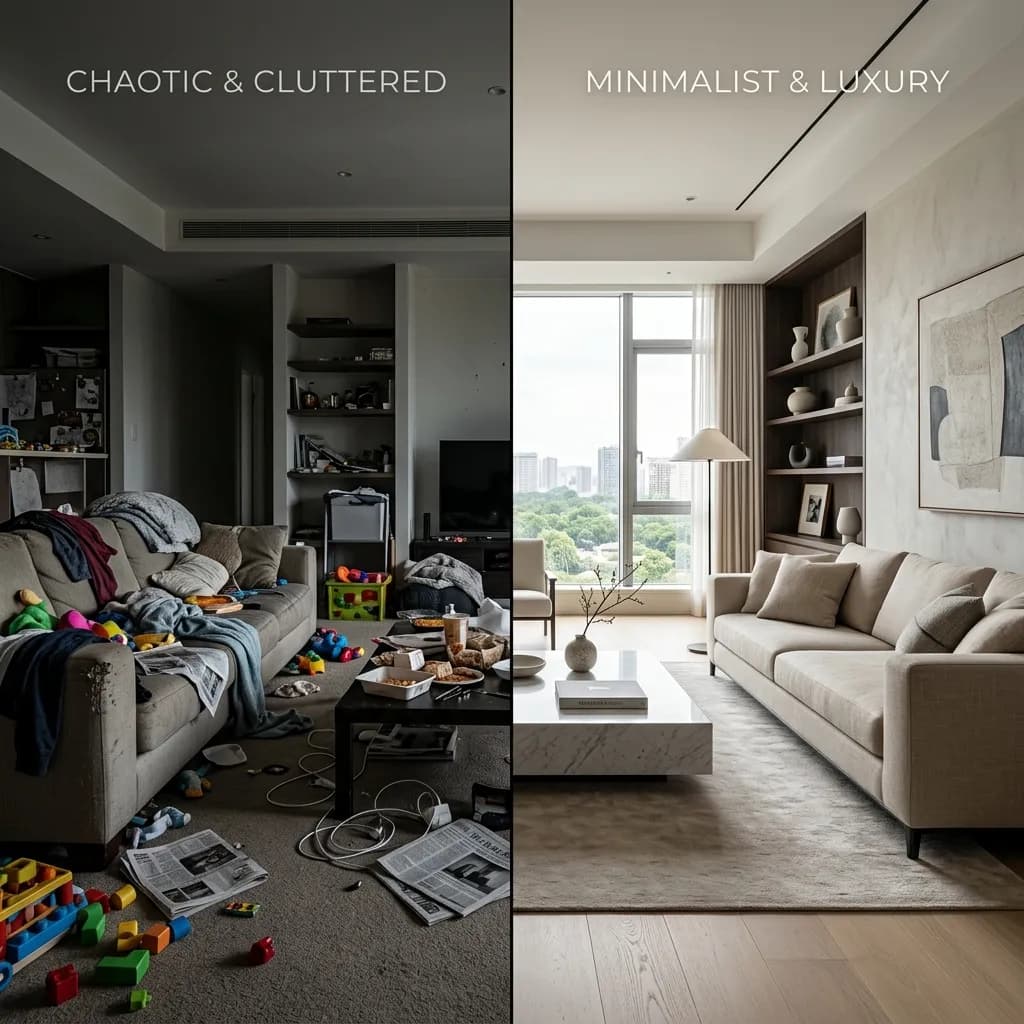
Bereavements strain families, and not everyone wants neighbours and acquaintances learning of the sale through the portal. Where that matters, photos without personal items and recognisable details are important – digital decluttering achieves more here than any wording in the brochure.
The typical mistakes
Advertising too early. Without settled ownership no sale is possible; a property online for months loses appeal.
Clearing the estate too fast. Documents on construction year, modernisations and the plot are valuable for marketing and otherwise end up in the skip.
Emotional price expectations. The value a family home holds for the family is not a market value. A sober valuation early on prevents months of failed attempts.
Solo runs by individual heirs. Whatever happens without coordination has to be corrected later – usually under time pressure.
Which documents to gather
Before marketing begins, a systematic search pays off – before the estate is cleared. Needed: land register extract, cadastral map, building permit and plans, evidence of modernisations with invoices, heating maintenance records, declaration of division for condominiums, minutes of recent owners' meetings, and existing energy certificates. Much of this sits in folders that end up in the container during clearing. A morning of sifting saves weeks later, because replacements from authorities and administrators take considerable time.
Handling the household contents
Clearing is emotionally the hardest part and practically the most time-consuming. A sequence has proven itself: first secure documents, then divide personal mementos among the heirs, then have valuables appraised, only then clear. In the reverse order, things regularly disappear that are missed later. For marketing: a cleared house photographs better than a crammed one, but a completely empty one feels cold. Where clearing is still pending, digital decluttering in the photos is the more pragmatic route.
When a co-heir will not move
The hardest case is the blocking single vote. Before considering the partition auction, look at the cause: often it is not economic calculation but an emotional bond to the family home or the feeling of having been passed over. In these cases conversations achieve more than deadlines. Where agreement is impossible, the takeover of the share by other heirs or the sale of the inheritance share to a co-heir can be a solution – both regularly better economically than the auction.
Letting instead of selling
Selling is not always the right decision. For a community of heirs in agreement, letting can make sense – say when the market is weak, when renovations are pending whose effect should be awaited, or when tax periods are still running. The flip side: a community of heirs as landlord is organisationally demanding, because every decision needs agreement. Where this path is chosen, engage a property manager from the start and equip one person with power of attorney.
The realistic timetable
Heirs regularly underestimate the duration. From the inheritance to the notary appointment, six to twelve months frequently pass even with good preparation: applying for and receiving the certificate of inheritance, correcting the land register, obtaining documents, valuation, coordination within the community, preparation and marketing, buyer search, the buyer's financing approval. Anyone planning for this period from the start does not come under pressure. Anyone counting on three months makes the final decisions under time constraints – the most common cause of results below value.
Related articles
Explore Virtual home staging
See what the service includes, which source material is useful and how a typical project starts.