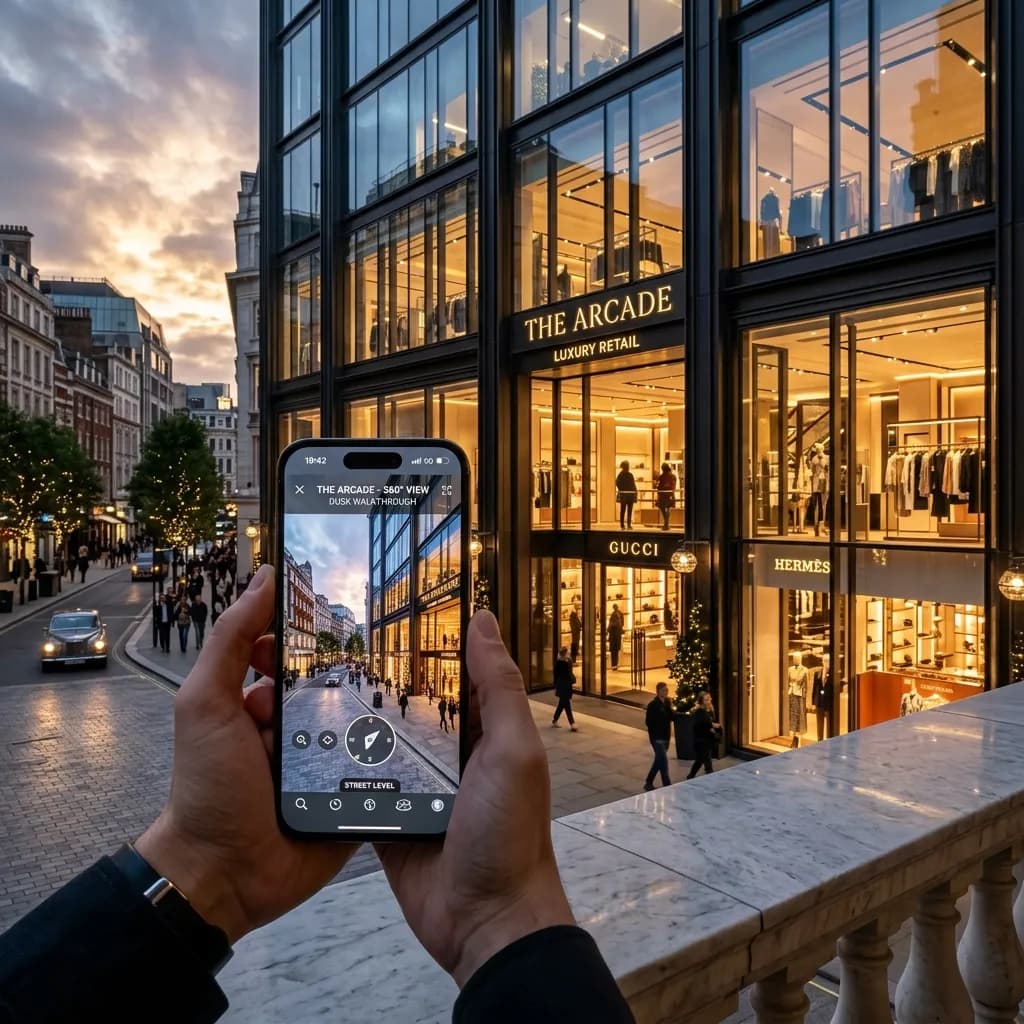
The tour in your Google profile: why local businesses benefit most
Anyone who knows a room beforehand enters it more easily. That is exactly the mechanism that works for local businesses.
A 360-degree tour is usually associated with property marketing. The economically more interesting use case lies elsewhere: local businesses embedding it directly in their Google business profile.
The mechanism behind it is simple and well documented: anyone who has seen a room beforehand enters it more easily.
The threshold of the first visit
With many local services it is not price that decides the first contact but uncertainty. What does it look like in there? Is it clean? Does it feel expensive? Where do I go when I walk in?
Nobody asks these questions aloud. But they cause one business to be skipped and the next to be clicked.
A tour answers them in seconds. It works especially well for medical practices, law firms, tax advisers, physiotherapy, restaurants, hotels, car dealerships and gyms – wherever the room is part of the service.
What it does in the profile
The tour appears directly in the Google business profile, exactly where local search ends. Two effects are measurable:
Longer dwell time in the profile. Users who open the tour stay considerably longer – a signal Google rates positively.
Higher interaction rate. Profiles with a tour generate more calls, route requests and website clicks than those without.
The second point is the commercially relevant one: it is not about visibility as such but the action that follows.
Doubly useful for agencies
For estate agents an additional aspect arises. A tour of your own office does two things: it lowers the threshold for owners considering a consultation – and it incidentally demonstrates exactly the technology you sell to your clients for their properties.
Anyone selling virtual tours without having one of their own office has a credibility problem nobody voices.
What matters in production
A tour done badly does more harm than none. The common mistakes:
Too few standpoints. Jumps across long distances create disorientation. One standpoint more is always better.
The wrong time of day. Rooms look markedly different across the day. Shooting at the best light and in a tidied state is obvious – and often skipped.
People in the shot. Staff and customers must either have consented or be unidentifiable. In practices and law firms that is a genuine data protection issue, not a formality.
Outdated captures. A tour showing a long-rebuilt reception creates irritation instead of trust on arrival. After major conversions it belongs renewed.
The effort
For a typical business with several rooms, capture takes a few hours. The business need not close – shooting usually happens before opening or in off-peak times.
Publication then follows the designated channels. What matters is linking to the correct profile and matching address data – deviations mean the tour exists but never appears in the profile.
How the tour technically reaches the profile
Publication happens not by simple upload but through the designated interfaces for 360-degree content. Decisive is the correct link to the right profile – with businesses holding several entries or similar names this regularly goes wrong, and the tour then exists but appears nowhere. After publication, check that it actually shows in the profile, not merely that it uploaded. Several days can also pass between publication and visibility.
What the tour shows beyond opening hours
An underrated side effect concerns reachability outside business hours. Anyone researching a business in the evening or at the weekend can neither call nor drop by – the tour is at that moment the only way to form an impression. For decisions researched at night and made in the morning, that participates in the outcome. This holds especially for hospitality, hotels and services where the feel of the room is part of the offer.
Making accessibility visible
For people with limited mobility, the question of steps, door widths and lifts is decisive – and it is reluctantly asked by phone. A tour answers it without asking. Businesses with accessible premises should show it deliberately: the step-free entrance, the lift, the accessible WC. That reaches an audience that otherwise pre-emptively chooses another provider. For medical practices, law firms and public institutions this point is practically more relevant than any design consideration.
Currency and upkeep
A tour ages with the business. After a conversion, a new reception or a redesign it shows a state visitors no longer find – creating irritation instead of recognition. As a rule of thumb: any change a regular customer would notice justifies a re-shoot. With stable interiors a tour lasts years without issue; with frequently redesigned sales floors it should keep pace with the redesign rhythm.
What the tour does for recruiting
Applicants research an employer before the interview, and the question of the working environment arises earlier than most businesses assume. A tour shows how bright the rooms are, how modern the equipment is, whether retreat spaces exist – questions nobody asks in an interview yet which shape the decision. For businesses in less attractive locations or sectors with staff shortages this is a real advantage: whoever sees the workplace in advance applies more readily. The tour embeds directly in job listings and works harder there than any description of team spirit.
Multiple use
The same capture serves beyond the Google profile: embedded on your own website, linked in social media, in application documents for skilled staff, or – with several locations – as a consistent appearance across all branches.
The last point pays off for chains in particular. A uniformly high-quality impression across every location is barely achievable with individual photos.
How we implement it is on the service page for Google Street View.
Related articles
Explore VR viewings
See what the service includes, which source material is useful and how a typical project starts.