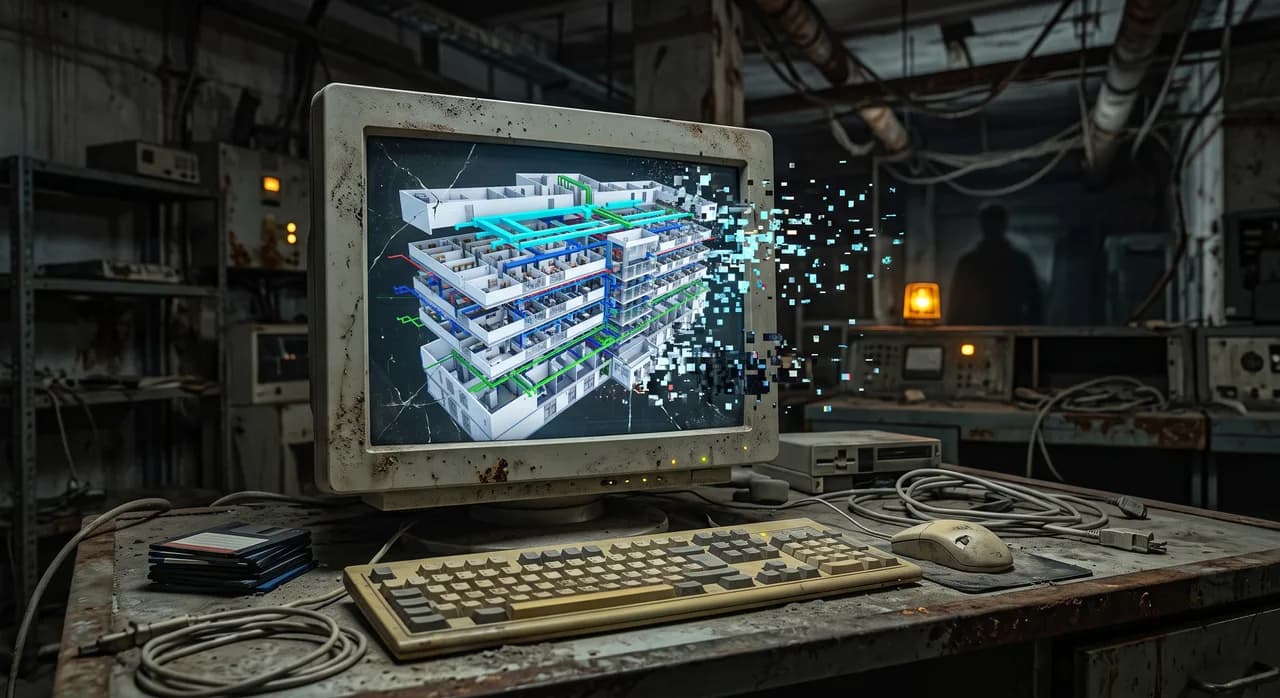
Few terms have attracted as much attention in recent years as the digital twin. At trade fairs, in expert talks and in white papers, it is presented as the logical continuation of digitalization: a virtual replica of a building or facility that reflects its current state at all times, integrates operational data and enables well-founded decisions. The promise is enticing, especially for facility and asset managers who battle daily with outdated plans, scattered documents and opaque building portfolios.
The reality often looks different. A considerable share of digital twin projects never reaches the state that was sketched out at the beginning. Models are built, demonstrated once and then disappear into a drawer. Others become outdated within a few months because no one maintains them. Still others turn out to be an expensive dead end because the data is locked in a format that can hardly be reused.
As a company that deals with 3D measurement and as-built surveying every day, we see these patterns again and again. And we believe it is more honest to speak openly about them than to sell the next glossy promise. This article describes the most common reasons why digital twins fail, and what distinguishes a realistic, viable start from a failed project.
The Digital Twin Is Treated as a One-Off Project
The most fundamental mistake happens in the mindset itself. Many organizations set up a digital twin like a classic construction project: there is a budget, a start and an end date, an acceptance milestone. Once the model is delivered, the project is considered complete. This is exactly where the misunderstanding lies. A twin that is meant to represent the current state of a building is not an outcome but a process. It thrives on keeping pace with reality.
A building changes constantly. Walls are moved, rental spaces are rebuilt, equipment is replaced, uses are adapted. A model that freezes the state as of the day of capture loses meaning with every one of these changes. After a year it might still match reality by eighty percent, after three years it no longer holds true in decisive places. Anyone who then makes a decision based on the model works from false foundations and undermines the very trust the twin was supposed to create.
The right framing is therefore that of an ongoing service, not a project. This does not mean that every small detail has to be updated immediately. But from the outset there needs to be an idea of the intervals and occasions at which the model will be updated, who initiates that and what it costs. If this question is ignored at the start, failure is already built in, even if it only becomes visible months later.
A Marketing Walkthrough Is Sold as a Full-Fledged Twin
A second, very widespread reason for disappointment lies in the language. The term digital twin is used for very different things. At one end there is a walkable 360-degree tour, familiar from real estate portals: visually appealing, quick to produce, ideal for presentation. At the other end there is a dimensionally accurate, semantically structured model in which building components are recognizable as such, can be given attributes and can be linked with operational data. Between these two ends lie worlds of difference in effort, benefit and price.
Problems arise when one is bought and the other is expected. A facility manager who was sold a virtual walkthrough as a digital twin quickly realizes that within it they cannot reliably measure areas, cannot link systems to maintenance data and cannot run any analyses. The tool is not bad, it is simply made for an entirely different purpose. The disappointment is then directed wholesale against the idea of the digital twin, even though the wrong product was simply chosen.
That is why it pays to get specific before every commission. What exactly should be possible with the model, and to what level of accuracy? Is a visual impression enough, or do the measurements have to be dependable? Should building components be addressable, or does a point cloud as a reference suffice? A reputable provider clearly distinguishes these levels instead of bundling everything under the same buzzword. Those who know the differences buy what fits their own task, not what looks most impressive.
The Data Foundation Is Too Weak From the Start
A digital twin is only ever as good as the data it is based on. That sentence sounds trivial, but in practice it is constantly disregarded. Models are built on the basis of old as-built plans that no one has checked against reality anymore. Or various sources are merged that do not fit together in coordinate system, level of detail and currency. The result looks coherent at first glance but contains errors that only become apparent when things get expensive.
What makes this particularly insidious is that such weaknesses can hardly be detected in the finished model. A nicely rendered wall looks correct, regardless of whether it stands twenty centimeters too far or an installation behind it is missing in the model. The twin suggests a precision and completeness that the underlying data never provided. If conversions are then planned or areas billed on this basis, the original errors propagate through all subsequent steps.
For this reason, a clean, verified capture of the actual as-is state stands at the beginning of every viable twin. A current on-site survey that captures the real geometry is not an optional luxury but the foundation. It is considerably cheaper to work thoroughly here than to build on a shaky model later and bear the consequences during operation. Those who cut costs on the data foundation cut costs in the wrong place.
The Twin Is Not Embedded in Daily Work
Even a technically flawless model fails if no one uses it. And only what fits into existing workflows gets used. A digital twin that exists as an isolated island solution, which you have to open through a separate program that talks to no other system, is consistently bypassed in the hectic day-to-day of operations. Staff continue to reach for the tools they know, and the model gathers dust.
The decisive question is whether the twin is available where work actually happens. Is it linked to the CAFM or maintenance system? Can orders be triggered or information retrieved from within the model that would otherwise have to be laboriously pieced together? Can a technician on site access the relevant data? If these connections are missing, the twin remains a showpiece that is presented to visitors but plays no role in the real process.
This integration cannot simply be bolted on afterwards; it must be thought through from the beginning. Which systems are in use, which interfaces exist, which concrete work step is the twin meant to make easier? Anyone who first asks these questions when the model is already finished faces the difficult task of forcing a finished solution into a landscape not prepared for it. This is often the point at which an otherwise good project vanishes into everyday operations.
Too Much Sensor Technology Without a Clear Use Case
A tempting wrong turn is the notion that a digital twin has to contain as much live data as possible in order to be valuable. So sensors are installed, meters are read out, data streams are connected, entire dashboards are filled with real-time values. On a presentation slide this looks impressive. In operation it quickly produces a flood of figures that no one evaluates, because it was never defined which question this data is actually supposed to answer.
Every sensor costs money in acquisition, installation, maintenance and data storage. If there is no concrete benefit to offset it, it becomes a burden. A temperature reading that is measured but linked to no action improves nothing. It merely creates the feeling of being digital. Worse still, an over-instrumented environment distracts from the few readings that would actually matter and makes the system more complex and failure-prone than necessary.
The better path begins with the question of the use case, not with the technology. Which decision is to be improved by which piece of information? Only once this chain is clear does it become apparent which data you really need and at what frequency. Often it turns out that a single relevant measuring point achieves more than a hundred decorative ones. A good digital twin is not distinguished by the quantity of connected sensors but by the economy with which it captures precisely what leads to an action.
Vendor Lock-In Through Proprietary Formats
A risk that only becomes noticeable late is dependence on a single provider. Many platforms store the model and the associated data in a closed, proprietary format. As long as the collaboration goes well, this attracts no attention. It becomes critical the moment you want to switch providers, transfer data into another system or use the model with a further tool. Then it turns out that the laboriously built-up information is effectively locked away.
This dependence is rarely accidental. A closed format is an effective means of binding customers to a platform for the long term. The exit is made so expensive and demanding that it practically never takes place, even when prices rise or the service declines. For the operator this means a creeping loss of freedom to act. The data about their own building formally belongs to them, but is hardly usable without the provider. Over the long operating periods customary in the real estate sector, that is a considerable risk.
The protection against this is conceptually simple but easily overlooked: insist on open, documented formats. Geometry, attributes and links should exist in standards that can also be read outside a single piece of software. A reputable partner has no problem with this and delivers the raw data in a reusable form. Anyone who asks the question of data export as early as the commissioning stage and demands a clear answer spares themselves a rude awakening later. Openness here is not a technical detail but a strategic safeguard.
No One Is Responsible for Maintenance
All the points mentioned so far converge at one place: ownership. A digital twin that no one feels responsible for maintaining inevitably ages. Imperceptibly at first, then faster and faster. Changes to the building are not entered, new documents end up elsewhere, discrepancies between model and reality accumulate. At some point no one trusts the data anymore, and from that moment on the twin is useless, no matter how much was invested in its creation.
The problem is organizational, not technical, in nature. In many organizations, maintenance is a task that lies between departments and is therefore taken on by none. IT does not see itself as responsible for the building stock, facility management not for the data models, the construction department only concerns itself with ongoing projects. Without a named person who owns the current state of the twin, the task falls through all the cracks. Good intentions and a note in the concept are not enough.
That is why every viable twin needs a clearly named person in charge, equipped with time, competence and a defined process. This person does not have to implement every change themselves, but they must ensure that changes are captured and transferred into the model. If this role is not filled, any discussion about technology and format is secondary, because the outcome is already determined. The twin will become outdated, and the money invested was a one-off snapshot with a limited shelf life.
Conclusion
Digital twins rarely fail because of the technology. They fail because of false expectations, a weak data foundation, a lack of integration into daily work, superfluous complexity, dependencies and, above all, unresolved ownership. Almost all of these causes can be avoided if they are taken seriously at the start, instead of getting swept up by the glossy promise.
Our advice is therefore a pragmatic start. Begin with a precise, verified survey of the actual as-is state, because this foundation carries everything else. Insist on open, documented formats so that your data belongs to you and remains usable, independent of any single provider. And name a person responsible for maintaining the twin before you think about additional functions and sensor technology.
A lean, current and open twin that someone stands behind is more valuable than an impressive model that no one takes seriously after a year. Those who start small, clean and with clear ownership can expand at any time. Those who start big and disorganized often end up with nothing but an expensive disappointment. The difference lies not in the technology, but in the attitude with which one approaches the subject.