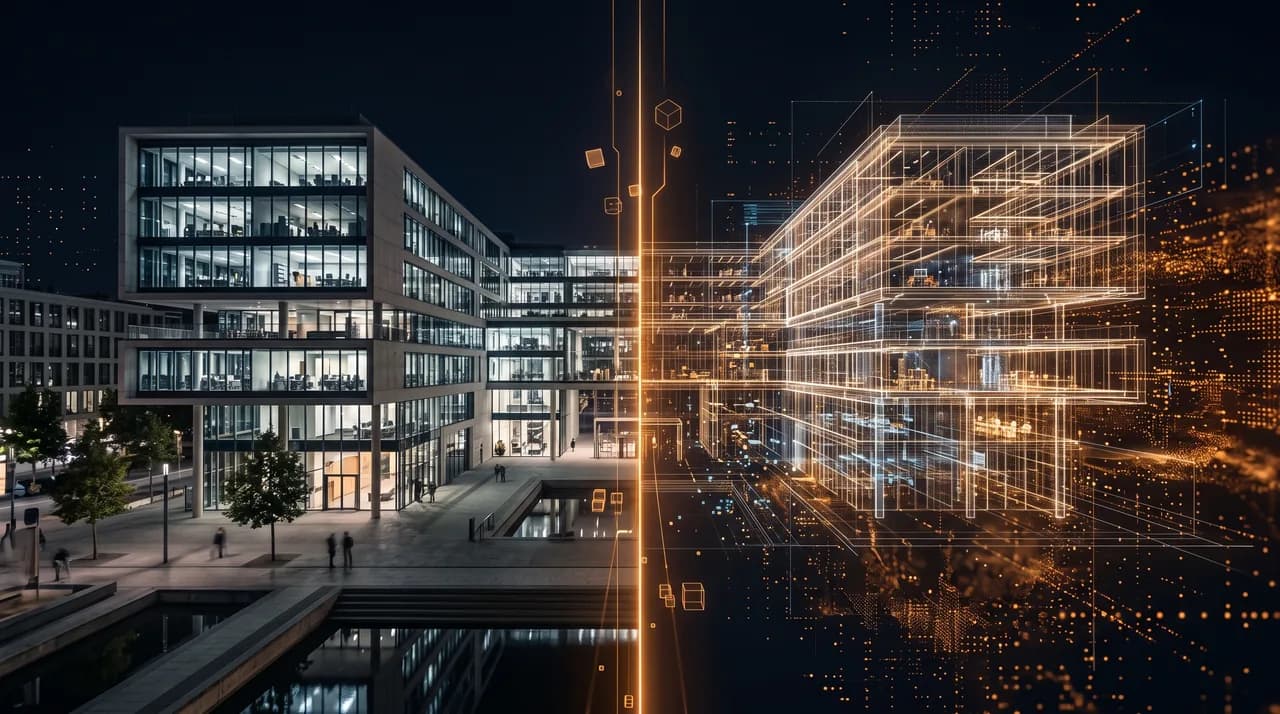
Few terms in the built environment have been stretched as far as "digital twin". A slick 3D walkthrough of a lobby, a BIM model handed over at project completion, a dashboard with a few temperature readings, a point cloud from a laser scan, all of these get marketed under the same banner. For facility managers, asset managers, and developers who have to justify budgets, this vagueness is a real problem. If a vendor promises a digital twin and delivers a spinning 3D image, you have paid for a brochure, not an operational asset.
This article is written for people who own or operate buildings and need to make procurement decisions, not for technologists chasing the next acronym. We will be honest about where the hype ends and the substance begins. Our position is simple: a digital twin is not a product you buy in a box, it is a layered capability you build up over time, and the first layer, an accurate as-built capture of the building as it actually exists, is worth far more to most operators than the live-data fantasy that gets pitched in sales decks.
Marketing 3D Tour vs. True Digital Twin: The Core Distinction
The fastest way to cut through the noise is to ask one question: does the model change when the building changes? A marketing 3D tour is a snapshot. It was captured on a specific day, it looks impressive, and it will look exactly the same in three years even though the building has been re-partitioned twice and the chiller has been replaced. It is a beautiful photograph of a moment. That has genuine value for leasing and orientation, but it is not a twin, because a twin implies a living correspondence between the physical object and its digital counterpart.
A true digital twin maintains that correspondence. It is connected, in some form, to the reality of the asset, so that when a sensor reports a fault, an occupancy pattern shifts, or a wall gets moved, the digital representation reflects it, or at least can be updated in a structured, repeatable way. The key word is "connected", not necessarily "real-time". Many valuable twins update on a monthly or quarterly cadence rather than by the second. The distinction is not about speed, it is about whether the model is a static artifact or a maintained system of record.
This is why so many "digital twin" projects disappoint. Buyers imagine a living, breathing replica and receive a one-off 3D scan dressed up with marketing language. Neither party is necessarily lying, they are simply using the same words for very different things. Getting precise about what you actually need, and what each layer costs to maintain, is the whole game.
The Four Layers of a Digital Twin
It helps enormously to stop thinking of a digital twin as one thing and start thinking of it as four stacked layers, each of which delivers value independently and each of which costs progressively more to build and maintain. Understanding these layers lets you buy exactly as much twin as your use case justifies, rather than paying for a full stack you will never operate.
The first layer is geometry, typically captured as a point cloud or reality-capture mesh from laser scanning or photogrammetry. This is the measured truth of the building: where the walls, columns, shafts, and equipment physically are, to millimetre or centimetre accuracy. It answers the question "what is actually there?", which is astonishingly hard to answer for existing buildings whose paper drawings are decades out of date. This layer alone resolves a huge share of day-to-day operational disputes.
The second layer is semantic BIM data. Here the raw geometry gets enriched with meaning: this object is not just a box, it is an air handling unit of a particular make, with a service history, a warranty, a spare-parts list, and a relationship to the ducts it feeds. This is where a point cloud becomes a structured asset database. The third layer is live sensor and IoT data: temperature, occupancy, energy consumption, equipment status, air quality, streamed from the building's management system and connected devices. The fourth layer is operational process data: work orders, maintenance schedules, tenant requests, space bookings, and energy contracts, the business processes that run on top of the physical asset. Each layer up the stack multiplies both the value and the cost of keeping things current.
Maturity Levels and What Each One Realistically Delivers
Because the layers stack, it is useful to describe digital twins in maturity levels, so you can name honestly where you are and where you want to be. Vendors love to sell the top of this ladder while most operators would benefit enormously from just reaching the second rung.
Level 1, the descriptive twin, is geometry plus basic semantic data. You have an accurate 3D model of the building with objects that carry attributes. This lets you measure spaces reliably, plan fit-outs, brief contractors from a single source of truth, and stop sending people to site with a tape measure. It is static, it updates when you commission a re-scan or a manual update, and for the overwhelming majority of facility management tasks it is already transformative. Level 2, the informative twin, connects the model to live building data so that current conditions are visible in spatial context: you can see which rooms are occupied, where energy is being wasted, which asset is throwing an alarm, all located precisely in the model.
Level 3, the predictive twin, uses the accumulated data to forecast: this pump's vibration signature suggests failure within six weeks, this zone will overheat given tomorrow's forecast, this floor's occupancy trend means you can consolidate leases. Level 4, the autonomous twin, closes the loop and lets the system act, adjusting setpoints or dispatching work orders without a human. Level 4 exists in serious form in a handful of flagship, heavily instrumented buildings and almost nowhere else. Be deeply sceptical of anyone selling Level 4 to a standard commercial or residential portfolio. The honest, valuable target for most operators is a solid Level 1 that some priority buildings extend selectively to Level 2.
What Most "Digital Twin" Projects Actually Deliver
Strip away the marketing and look at what changes hands when a digital twin project completes, and a consistent picture emerges. The great majority of delivered projects are Level 1: an accurate geometric capture, often with a partial semantic layer, presented through a web viewer. That is genuinely useful and worth paying for. The problem is only that it was frequently sold with the imagery and vocabulary of Level 3 or Level 4, so the client feels short-changed even when they received something valuable.
A second common outcome is the orphaned live dashboard. A vendor connects a handful of sensors, builds an impressive real-time visualisation for the launch demo, and then the data stops flowing within months because nobody owns the integration, the sensor batteries die, or a BMS upgrade breaks the connection. The dashboard becomes a screen that shows plausible but stale numbers, which is arguably worse than no dashboard at all, because it invites decisions based on fiction. This is the single most common way live-data twins fail: they are built as a project, not operated as a service.
The third pattern is the beautiful model that nobody uses because it was never wired into a workflow. If your facility team still opens their old CAFM system and their old spreadsheets to do their actual jobs, the twin is decoration. Value comes not from the model existing but from a real task, area measurement, contractor briefing, energy reporting, moving into the twin as the default tool. A modest twin embedded in daily work beats a sophisticated one that sits in a browser tab nobody opens.
Why a Pragmatic Start Is an Accurate As-Built Capture
Given all of this, the pragmatic entry point is almost always the same: capture the building as it actually is, accurately, before doing anything else. Every higher layer depends on trustworthy geometry. You cannot sensibly attach live sensor data, run space analytics, or plan a refurbishment on top of a model that is wrong about where the walls are. Reality capture through laser scanning or photogrammetry gives you that measured foundation, and it does so as a discrete, deliverable project with a clear scope and price, rather than an open-ended integration commitment.
An accurate as-built capture pays for itself immediately and independently of any twin ambitions. It ends the recurring cost of sending people to site to re-measure, it resolves disputes with contractors and tenants about what is actually there, it feeds directly into renovation and fit-out planning, and it becomes the coordination base for any construction work. These are hard, near-term savings that a CFO can understand, and they accrue whether or not you ever build a single higher layer. That is what makes it the safe first investment: the downside is bounded and the upside compounds.
Crucially, starting here also protects your future options. A well-executed, well-registered point cloud and a clean semantic model are the substrate onto which live data and analytics can later be added, building by building, use case by use case, as each one proves its return. You are not locked into a monolithic platform decision made before you understood your own needs. You build the foundation once, then extend deliberately where the numbers justify it, rather than buying a full stack on faith.
Cost and Benefit: Reasoning About the Investment
The economics of a digital twin only make sense when you separate the one-time capture cost from the ongoing maintenance cost, because they behave completely differently. Geometry and semantic data (Levels 1) are dominated by an upfront capture-and-model cost that then depreciates slowly; you re-scan only when the building changes materially. Live data and analytics (Levels 2 to 4) are dominated by recurring costs: sensor maintenance, data integration, software subscriptions, and the staff time to keep it all alive. Many twin business cases collapse because buyers price only the exciting upfront build and ignore the unglamorous run cost that never stops.
The way to reason about it is use case by use case, not building by building or portfolio-wide in one leap. Ask what specific, recurring cost or risk each layer removes. Accurate as-built geometry removes re-measurement cost and de-risks capital projects, which is easy to quantify. Live energy data in spatial context can justify itself in a large, energy-intensive building through consumption savings, but the same sensors in a small, stable office may never recover their maintenance cost. Predictive maintenance pays off on critical, expensive, failure-prone equipment and is pure overhead on simple assets. The twin should be as deep as the specific asset's economics warrant, and no deeper.
This is also why portfolio strategies work best when they are tiered. Capture accurate geometry across the whole portfolio, because that foundation is cheap relative to its broad utility. Then add live and predictive layers only to the subset of trophy assets, energy-intensive buildings, or mission-critical facilities where the recurring investment clears a clear return threshold. Uniformly instrumenting an entire portfolio to Level 3 is how organisations burn budgets and end up with orphaned dashboards. Selective depth on a common foundation is how they build something that lasts.
Common Reasons Digital Twin Projects Fail
When these projects disappoint, the causes are remarkably repetitive, and almost none of them are about the technology being incapable. The first and most common is treating the twin as a project rather than a service. A capture-and-build engagement has an end date; a live, maintained twin does not. If no one is funded and accountable for keeping data flowing and the model current after go-live, the twin decays. Decide who owns it in operation before you commission it, or deliberately scope a static Level 1 deliverable that does not need ongoing feeding.
The second is mismatched expectations from the start, usually because the word "twin" meant different things to buyer and seller. The cure is boring and effective: write down which layers and which maturity level you are actually buying, in plain language, with the update cadence stated explicitly. The third is poor data foundations: building live and predictive layers on inaccurate geometry or inconsistent asset naming, so the whole edifice inherits errors. The fourth is no workflow integration, the beautiful-model-nobody-uses problem, where the twin is never made the default tool for a real recurring task.
The fifth is over-instrumentation without a use case, deploying sensors everywhere because the platform can, then drowning in data nobody analyses while paying to maintain it all. And the sixth is vendor lock-in through proprietary formats, where your building data is trapped in one supplier's cloud in a form you cannot export, so the twin you paid for is not really yours. Insisting on open, exportable deliverables, point clouds and models in standard formats, protects the long-term value of your investment regardless of which software you use to view it.
Conclusion
A digital twin for buildings is neither the magical living replica of the sales deck nor merely the pretty 3D tour that gets mislabelled as one. It is a layered capability: measured geometry, semantic asset data, live sensor streams, and operational processes, each delivering value and demanding cost in different proportions. The honest truth is that most operators do not need, and should not pay for, the top of that stack. They need an accurate, trustworthy foundation and the discipline to extend upward only where a specific use case pays for itself.
Start with an accurate as-built capture of the building as it actually exists. That single step ends re-measurement costs, de-risks your capital projects, resolves disputes, and quietly becomes the substrate for anything you choose to add later. Extend to live and predictive layers selectively, on the assets whose economics justify the recurring investment, and only after you have decided who will own and maintain them. Insist on open, exportable data so the twin remains yours. Do that, and you will have built something genuinely useful, on solid ground, at a cost you can defend, while the market is still arguing about what the words mean.