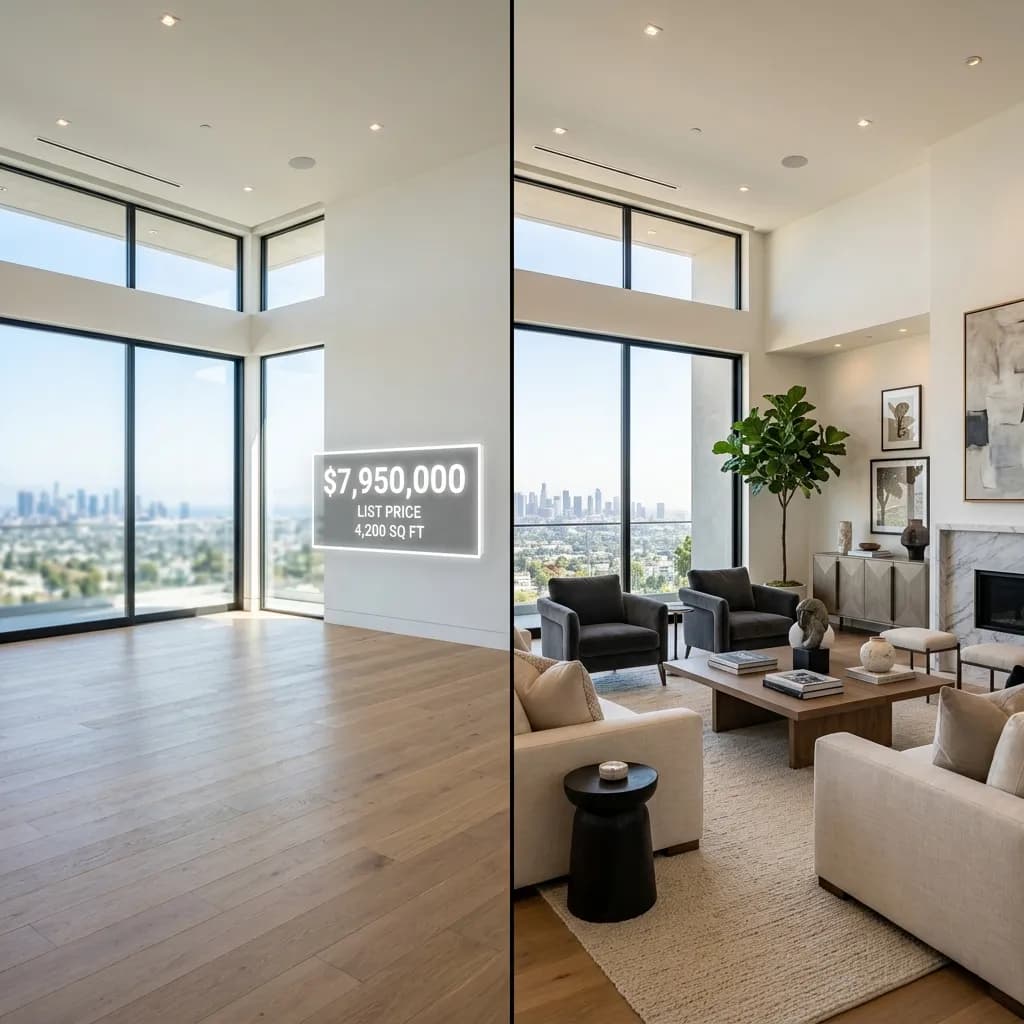
Marketing an empty property is a rookie mistake in modern sales. Empty rooms appear significantly smaller in photos than furnished ones, lack any emotional appeal, and make it almost impossible for the buyer to estimate the true proportions (e.g., "Will my 2x2 meter bed fit here?").
The industry agrees: Home staging is an absolute must. But the crucial question for developers, real estate investors, and broker offices in 2026 is: Do you still invest in expensive, real rental furniture (real staging) or do you rely on photorealistic 3D renderings (virtual staging)?
In this comprehensive B2B guide, we dissect both methods and provide you with a transparent cost-benefit comparison that will sustainably change your sales margin.
1. The Cost Structure: A Calculation Example
The most direct lever for your business success is the margin. Let's compare the costs for an average 150 sqm single-family house.
Real (Physical) Home Staging:
You hire a staging agency. They plan the concept, rent the furniture, hire a shipping company, have the furniture set up, and decorate the rooms.
- Cost factor: In the DACH region, the costs for a 3-month setup including logistics average 4,500 to 7,000 euros.
- The problem: If the property is not sold within 3 months, you have to extend the furniture rental at a high cost (often 15% to 20% of the initial price per month).
Virtual Home Staging: A professional real estate photographer (like FotoEstate) photographs the empty rooms. Our 3D artists then arrange the digital photos on the computer with photorealistic designer furniture.
- Cost factor: A set of 6 to 8 high-quality, digitally staged images costs you on average 300 to 500 euros.
- The advantage: You own the unlimited usage rights to the images – forever. No renewal fees, no hidden costs.
Cost Result: Savings of over 90% through virtual staging.
2. Time-to-Market (Marketing Speed)
For property developers and fix & flip investors, time is literally money. Every month of vacancy costs interest on the interim financing.
The logistics bottleneck of real staging:
Freight forwarders and staging agencies will suffer from an acute shortage of skilled workers in 2026. If you call today, you often only get an appointment for the setup in three to four weeks. Only after that can the photographer come. You lose a whole month.
The Digital Turbo:
With virtual staging, all physical logistics are eliminated. After the initial photo shoot of the empty property, FotoEstate delivers the fully furnished glossy images to you within 48 hours. You can immediately publish the listing on ImmoScout24 and save valuable interest weeks.
3. The Liability Risk: Scratches in the Parquet
One aspect that is often forgotten in the calculation is the risk of damage.
When four movers carry a heavy velvet sofa through the narrow stairwell of a newly renovated old building, damage is often inevitable. A dent in the freshly painted door frame or a deep scratch in the hand-laid herringbone parquet leads to massive conflicts with the owner. As a broker or asset manager, you suddenly find yourself liable and under the stress of damage regulation.
Virtual staging is 100% digital and therefore 100% risk-free. No one enters the property with heavy objects. The freshly polished parquet remains untouched.
4. Multi-Styling: A/B Testing in Real Estate Marketing
Physical staging is static. If you have chosen a bright, Scandinavian wood design, you have to hope that this style suits the taste of the final buyer.
The digital revolution 2026 enables agile marketing (A/B testing). We can render the same room on the computer in an extremely cost-efficient way in three completely different styles:
- Style A: Young, minimalist, industrial loft style (target group: DINKs - Double Income No Kids).
- Style B: Warm, familiar, boho-chic (target group: young families).
- Style C: Luxurious, classic, heavy fabrics (target group: best agers / downsizing).
You upload all three cover images to the portal and analyze the click-through rates (CTR) after a week. The market decides which design converts best. You are no longer stuck in a design dead end.
5. The Hybrid Approach: The Symbiosis for Premium Properties
Many brokers ask: "But what happens if the customer comes to the viewing after seeing the great online pictures and the house is completely empty? Won't they be disappointed then?"
Practice shows: No. The client knows from the brochure that the images were digitally staged (transparent labeling). The images have fulfilled their purpose: they have emotionally engaged the client and prompted a targeted, real viewing (a filter effect through which real estate agents in combination with virtual tours save massive amounts of time).
The Solution 2026 (Augmented Reality):
We use the hybrid approach. The real estate agent hands the customer a tablet (or an AR headset) during the viewing of the empty house. The customer points the tablet into the empty room and sees on the display in real time (augmented reality) exactly the furniture they know from the brochure, positioned millimeter-perfectly in the room. The illusion is perfect, costs remain minimal.
Conclusion: Real staging is an outdated model
If we analyze the hard facts – costs, time-to-market, risk, and flexibility – physical home staging loses every direct comparison in 2026.
Real staging today only makes sense in absolute ultra-luxury exceptional cases, where the tactile feeling of materials matters. For 99% of the market, virtual home staging is the economically, logistically, and visually superior choice.
Increase your profit margin and drastically accelerate your sales. FotoEstate provides you with this photorealism quickly, legally secure, and at the highest architectural level.