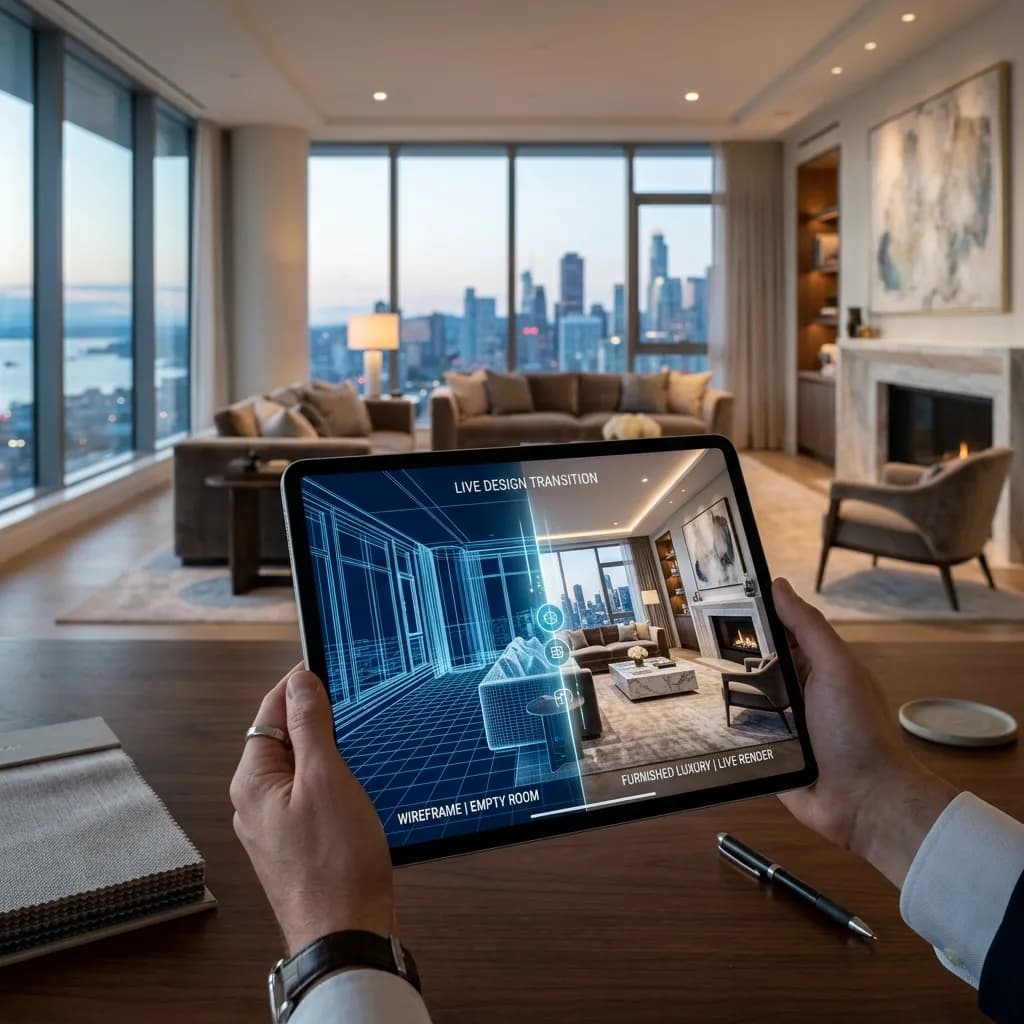
The most important trends in Virtual Home Staging in 2026
Discover the latest developments and technologies in virtual home staging that are revolutionizing real estate marketing in 2026.
Selling an empty property is a tough test for any real estate agent. Empty rooms paradoxically always appear smaller in photos than furnished ones, they radiate coldness and reveal every little scratch in the parquet (which, along with issues like correct area calculation, is often the biggest hurdle for buyers). The biggest problem, however, is that without furniture, 90% of potential buyers cannot imagine how they will use the space in the future.
For a long time, physical home staging (renting real furniture) was the only solution – a costly (often 3,000 to 8,000 euros), logistically complex, and time-consuming method. In 2026, virtual home staging completely disrupted the market. Driven by new rendering engines and artificial intelligence, digital furnishing today is indistinguishable from the original. In this B2B guide, we show real estate agents, builders, and project developers which trends dominate the year 2026.
1. Hyper-Realism through Ray Tracing and Unreal Engine 5
Just a few years ago, virtual staging was often recognizable as such: The digital sofas seemed to float above the floor, shadows fell in the wrong direction, and the proportions looked distorted.
The year 2026 is marked by absolute photorealism. The 3D artists at FotoEstate use technologies that come from Hollywood and the high-end gaming industry (Unreal Engine 5). Through real-time ray tracing, the behavior of light rays is simulated physically correctly.
- Perfect Reflections: The digital designer lamp is correctly reflected in the real window glass.
- Materiality: Velvet looks soft, leather casts realistic folds, and chrome metal reflects the color of the real walls.
- Light and Shadow: The digital bed casts a physically correct, soft core and cast shadow onto the real parquet floor, based on the actual sunlight in the original photo.
For the viewer on ImmoScout24, it is impossible in 2026 to tell whether the room was furnished physically or virtually.
2. From Staging to "Virtual Renovation" (Virtual Renovation)
Virtual staging traditionally means filling empty rooms with furniture. However, the mega-trend of 2026 goes a massive step further: virtual renovation.
Especially with existing properties from the 70s or 80s (with dark brown tiles, floral wallpaper, and wooden ceilings), staging is not enough. The building fabric deters buyers.
The digital core renovation:
We virtually tear down the wall between the kitchen and living room, lay a light oak herringbone parquet, plaster the walls white, and install a freestanding kitchen island.
This visualization of the potential is worth its weight in gold for investors and 'fix and flip' buyers. They no longer sell the unattractive current state, but the radiant vision of the fully renovated property – including a construction cost estimate provided by the real estate agent.
3. Target Group Targeting through Multi-Styling (A/B Testing)
Physical staging forces you to make a decision: Do you furnish the house in a classic-elegant or modern-Scandinavian style?
The digital revolution of 2026 enables multi-styling. Since a new rendering now costs only a fraction of the price, smart brokers render the same empty living room in three completely different styles:
1. Scandinavian / Boho: For the young family, light wood, many plants.
2. Industrial Loft: For the single DINK (Double Income, No Kids), dark steel, leather sofa.
3. Classic Luxury: For best-agers (downsizing), heavy fabrics, chandelier.
Real estate agents can run A/B tests on portals: Which cover photo generates the highest click-through rate (CTR)? Suddenly, the property appeals emotionally not to just one, but to three completely different buyer groups.
4. Staging in the 3D Tour (Spatial Computing)
So far, virtual staging has been limited almost exclusively to 2D photos. The next technological leap in 2026 is embedding digital furniture into walkable 3D tours (like Matterport).
Instead of navigating through an empty digital twin, prospects walk through a fully furnished 3D model. Thanks to spatial computing, buyers with VR headsets (like Apple Vision Pro) can directly walk through the virtually furnished living room and physically feel the distances between the digital dining table and the real wall.
5. The ROI Argument (Cost, Time & Sustainability)
Why are developers and asset managers almost completely foregoing physical staging in 2026?
- Cost Structure: Real staging of a single-family home costs 5,000 euros rent for 3 months plus shipping. Virtual staging of 6 rooms costs a few hundred euros – a fraction of the budget.
- Time-to-Market: The shipping company needs two weeks for setup. FotoEstate delivers virtually staged images within 24 to 48 hours.
- Risk & ESG: No one scratches the freshly painted door frame when bringing in sofas. No CO2 emissions from furniture transporters.
Conclusion: Emotion is the key to selling
Purchase decisions in real estate are made 80% based on gut feeling and are rationally justified afterwards. Empty spaces, however, trigger the mind ("Isn't this too small?"), while furnished spaces awaken emotions ("Here I drink my coffee on Sundays").
Virtual home staging in 2026 is the most efficient weapon in the marketing arsenal of real estate agents and developers to create exactly these emotions, minimize viewing tourism, and significantly increase the final selling price. FotoEstate provides you with this photorealism quickly, legally secure (marked as visualization), and at the highest architectural level.
Related articles
Explore Virtual home staging
See what the service includes, which source material is useful and how a typical project starts.