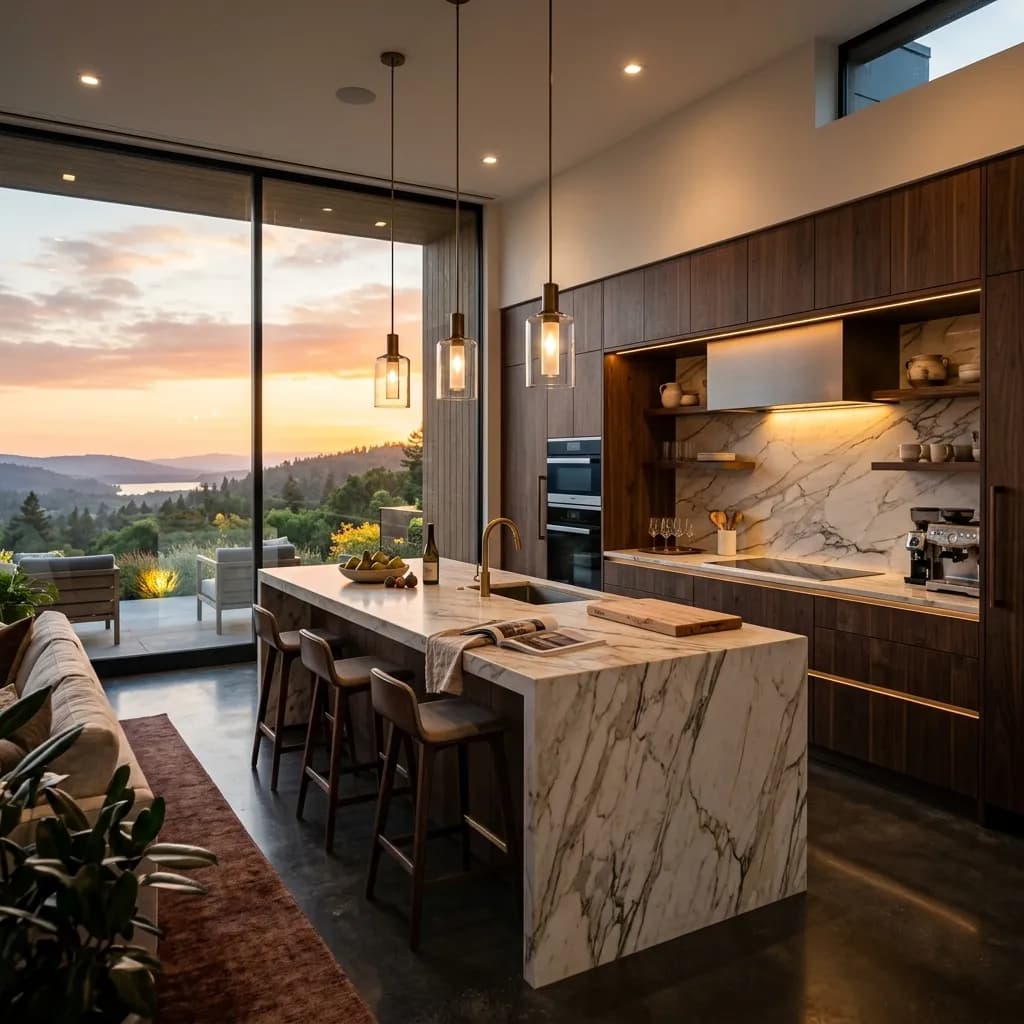
The high-end real estate market has its own rules. UHNWIs (Ultra High Net Worth Individuals), wealthy investors, and discerning owner-occupiers are not looking for four walls and a roof – they are looking for status, design, and an unparalleled lifestyle. When a luxury broker or project developer markets a property in the double-digit million range, the exposé is the most important business card.
But it is precisely here that expectations and reality often differ by miles. A villa can be architecturally brilliant; if the images appear cold, distorted, or flat, the premium character is immediately lost. True premium real estate photography is an art form that combines psychology, lighting architecture, and cutting-edge technology. In this deep dive, we reveal the secrets of high-end architectural photography and show you how FotoEstate stages properties to evoke maximum desirability.
Secret 1: Hand-Blending (The Masterclass of Light)
The biggest enemy of premium photography is the HDR software automation. You know these pictures: oversaturated, poisonous green meadows, glowing "halos" around furniture edges, and a completely flat, artificial comic look. This happens when you blindly trust software.
The Premium Approach (Flambient & Hand-Blending):
We refrain from HDR automation. Our photographers work on site with the Flambient technique – a combination of natural light (Ambient) and powerful, color-neutral studio flashes (Flash).
In post-production, the real magic begins: the hand-blending. Our retouchers manually mask light sources, windows, and shadows completely in Photoshop. The goal is to preserve the natural volume and three-dimensionality of the room. Real shadow patterns on the solid wood floor remain, while the view from the window (window pulling) is crystal clear, yet completely naturally integrated. The result is an honest but perfect image that practically draws the viewer into the room.
Secret 2: Twilight Shots (The Twilight Magic)
Nothing sells the 'dream of a luxury house' better than a perfectly staged twilight shot during the so-called 'blue hour'.
The psychology behind it:
During the blue hour (the 30 to 40 minutes after sunset), the sky glows in a deep, rich blue. At the same time, the interiors of the villa and the exterior lighting (pool, garden spots, terrace lamps) are turned on. This extreme color contrast – the cool blue of the night combined with the warm, inviting gold/orange of the house – creates an irresistible emotional appeal (cocooning effect).
A house at dusk not only looks like a home, it looks like an exclusive retreat. For developers, real estate agents, and operators of holiday homes (for whom holiday home photography is a direct driver of booking numbers), the twilight hero image on the cover of the exposé is often the decisive factor for click-through rates (CTR), which are up to 300% higher than with daylight shots.
Secret 3: Tilt-Shift Lenses and Absolute Geometry
Luxury architecture lives from symmetry and perfect proportions. The amateurish use of ultra wide-angle lenses mercilessly destroys this geometry.
The Architectural Rule:
Vertical lines (walls, door frames) must always run 100 percent perpendicular in the image. If you tilt a camera up or down, "falling lines" occur – the building appears as if it is falling backward.
The Premium Technique:
FotoEstate photographs high-end architecture exclusively from a tripod, equipped with highly precise geared heads (for millimeter-accurate leveling) and tilt-shift lenses. With a tilt-shift lens, the lens system can be mechanically shifted up or down without tilting the camera. This allows us to photograph multi-story foyers or galleries while keeping all lines absolutely parallel. The rooms thus appear stable, majestic, and true to scale.
Secret 4: Lifestyle Vignettes and Detail Shots
A common mistake in standard exposés is the desperate attempt to show "the whole room" in every picture. In the luxury segment, however, the customer does not buy square meters, but quality.
Storytelling through Details:
We deliberately break up the overview shots with so-called vignettes or detail shots. We photograph the fine grain of the Calacatta marble kitchen island. We focus on the brushed Dornbracht faucet in the spa bathroom, while the background fades into a soft blur (bokeh). We stage the crackling fireplace or the expensive Gaggenau espresso machine.
These detailed shots (close-ups) serve as emotional anchor points. They subconsciously communicate: 'Nothing was spared here. Here, you can expect absolute perfection.' These images slow down the buyer's scrolling and invite them to mentally adapt to the lifestyle of the property.
Secret 5: Uncompromising Direction (Micro-Staging)
The camera is merciless – it sees everything. The best lighting technique is of no use if the room looks chaotic.
The Work Before the Click:
Premium photographers often spend more time preparing the room than actually taking photographs. We call this micro-staging. Power cables are laid out of sight, cushions are fluffed with millimeter precision, chairs at the dining table are placed at equal distances using a tape measure. Personal items (the so-called "visual clutter") are rigorously removed.
The goal is a tidy, almost zen-like calm in the image. Nothing should distract the viewer's eye. The architecture and interior design must be able to breathe freely.
Conclusion: The visual capital of your property
Premium real estate photography is an orchestrated interplay of light, understanding of architecture, and psychological image guidance. Anyone marketing a million-dollar property must not place this visual capital in the hands of amateurs.
With FotoEstate as your B2B partner, you secure photography at magazine level. We master the most complex lighting situations, stage twilight shoots, and deliver image worlds that justify the price of your properties and immediately captivate your most demanding target audience. Elevate your brand to the next level and turn your properties into visual masterpieces.