The 5 Most Common Mistakes in Premium Real Estate Photography and How to Avoid Them
How to achieve maximum results in premium real estate photography and save valuable budget.
In the luxury and premium segment of the real estate industry, the brochure is not just a simple data sheet, but the ticket to an emotional world of experiences. When a developer markets a million-dollar project or an agent offers an exclusive villa, the very first visual impression often determines success or failure. Potential buyers scroll through platforms in seconds – an unprofessional image leads to an immediate drop-off.
Premium real estate photography is fundamentally different from a quick smartphone snapshot. It's about lighting, understanding architecture, and millimeter-precise precision in post-production. If compromises are made here, even the most expensive property looks cheap. We reveal the five most serious mistakes that real estate professionals must avoid when hiring photographers or producing photos themselves.
Error 1: The Mixed Light Catastrophe (The Yellow-Blue Cast)
A classic beginner's mistake that immediately catches the eye, especially in high-quality interiors.
Why this fails: Many photographers just snap away, while cool daylight (around 5500 Kelvin) comes through the windows and warm halogen or LED lamps (around 2700 Kelvin) are burning inside. The camera sensor cannot compensate for these extreme differences in color temperature at the same time. The result: The walls glow unnaturally yellow or orange, while the shadows and window frames sink into deep blue. A high-quality oak parquet floor suddenly looks like cheap laminate.
The B2B Solution (Flambient Technique):
Professionals from FotoEstate use complex lighting techniques (such as the Flambient method). We first photograph the room using only the natural ambient light. Afterwards, we illuminate the room with strong, color-neutral studio flashes precisely. In post-production, these images are manually blended. The result is an absolutely true-to-life color reproduction without ugly color casts – the oak parquet floor retains its real, noble hue.
Error 2: Burned-out Windows (The White Fog)
In a penthouse apartment or a villa with a lake view, the view is a massive price driver. Nevertheless, it is often destroyed photographically.
Why this fails:
The contrast between a relatively dark interior and the extremely bright exterior (sun) overwhelms any camera sensor. The camera either exposes the interior correctly – then the window becomes a pure white, dazzling surface ("burnt out") and the expensive view is gone. Or it exposes the view correctly – then the interior is pitch black.
The B2B Solution (Window Pulling):
We solve this problem through manual 'window pulling.' During shooting, deliberately underexposed photos are taken specifically for the window areas. In retouching, our image editors seamlessly insert the perfect view into the properly exposed interior photo. The buyer immediately sees: bright living room AND breathtaking skyline view.
Error 3: Converging Lines and the Ultra Wide-Angle Tunnel
Architecture requires absolute geometric precision.
Why this fails:
If the camera is tilted even slightly up or down (often because it is photographed from eye level while standing), the vertical lines collapse. Walls and door frames visually lean backward, and the room loses its stability. Even worse is the use of extreme ultra-wide-angle lenses (as with a smartphone) to artificially enlarge small rooms. As a result, rooms appear like long, unnatural tubes, and furniture at the edges is extremely distorted.
The B2B Solution:
We consistently photograph from a tripod with a spirit level (geared head). The camera is precisely leveled to approximately 1.10 m height (waist height), so that all vertical lines in the image run absolutely parallel to each other. Instead of distortion-prone ultra-wide lenses, we use high-quality tilt-shift lenses or moderate wide-angles to respectfully preserve the real proportions of the architecture.
Error 4: "Visual Clutter" and missing staging
Photography can only depict what happens in front of the lens. Lack of direction on site is a profit killer.
Why this fails:
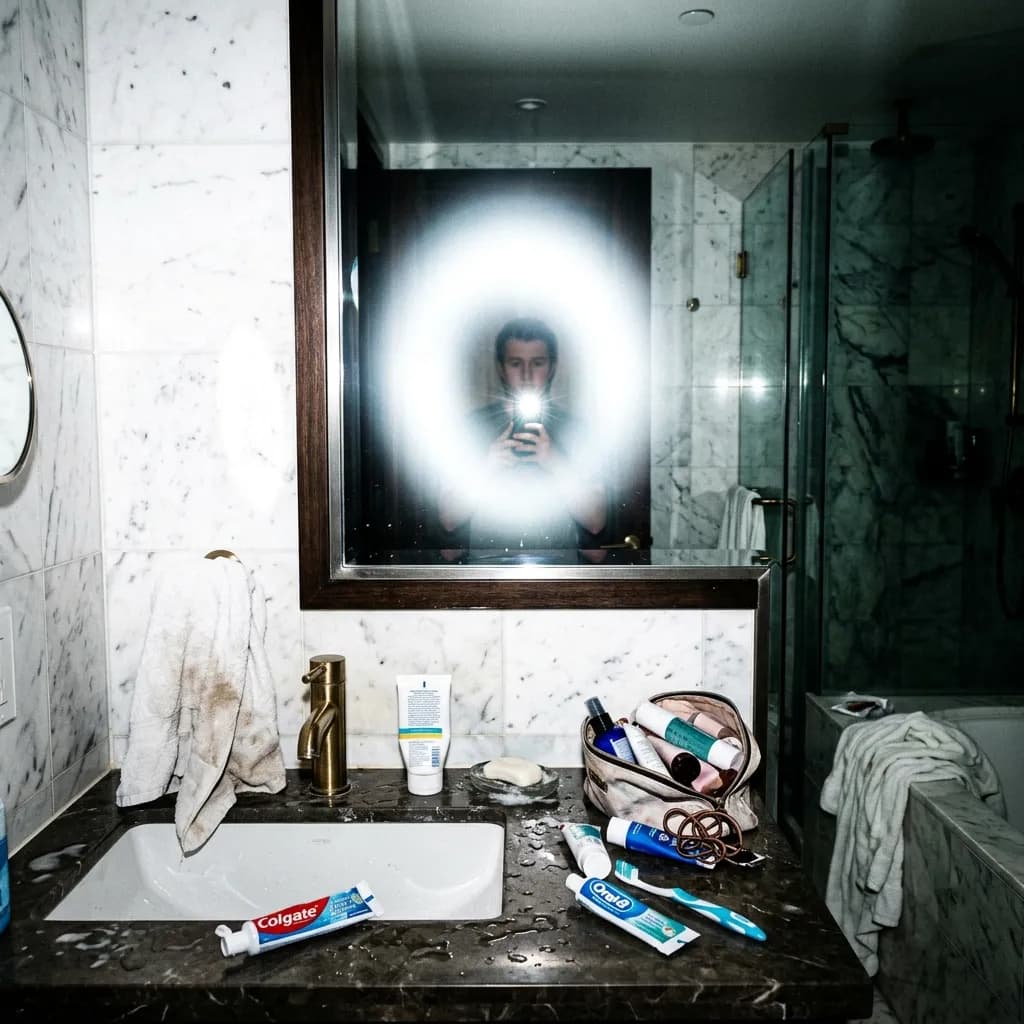
The photographer merely documents the current state. In the kitchen, there are coffee machines and dish soap, in the bathroom colorful towels hang, and newspapers lie on the table. This "visual clutter" (optical disorder, which incidentally is also one of the biggest mistakes in floor plan staging) draws the buyer's eye like a magnet. Instead of admiring the generosity of the architecture, the viewer focuses on the disorder. The property immediately appears cramped and worn.
The B2B Solution (Micro-Staging):
Every premium shoot requires rigorous decluttering. Before our photographers press the shutter, we take charge of the staging. Personal items disappear, chairs are perfectly aligned, cushions are fluffed. Often, a simple, targeted micro-staging (a fresh bowl of fruit, a design book) is enough to transform the room from 'lived-in' to 'exclusive'.
Error 5: The "HDR comic look" through software automation
In the attempt to fix errors 1 and 2, many fall into the trap of cheap automatic software.
Why this fails:
Bracketed exposures are often simply run through an HDR program. The program mercilessly boosts all contrasts. The result is glowing "halos" around furniture edges, oversaturated, garish colors, and an extremely artificial, flat comic look. Such images practically scream "fake" and destroy the credibility of any luxury real estate agent.
The B2B Solution (Manual Blending):
Premium image editing is handcrafted. At FotoEstate, we do without HDR automation. Our retouchers manually mask light sources, windows, and shadows (hand blending). This way, we preserve the natural shadowing and light fall-offs that give a room its depth and three-dimensionality.
Conclusion: Premium images as the strongest sales lever
High-quality real estate photography is not an expense, but an investment in marketing speed and the final sale price. Those who, as developers or real estate agents, rely on excellent, flawless visual communication immediately separate themselves from 90 percent of the competition.
FotoEstate offers you premium real estate photography across Germany, combining architectural precision with high-quality, handcrafted post-production. Do not leave the value of your properties to chance – present them in their best light.
Related articles
Explore Virtual home staging
See what the service includes, which source material is useful and how a typical project starts.